Entity Clarity Longitudinal Report — January to July 2026
Summary
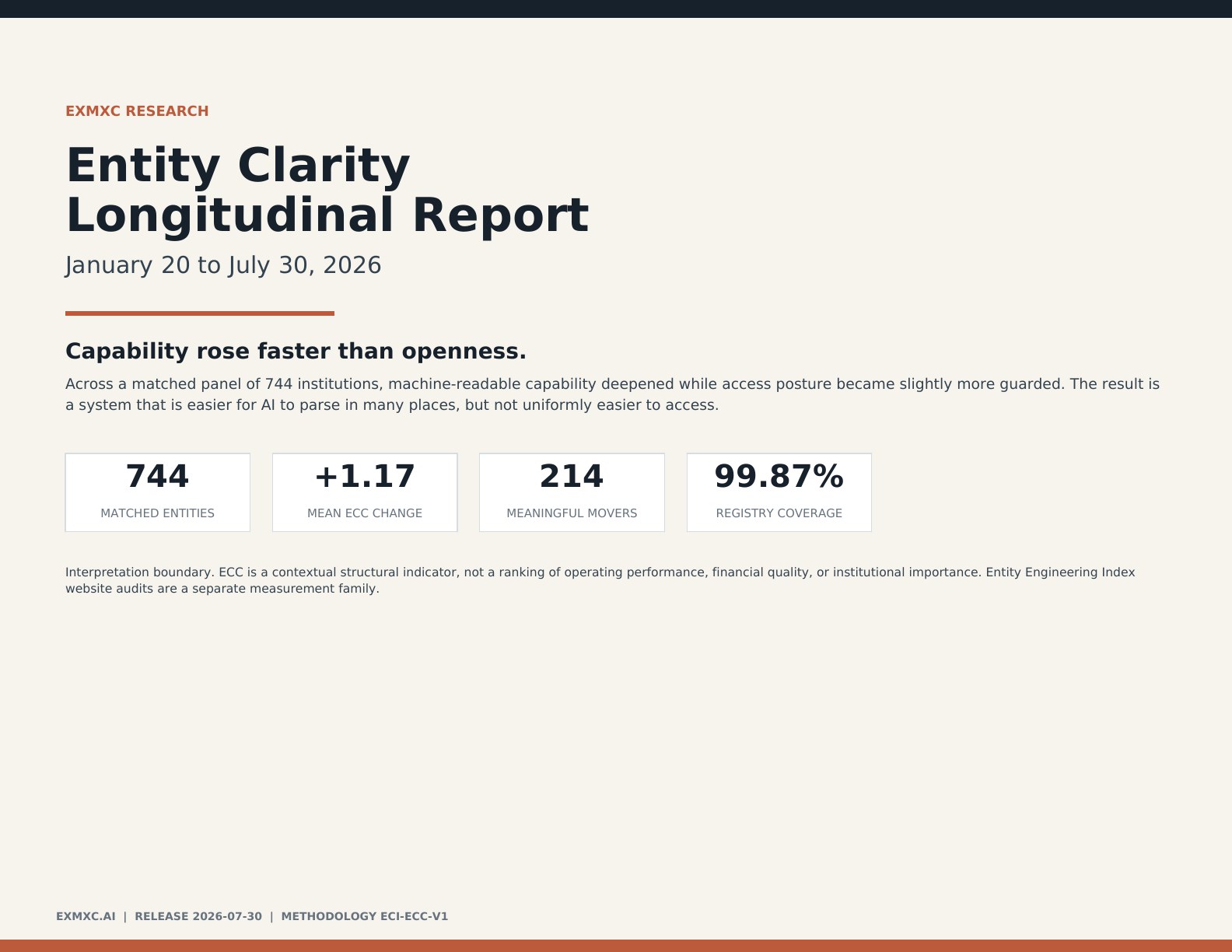
Across the matched panel of 744 entities, average ECC rose from 51.26 to 52.43 between January 20 and July 30, 2026. The more important movement was structural: high capability expanded while the share of Open entities edged down, showing that machine legibility can improve without a parallel increase in openness.
Methodology
This report compares the same entity registry at two observation dates. Posture describes whether an entity is Open, Defensive, or Blocked; capability describes the strength of machine-readable organizational signals; ECC summarizes the combined clarity and capability signal. Scores are contextual structural indicators, not rankings of operating performance. Blocked entities score zero by definition.
The PDF is the authoritative editorial record. The linked dataset provides versioned observations, change classifications, release metadata, and QA disclosures.
Findings
- 444 entities were unchanged; 204 increased and 96 declined.
- 214 entities were meaningful movers: 74 score movers, 97 structural movers, 21 legibility entries, and 22 legibility exits.
- Continuously legible entities contributed a net gain of 1,050 ECC points, while entry and exit effects produced a net loss of 178 points.
- Capability improved faster than openness. That divergence is the central longitudinal finding.
Landscape
The matched panel contains 744 entities from a stable registry of 745. Mean ECC increased 1.17 points, from 51.26 to 52.43, and the median moved from 63 to 64. High-capability entities increased from 107 to 147, while Open posture declined from 460 to 453 and Blocked posture rose from 138 to 139.
Archetypes
Movement classes
- Stable (435): no posture, capability, or material ECC change.
- Drift (95): small ECC movement without a structural state change.
- Score Mover (74): material ECC movement while posture and capability remain stable.
- Structural Mover (97): a change in posture or capability within continued legibility.
- Legibility Entry (21): movement from Blocked into an observable posture.
- Legibility Exit (22): movement from an observable posture into Blocked.
Index
The authoritative 744-entity longitudinal Index appears in the attached PDF. Every entity-level ECC score is presented with its January and July posture and capability, score change, and movement class.
Strategic Implications
Entity clarity should be treated as part of capital-allocation infrastructure. Better machine legibility can lower research friction and improve discoverability, but it does not remove posture risk. Allocators should distinguish durable clarity gains from access-state changes, review legibility exits as potential information-risk events, and avoid treating a high ECC score as a substitute for fundamental diligence.
Full Report
Executive finding
Entity capability rose faster than entity openness. The ecosystem became easier for AI systems to parse in many places, but not uniformly easier to access.
What changed
Average ECC increased modestly across the matched panel, while the distribution shifted toward high capability. At the same time, posture transitions created material entry and exit effects that broad averages can conceal.
How to use this report
Read score movement together with posture and capability. Structural movers and legibility entries or exits deserve priority review because they can change the reliability, comparability, or cost of machine-mediated research.
Publication note
This web record is a synopsis. The attached PDF is the authoritative editorial record and contains the complete 744-entity longitudinal Index. The linked dataset is the canonical machine-readable release.