Entity Clarity Report — Media Landscape in the AI Era: Q2 2026 Update
Summary
Superseded July 30, 2026. This May snapshot is preserved as publication history. Its early movement counts and extreme-mover claims were corrected in the governed January-to-July Media release. Read the current Media report.
Methodology
No changes to the ECC framework were made for Q2.
Posture definitions, capability tiers, and the three weighted ECC components — Entity Comprehension & Trust, Structural Data Fidelity, and Page-Level Hygiene — remain as published in the Q1 report.
One methodology note worth restating, because it applies to a meaningful share of Q2 movement: a Blocked posture produces an ECC of 0 by definition, not by measurement. When a publisher prevents AI systems from crawling its surfaces, the framework has nothing to score. This is recorded as a strategic choice, not a capability failure. Several of the largest negative moves in Q2 are Blocked transitions — these reflect publisher decisions, not editorial or technical decline.
Quarterly cadence continues. The Q3 update will publish following Q3 2026 close.
See details on the 13-signal framework
Findings
Four findings emerge from the first quarterly reading.
1. The Sky News exit is the largest single-quarter ECC drop in any ECC dataset to date
Sky News moved from ECC 86 — Sovereign tier in the Q1 baseline — to ECC 0 in one quarter. Posture shifted from Open to Blocked. Capability dropped from High to Low.
This is the largest single-quarter ECC reversal recorded across any Entity Clarity Report. Larger than Applied Materials' simultaneous Q2 exit from the Tech 100 Authority Compounder tier. Larger than any move in the Q1 Energy, Finance, or Health Care reports.
The implication is not about Sky News' capability. It is about the cost of being interpreted. In Q1, Sky News was structurally optimized to be a default reference source inside AI systems. In Q2, that optimization was withdrawn. A company that had built among the highest-quality AI-legibility infrastructure in the dataset decided that infrastructure was no longer worth maintaining.
The Q3 reading on Sky News will determine whether this is durable or reversible. If ECC remains at 0, this was structural. If it recovers, this was an event.
2. The Bloomberg–People–Investopedia migration signals a new strategic pattern
Bloomberg (Q1: Open/Medium/68 → Q2: Blocked/Low/0), People (Q1: Open/Medium/67 → Q2: Blocked/Low/0), and Investopedia (Q1: Open/Medium/66 → Q2: Blocked/Low/0) all moved from Open to Blocked in one quarter. None catastrophically failed at AI legibility. All chose to exit it.
The People decision is the most strategically transparent of the three. IAC has publicly repositioned People as its flagship asset and the core of its post-restructure identity. Moving People into Blocked posture in Q2 is consistent with that strategy: if People is the company's most valuable IP, allowing AI systems to summarize and redistribute it freely undermines the asset's pricing power. The blocking is not a failure of AI strategy — it is an AI strategy.
This is the first Q2 example of a company using Blocked posture as an offensive move rather than a defensive one. The Q1 framework described the Exclusion Bloc as protecting subscription revenue. Q2 adds a new motive: protecting flagship IP value for future licensing.
Bloomberg and Investopedia fit the same pattern. Both are publishers whose core value sits in proprietary data interpretation — financial data and financial education, respectively. Both calculated that AI re-use of that interpretation erodes the underlying asset.
The pattern to watch in Q3: which other premium-IP publishers follow the same path.
3. Three publishers re-entered AI legibility — Al Jazeera most notably
While seven publishers exited toward Blocked, three moved in the opposite direction. Al Jazeera moved from Blocked/Low/0 to Open/Medium/66. Chicago Tribune moved from Blocked/Low/0 to Open/Low/57. SFGate moved from Blocked/Low/0 to Open/Low/7.
Al Jazeera's re-entry is the most significant. Moving from 0 to 66 in one quarter is the largest positive ECC gain in any Entity Clarity Report. The implied strategic decision is the inverse of the Bloomberg–People–Investopedia choice: Al Jazeera judged that AI-mediated reach is more valuable than the controls Blocked posture provided.
The Chicago Tribune and SFGate moves are smaller and more consistent with operational normalization than strategic reversal — both were ECC 0 in Q1, and both reappeared at modest ECC levels in Q2.
The Q1 framework predicted that the Exclusion Bloc would eventually split. Q2 confirms this is already happening, in both directions, in the same quarter.
4. Yahoo News graduated from the Relay Layer
Yahoo News moved from Open/Low/44 to Open/Medium/66, gaining a capability tier. The Q1 Media report specifically named the Relay Layer as fragile — aggregators trading identity strength for reach. Yahoo News' Q2 capability upgrade suggests it is investing in structural authority rather than accepting commodity status.
If this pattern holds through Q3, the framework's prediction that select aggregators could upgrade into Sovereigns becomes empirically supported.
Landscape
The Q1 baseline described a media landscape divided into six archetypes — Sovereigns, Gated Guardians, Prestige Drifters, the Negotiation Exclusion Bloc, the Relay Layer, and Fragmented Network Operators. The framework predicted that the Exclusion Bloc would eventually split, with some publishers doubling down on blocking and others re-entering through licensing or partial openness.
Q2 confirms that prediction earlier and more decisively than expected — but in both directions simultaneously.
The Exclusion Bloc grew. Seven publishers moved into Blocked posture in Q2: Bloomberg, Sky News, People, Investopedia, NJ.com, and effectively The Telegraph and Chron through near-total ECC collapse. Three of these (Bloomberg, Sky News, People) were among the Q1 Sovereigns or higher-ECC publishers. This is not Exclusion Bloc members hardening — this is publishers from other archetypes choosing to join it.
The Exclusion Bloc also lost members. Three publishers re-entered AI legibility: Al Jazeera (Blocked → Open, 0 → 66), Chicago Tribune (Blocked → Open, 0 → 57), and SFGate (Blocked → Open, 0 → 7). Al Jazeera's move is the largest re-entry in the dataset.
The middle moved less than expected. Most Prestige Drifters held position. The New York Times, The Guardian, The Atlantic, and Variety all remained within the same archetype with minimal ECC change. The Q1 thesis that this group would either modernize or fall behind has not yet resolved.
The most important structural finding of Q2: the bifurcation is now empirical, not theoretical. Media companies are no longer drifting toward an equilibrium. They are choosing sides.
Archetypes
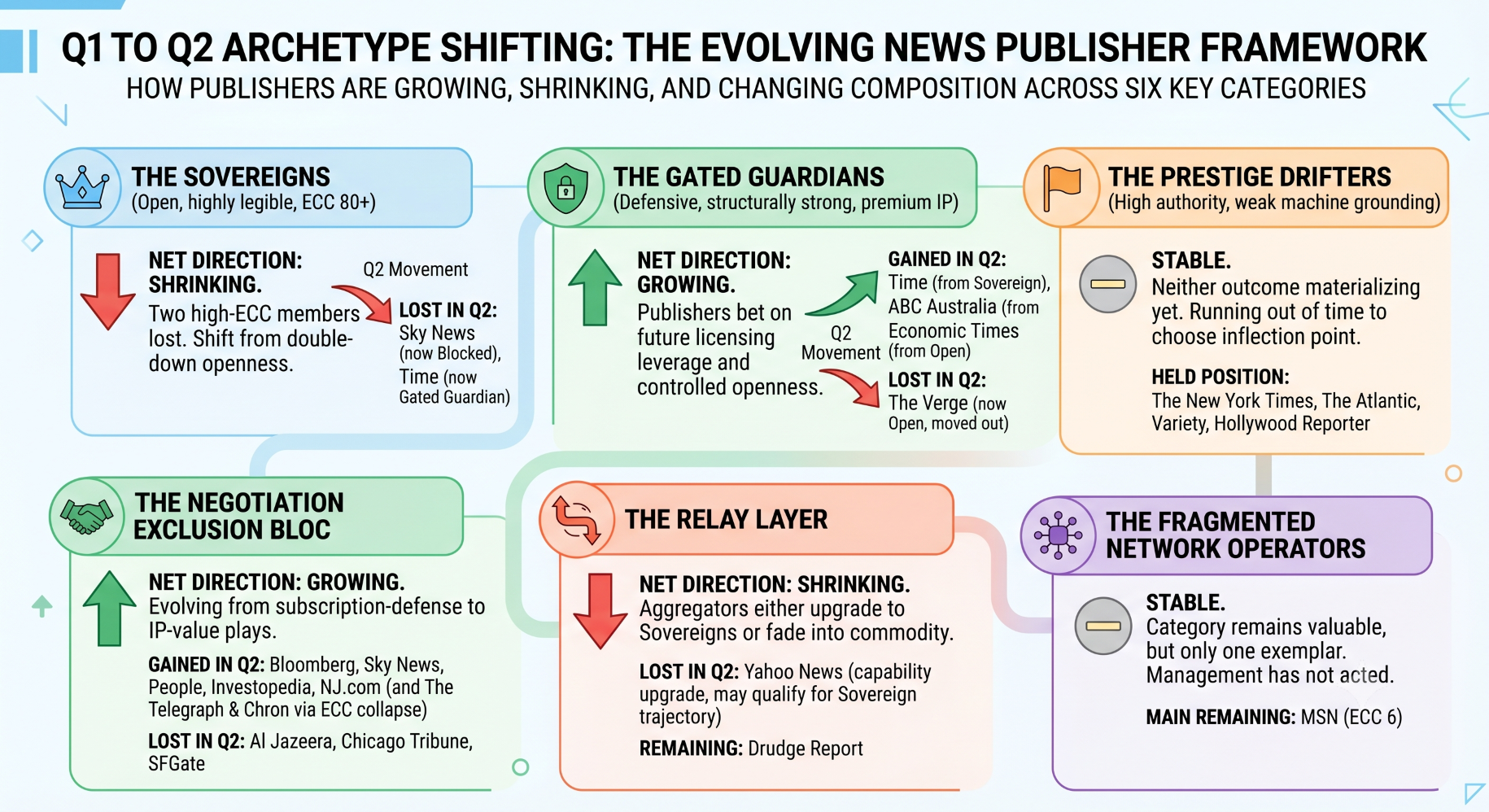
The six archetypes from Q1 remain the framework. What changed in Q2 is who sits in them, and which archetypes are growing or shrinking.
The Sovereigns (Open, highly legible, ECC 80+)
Lost in Q2: Sky News (now Blocked), Time (now Gated Guardian, Open → Defensive)
Net direction: Shrinking. Two of the highest-ECC Sovereigns from Q1 are no longer Sovereigns. Sky News exited the entire AI legibility layer. Time moved into Gated Guardian posture, suggesting a deliberate shift toward selective licensing leverage.
The archetype that Q1 described as "double-down on openness" lost members in Q2 rather than gaining them. The Q3 question is whether this is a one-quarter reversal or the beginning of a structural shift.
The Gated Guardians (Defensive, structurally strong, premium IP)
Gained in Q2: Time (from Sovereign), ABC Australia (from Open), Economic Times (from Open), The Verge (now Open, moved out)
Net direction: Growing. Time's move into this archetype is the most strategically significant — it suggests a deliberate decision to preserve future licensing optionality. Economic Times made the same move at ECC 88, keeping its capability tier intact.
The Gated Guardians archetype is the destination for publishers that previously bet on openness but now want negotiation leverage with AI platforms. This is consistent with the Q1 framework's prediction that some Sovereigns would migrate toward controlled openness as licensing markets matured.
The Prestige Drifters (high authority, weak machine grounding)
Stable. The New York Times, The Atlantic, Variety, and Hollywood Reporter all held position. No significant movement in or out of this archetype.
The Q1 framework called this group "the greatest upside if they modernize, with greatest downside if they don't." Q2 indicates neither outcome is materializing yet. These publishers are running out of time to choose. Q3 may be the inflection.
The Negotiation Exclusion Bloc
Gained in Q2: Bloomberg, Sky News, People, Investopedia, NJ.com (and effectively The Telegraph and Chron via ECC collapse)
Lost in Q2: Al Jazeera, Chicago Tribune, SFGate
Net direction: Growing, and changing composition.
The Q1 Exclusion Bloc was composed of publishers whose business model required protecting subscription revenue: WSJ, Reuters, Politico, MarketWatch, Washington Post. Q2 adds a new motive: protecting flagship IP value. Bloomberg, People, and Investopedia are not primarily subscription-defense plays — they are IP-value plays. This is a meaningful evolution of the archetype.
The simultaneous exits (Al Jazeera most notably) confirm the Q1 thesis that the bloc would split. The split is happening faster than expected.
The Relay Layer
Lost in Q2: Yahoo News (capability upgrade, may now qualify for Sovereign trajectory)
Net direction: Shrinking. The Q1 Relay Layer had only two members. Yahoo News's Q2 capability gain leaves Drudge Report as the only clear remaining example.
If Yahoo News continues to gain ECC in Q3, the archetype may functionally dissolve — confirming the Q1 prediction that aggregators either upgrade into Sovereigns or fade into commodity status.
The Fragmented Network Operators
Stable. MSN remained at ECC 6 with no meaningful change. No new entries.
The Q1 framework described this archetype as "fixable if management acts." Q2 indicates management has not acted. The archetype remains valuable as a category but has only one clear exemplar in the dataset.
Index
Strategic Implications
Q1 framed the Media chessboard as a strategic landscape of deliberate posture choices. Q2 sharpens that framing in four ways.
Blocking is now an offensive strategy, not just a defensive one. The Q1 Exclusion Bloc was characterized as defensive — publishers protecting subscription revenue through isolation. Q2 introduces a new pattern: publishers using Blocked posture to protect flagship IP value for future licensing negotiations. The People decision under IAC's restructured strategy is the cleanest example. When a company has identified a single asset as its strategic core, allowing AI to freely re-summarize that asset undermines its pricing power. Blocking becomes the rational move.
This means the Exclusion Bloc is no longer a single archetype. It now contains two distinct strategies: subscription defense (WSJ, Reuters, Politico) and flagship IP protection (Bloomberg, People, Investopedia, Sky News). Q3 will indicate whether these diverge into two formal sub-archetypes or remain functionally similar.
Re-entry from Blocked is now documented as a viable path. Al Jazeera moved from full opacity to ECC 66 in one quarter. The Q1 framework predicted some Exclusion Bloc members would re-open access. Q2 confirms this is operationally achievable. Publishers currently in the Blocked tier — Reuters, WSJ, Washington Post, Politico — now have an example of how to reverse course if their strategic calculus changes.
The Sovereign archetype is not durable by default. Two of the highest-ECC Sovereigns from Q1 (Sky News, Time) are no longer Sovereigns. Sky News exited the entire AI layer. Time moved to Defensive posture. The Q1 framework described Sovereigns as "doubling down on openness." Q2 shows that this doubling-down is not automatic — it requires continuous strategic commitment. Publishers that achieved Sovereign status in Q1 must actively choose to remain there.
The Prestige Drifter inflection has not happened yet. The Q1 framework predicted this group would either modernize upward into Sovereign status or decline into structural irrelevance. Q2 shows neither. The Prestige Drifters held position. This is the most strategically interesting non-event of Q2: the publishers with the most to lose from delay are the ones moving least. The Q3 reading will indicate whether this group has chosen drift as a strategy or is preparing a delayed inflection.
ECC will continue to influence audience trust, licensing leverage, and long-term narrative authority. Q2 adds one critical new use case: distinguishing offensive blocking (IP protection) from defensive blocking (subscription protection). The strategic question for media executives is no longer whether to be legible, but whether their blocking strategy is positioned for the future they actually expect.
Full Report
Media's AI posture is not ideological. It is strategic.
One quarter after the Q1 baseline, the framework has its first quarterly reading on the Media sector. Roughly one-third of the index moved — significantly higher movement than the Tech 100 Q2 reading. The methodology held. The archetype structure held. What changed was the composition inside the archetypes, and the speed at which the Q1-predicted bifurcation became reality.
The Sky News exit is the largest single signal of Q2 across any ECC dataset. A publisher that ranked among the highest-ECC Sovereigns in Q1 (ECC 86, Open, High capability) moved to ECC 0 in one quarter. This is not a capability decline. It is a deliberate decision about the cost of interpretation. Sky News had invested in the structural infrastructure required to be a default reference inside AI systems. In Q2, that investment was withdrawn. The framework records 0 because a Blocked posture cannot be scored — but the underlying judgment is what matters. Sky News decided that the cost of being summarized by AI systems exceeded the value of remaining a Sovereign.
The Bloomberg–People–Investopedia migration establishes a new strategic pattern. All three were Open-posture publishers in Q1 with middling-to-strong ECC scores. All three moved to Blocked in Q2. None failed structurally — they chose to exit.
The People decision is the most strategically transparent of the group. IAC publicly repositioned People as its flagship asset following its restructuring. When a company identifies a single asset as the core of its identity, allowing AI to freely summarize and redistribute that asset's content erodes its pricing power. Blocking becomes the rational defense of a strategic concentration. Bloomberg and Investopedia fit the same pattern — both publishers whose core value sits in proprietary interpretation of data (financial markets and financial concepts, respectively), and both calculated that AI re-use of that interpretation erodes the underlying asset.
This is a new motive for the Exclusion Bloc. The Q1 archetype framed blocking as subscription defense. Q2 adds flagship IP protection. These are different strategies producing the same posture, and they require different analytical treatment going forward.
The Time and Economic Times migration to Defensive posture (formerly Open) suggests a third strategic motive: licensing leverage. Both publishers retained high capability tiers — Time at ECC 84, Economic Times at ECC 88. Neither exited AI legibility. Both shifted into the Gated Guardian archetype, which the Q1 framework characterized as preserving optionality for licensing negotiations. This is consistent with a maturing licensing market where publishers want to remain visible to AI systems while controlling the terms of that visibility.
The Al Jazeera re-entry is the largest counter-signal of Q2. Moving from Blocked/Low/0 to Open/Medium/66 in one quarter is the largest positive ECC gain recorded in any ECC report. The implied strategic decision is the inverse of the Bloomberg–People–Investopedia choice: Al Jazeera judged that AI-mediated reach exceeds the value of access controls. This is the operational proof that the Q1 framework called for — confirmation that the Exclusion Bloc would split in both directions, not just one.
The Yahoo News graduation from the Relay Layer signals an underappreciated dynamic. The Q1 framework treated aggregators as fragile — high-volume, low-identity, vulnerable to AI substitution. Yahoo News's Q2 capability upgrade from Low to Medium, with ECC moving from 44 to 66, suggests deliberate investment in structural authority. If the pattern continues in Q3, the Relay Layer archetype may functionally dissolve, with members either upgrading into Sovereign trajectories or fading entirely.
The Prestige Drifter stability is the quarter's most strategically interesting non-event. The Q1 framework predicted this group would either modernize into Sovereigns or decline into irrelevance. Q2 shows neither. The New York Times, The Atlantic, Variety, and Hollywood Reporter all held position. These are publishers with the most at stake — high cultural authority but weak machine grounding. Their decision to hold is itself a decision. The question is whether they have actively chosen drift, or whether they are preparing for a delayed inflection point.
Five questions will frame the Q3 reading:
- Does Sky News recover, partially recover, or stay at 0? The answer determines whether Q2 was an event or a structural shift in the Sovereign tier.
- Do additional premium-IP publishers follow Bloomberg, People, and Investopedia into the Exclusion Bloc? Likely candidates include high-value subscription brands not yet in the bloc.
- Does Al Jazeera sustain its re-entry, or revert toward Blocked? The durability of re-entry will determine whether other Q1 Blocked publishers consider the same move.
- Does Yahoo News continue gaining structural authority, or stabilize? Its trajectory will indicate whether the Relay Layer is dissolving or merely shifting.
- Do the Prestige Drifters finally move? The New York Times in particular is the watch entity — a single structural decision from this publisher would reset the Q1 framework's predictions.
Sovereigns are still becoming the grammar of AI-mediated news. Gated Guardians are buying time. Prestige Drifters are leaking authority quietly. The Exclusion Bloc is splitting in both directions — and now contains two distinct strategies inside the same posture.
Q2 adds one new line to the Q1 frame: some publishers, having achieved AI legibility, are now choosing to withdraw it as an offensive strategic move. Whether that becomes a pattern or remains an exception is the most important question for Q3.