Entity Clarity Report — Restaurants & Hospitality in the AI Era: Q2 2026 Update
Summary
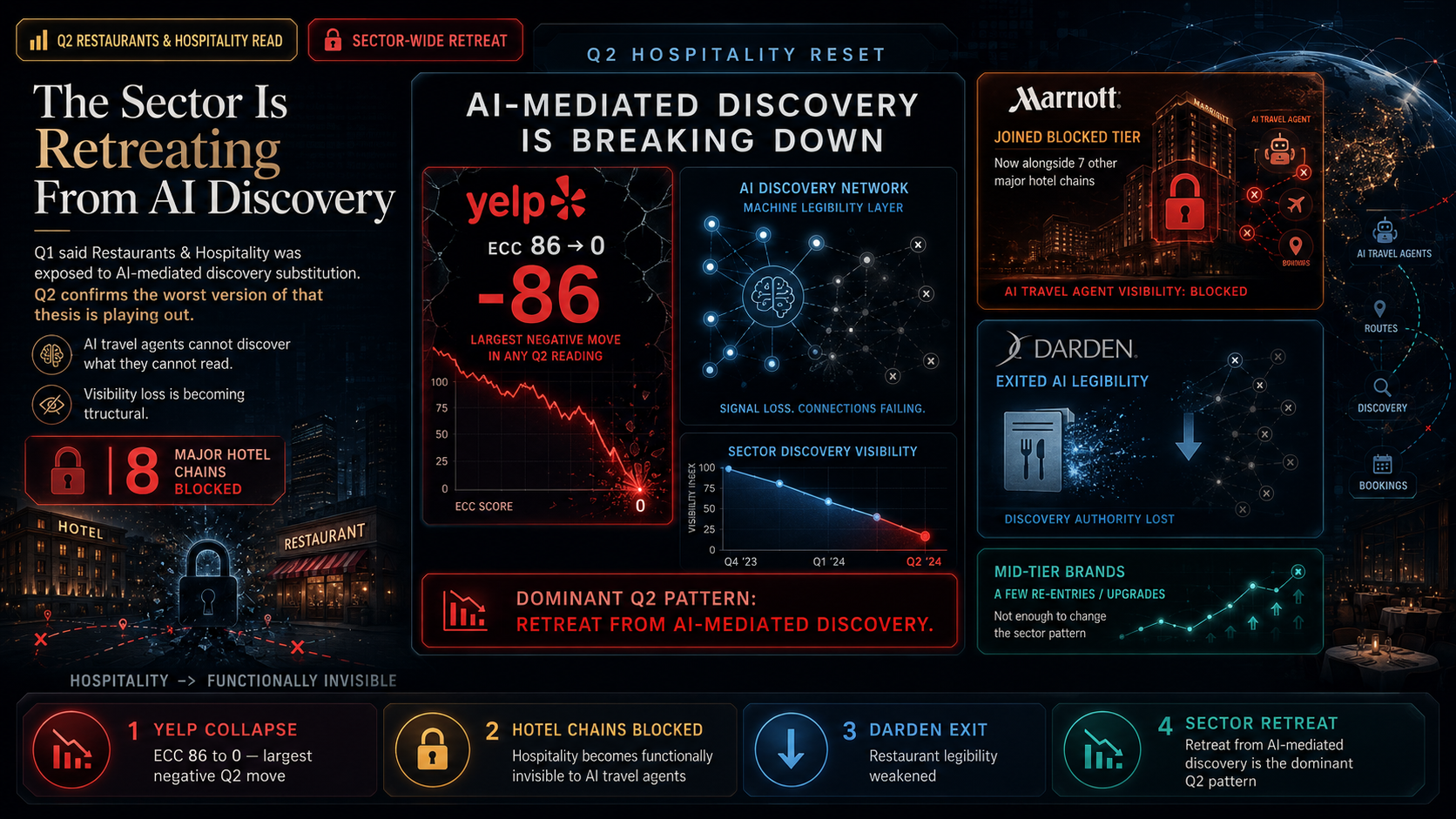
The Q1 Restaurants & Hospitality thesis described a sector caught between habit and interpretation, structurally exposed to AI-mediated discovery substitution. Q2 confirms the worst version of that thesis is playing out. Yelp collapsed from ECC 86 to 0 — the largest negative move in any Q2 reading. Marriott joined the Blocked tier alongside seven other major hotel chains, leaving the hospitality sector functionally invisible to AI travel agents. Darden Restaurants exited AI legibility. A handful of mid-tier brands re-entered or upgraded, but the dominant Q2 pattern is sector-wide retreat from AI-mediated discovery.
Methodology
No changes to the ECC framework were made for Q2.
Posture definitions, capability tiers, and the three weighted ECC components — Entity Comprehension & Trust, Structural Data Fidelity, and Page-Level Hygiene — remain as published in the Q1 report.
Two methodology notes specific to Q2 Restaurants & Hospitality:
One — The volume and direction of negative movement in Q2 is unique among the sectors covered in this Q2 cycle. Seven sectors covered to date showed mixed positive and negative movement with most archetypes remaining stable. Restaurants & Hospitality shows a coherent sector-wide retreat from AI legibility, particularly in hotels and select casual dining. This is the first sector-level negative pattern documented in the Q2 cycle.
Two — The Yelp move (ECC 86 → 0) represents a special case worth flagging in the methodology. Yelp is a discovery-platform whose business model historically depended on being AI-legible. Its Q2 move to Blocked is structurally inconsistent with its product strategy unless Yelp has reached a private AI licensing agreement that operates outside the public ECC measurement framework. The framework cannot directly observe private licensing; it can only measure public AI legibility. The Q3 reading will indicate whether Yelp recovers (suggesting the Q2 reading was an artifact) or holds at 0 (suggesting a deeper strategic shift).
The full Q2 index with company-by-company values is available in the Q1 baseline report. This update covers the structural moves and patterns directly.
See details on the 13-signal framework
Findings
Six findings emerge from the Q2 Restaurants & Hospitality reading.
1. Yelp's -86 collapse validates the Q1 prediction about reputation intermediaries
Yelp moved from Defensive/High/86 to Blocked/Low/0. The Q1 Restaurants & Hospitality report explicitly identified Yelp as one of only three High Capability brands in the 46-company dataset, alongside Nobu Hospitality and TAO Group. The Q1 framework also explicitly contrasted Yelp's defensive openness with TripAdvisor's blocked posture, noting that Yelp's strategy was "more coherent" because it preserved the firm's role as a structured reputation database.
Q2 reverses that strategic position. Yelp has now adopted the same Blocked posture as TripAdvisor — meaning both major reputation intermediaries in restaurants and travel are now AI-invisible. The Q1 framework predicted TripAdvisor was "accelerating its own irrelevance" through Blocked posture. Yelp has now joined that trajectory.
Three possible explanations exist, and the Q3 reading will distinguish among them. The first is that Yelp has reached private AI licensing arrangements with major LLM providers (OpenAI, Anthropic, Google, Perplexity) that operate outside public crawl access. If this is the case, the public ECC reading captures only part of Yelp's actual AI distribution strategy. The second is that Yelp made the same strategic error TripAdvisor made — fearing review reframing more than substitution. The third is that Q2 captured a temporary technical state.
The most strategically important interpretation is the first. If Yelp is monetizing AI distribution through private licensing rather than public crawl access, the framework has identified an emerging two-tier AI legibility market: a public crawl tier (where ECC currently operates) and a private licensing tier (which the framework cannot directly observe). Yelp may be the first major Q2 example of an institution explicitly choosing the private tier over the public tier. The Q3 framework should consider how to incorporate this distinction.
2. The hotel/casino blocked rate is now 71%
The Q1 framework documented hotels and casinos blocking at 64% (9 of 14 lodging and casino companies). Marriott's Q2 retreat to Blocked raises this to 71% (10 of 14). With Marriott now Blocked, only Wyndham, Accor, Rosewood, and Wynn Resorts remain meaningfully AI-readable in the global hotel and casino cohort.
This is the most extreme sector-level Blocked pattern in any Q2 ECC reading. By comparison: Tech 100 has approximately 20% Blocked rate, Media has 25%, Finance has 10%, Energy has 15%. Hotels and casinos are now functionally invisible to AI travel agents at sector level.
The Q1 framework predicted this trajectory and named the strategic error: hotel chains are blocking because they fear review reframing more than substitution, but AI synthesizes reputation from public signals regardless. Q2 demonstrates the industry has not absorbed that prediction. The retreat is continuing and accelerating.
Wyndham, Accor, Rosewood, and Wynn now face the most significant competitive opportunity in the global hotel and casino sector. While the major chains hide, these four brands can position themselves as the AI-readable alternatives. Wyndham specifically — with a portfolio spanning Days Inn, Ramada, La Quinta, and other tiered brands — is positioned to capture AI-mediated recommendations across multiple price points. Rosewood's Q2 capability upgrade (Low → Medium) indicates the firm is investing in this opportunity. Wynn's posture flip from Defensive to Open at constant ECC 73 may indicate the firm is also positioning for the opening.
The Q3 question is whether any of the Blocked chains reverses course. The Q1 framework called the strategy mistaken; Q2 doubled down on the mistake. Q3 will indicate whether the framework's prediction holds (chains eventually reverse course) or whether the chains continue blocking indefinitely.
3. The Darden retreat extends the casual dining structural collapse
Darden Restaurants moved from Open/Low/55 to Blocked/Low/0. Darden's portfolio includes Olive Garden, LongHorn Steakhouse, Capital Grille, Cheddar's, Yard House, Bahama Breeze, and Eddie V's. The Q1 framework identified Darden as part of the "Structurally Fragile Chains" archetype — casual dining brands with weak narrative coherence whose value evaporates under AI summarization.
The Q2 move is rational for Darden's strategic position. The Q1 framework noted that AI reduces casual dining brands to "casual American restaurant chain" — losing the differentiation Olive Garden has spent decades building. By moving to Blocked posture, Darden prevents AI from coherently describing its brands at all, reducing the rate at which AI dining agents commoditize the firm's portfolio.
However, the Q1 framework's central prediction applies here too: blocking does not prevent AI from synthesizing reputation. Reviews, social media, news, and third-party signals still feed AI's understanding of Olive Garden. Darden's Blocked posture removes only Darden's own voice from that synthesis.
The Q3 question for casual dining is whether other Structurally Fragile Chains follow Darden's path. Texas Roadhouse (55), Cracker Barrel (20), Brinker International (7), Bloomin' Brands (40), and Dine Brands (56) are all candidates for Q3 retreat. If casual dining as a category continues to retreat into Blocked posture, AI dining agents will recommend independents, fast casual, and the small number of casual dining brands that remain readable.
4. The Cheesecake Factory re-entry confirms the cross-sector pattern
Cheesecake Factory moved from Blocked/Low/0 to Open/Low/59 — a +59 ECC gain with posture change. The Q1 framework specifically named Cheesecake Factory in the Blocked tier alongside Yum! Brands and Cava Group. Q2 represents the firm's exit from that archetype.
This follows the cross-sector pattern documented in eight Q2 readings now: Al Jazeera (Media, +66), Marsh & McLennan (Finance, +65), eBay (eCommerce, +60), Marathon Oil (Energy, +64), Cheniere (Energy, +60), Cheesecake Factory (Hospitality, +59). Across six sectors, Q1 Blocked-archetype members are reversing course in Q2 at remarkably consistent magnitudes (+59 to +66 ECC).
The strategic logic across all six cases is identical: the institution concluded that the cost of being unread by AI systems now exceeds the value of the control Blocked posture provided. For Cheesecake Factory specifically, the firm is positioned as one of the few mid-tier casual dining brands AI agents can coherently recommend at a moment when major peers (Darden, Yum!, Cava) are choosing invisibility. The competitive opportunity is significant.
If other Blocked restaurant brands follow Cheesecake Factory's path in Q3, the casual dining retreat may reverse. Yum! Brands and Cava Group are the most likely candidates given their scale. Watch for Q3 reversals.
5. Portillo's and The One Group represent the within-archetype upgrade pattern
Portillo's moved from Open/Low/61 to Open/Medium/78 — a +17 ECC gain with capability moving from Low to Medium. Portillo's is now the highest-scored QSR/fast-casual brand in the dataset, ahead of McDonald's (67), Starbucks (58), Chipotle (61), Shake Shack (63), Dutch Bros (66), Sweetgreen (64), and Wendy's (58).
The One Group moved from Open/Medium/78 to Open/High/80 — a +2 ECC gain with capability moving from Medium to High. The One Group is now an Authority Compounder, joining Nobu (88), TAO (85), Yelp (formerly), Wynn Resorts (Q1: Defensive/Medium/73, Q2: Open/Medium/73), and Wyndham (73). With Yelp's Q2 collapse, The One Group becomes the third High Capability company in the dataset, replacing the Q1 trio of Nobu/TAO/Yelp with Nobu/TAO/The One Group.
The pattern is consistent with the Q1 framework's prediction: brands with narrow, coherent narratives that compress well into AI summaries are the structural winners. Portillo's owns "Chicago-style hot dogs and Italian beef." The One Group operates premium dining concepts (STK, Bagatelle, Kona Grill) with clear category positioning. Both brands' Q2 upgrades confirm the Q1 framework's prescription: clarity compounds, scale does not.
The Q3 reading will indicate whether Portillo's continues its upward trajectory toward Authority Compounder status. At ECC 78, Portillo's is two points away from joining the top tier. If the firm continues investing in structural clarity, Q3 could see Portillo's become the first QSR-tier brand in the Authority Compounder archetype.
6. The casino sector shows extreme posture diversity within the same competitive set
Wynn Resorts moved from Defensive/Medium/73 to Open/Medium/73 — same capability and ECC, posture changed from Defensive to Open. Penn Entertainment moved from Open/Medium/69 to Defensive/Medium/69 — same capability and ECC, posture changed from Open to Defensive. MGM Resorts and Las Vegas Sands remained Blocked. Caesars Entertainment held at Open/Low/48.
The five major US casino brands are now distributed across all three postures. This is the most extreme posture distribution in any sector covered in Q2 across a single competitive set. Wynn (Open), Penn (Defensive), Caesars (Open with lower ECC), MGM and Las Vegas Sands (Blocked).
The strategic calculations diverge significantly. Wynn's move to Open at constant ECC 73 signals confidence that AI-mediated discovery will favor premium-positioned brands. Penn's move to Defensive at constant ECC 69 signals concern about regulatory exposure or competitive sensitivity while preserving partial visibility. Caesars at Open/Low/48 reflects either intentional minimalism or structural underinvestment. MGM and Las Vegas Sands remain in the Q1 Blocked Legacy Lodging & Casino Defenders archetype.
The most direct competitive test is Wynn versus MGM in Las Vegas. Both compete for upscale gaming demographics. Wynn is now Open and AI-readable. MGM is Blocked. The Q3 reading will indicate whether AI travel agents recommend Wynn more frequently than MGM for "upscale Las Vegas experiences" — providing near-experimental data on whether Open versus Blocked posture meaningfully affects AI-mediated recommendations within a tightly competitive set.
Landscape
The Q1 Restaurants & Hospitality report opened with a thesis that has now become its own validation test: hospitality is not blocking AI because it fears substitution; it is blocking AI because it fears review reframing. But AI does not need to crawl a site to summarize reputation — it synthesizes public signals elsewhere. The Q1 framework stated this plainly: blocking buys nothing here.
Q2 indicates the industry has not absorbed that lesson. The retreat continues, and it is accelerating.
The hotel/casino blocked rate increased from 64% to 71%. Marriott's Q2 move from Defensive/Medium/69 to Blocked/Low/0 brings the total Blocked hotel/casino count to 10 of 14 lodging and casino companies. With Marriott now Blocked alongside Hilton, Hyatt, IHG, Choice Hotels, Four Seasons, Radisson, MGM Resorts, and Las Vegas Sands, the only meaningfully AI-readable major hotel brands are Wyndham (Defensive/Medium/73), Accor (Open/Medium/67), Rosewood (now Defensive/Medium/65, upgraded from Low capability), and Wynn Resorts (Open/Medium/73, posture flipped from Defensive in Q2).
When AI travel agents are asked to recommend hotels, eight of the ten largest global chains cannot participate in the answer. The agents synthesize reputation from public signals — OTAs, reviews, social media, news — and form recommendations regardless. The Blocked chains have removed their own voice from that synthesis without removing themselves from the synthesis.
The Yelp -86 collapse confirms the Q1 prediction about reputation intermediaries. The Q1 report explicitly named TripAdvisor and Yelp as the two reputation intermediaries facing existential pressure and noted they had chosen opposite Q1 strategies: TripAdvisor blocked (ECC 0), Yelp defensively open (ECC 86). The Q1 framework predicted TripAdvisor's blocked posture was accelerating its own irrelevance. Q2 shows Yelp has now adopted the same posture, moving from Defensive/High/86 to Blocked/Low/0.
If both reputation intermediaries are now Blocked, the discovery function migrates entirely to AI agents themselves. The Yelp and TripAdvisor brand-mediated recommendation layer that consumers historically used is being structurally bypassed by AI synthesis of underlying review signals. Whether either platform recovers through private licensing arrangements (a possibility the framework cannot directly observe) or both fade into irrelevance is the Q3 question — but the public ECC measurement says both are now Blocked.
Darden Restaurants extends the structural retreat to casual dining. Darden moved from Open/Low/55 to Blocked/Low/0 — joining the Q1 Blocked casual dining anchor (Cheesecake Factory, though Cheesecake Factory has now reversed course). Darden owns Olive Garden, LongHorn Steakhouse, Capital Grille, Cheddar's, Yard House, Bahama Breeze, and Eddie V's. Its retreat places a major multi-brand casual dining operator alongside Yum! Brands and Cava Group in the Blocked tier.
The counter-signals are small but exist. Cheesecake Factory re-entered AI legibility from Blocked (+59). Portillo's gained a capability tier (+17, Low → Medium, now ECC 78). Dutch Bros gained a capability tier (+11, Low → Medium). Rosewood gained a capability tier (+7, Low → Medium). The One Group reached Authority Compounder status (+2, Medium → High). These positive moves are real but small in aggregate compared to the negative volume — the sector is not bifurcating, it is broadly retreating with a few brands choosing the opposite direction.
The Q1 framework's predictions are being validated in Q2 with painful precision. Compression is happening. Habit is not protecting brands. Hotels and casinos are blocking en masse. The intermediaries are accelerating their own irrelevance. The brands with narrow, coherent narratives (Nobu at 88, TAO at 85, The One Group now at 80) are holding or upgrading. Everyone else is sliding.
Archetypes
The five Q1 archetypes remain the framework. Q2 changes membership significantly in three of them.
Defensive Habit Brands (large QSR and casual dining, scale-driven, ECC 50-70)
Lost in Q2: Marriott (now Blocked Legacy Lodging & Casino Defender).
Held position: McDonald's (67), Starbucks (58 with -1 drift), Restaurant Brands International (55), Wendy's (58, posture moved Defensive → Open), Wyndham (73), Domino's (57 with +7 drift).
New entry: Papa John's gained Medium capability (+4 to ECC 61).
Net direction: Stable but losing high-end members. Marriott's exit removes the strongest Defensive Habit Brand in the lodging sub-segment. The remaining members are predominantly QSR — confirming the Q1 framework's observation that habit protects brands with strong consumer mental availability.
The QSR cohort within this archetype is the most strategically protected group in the dataset. McDonald's, Starbucks, and other QSR brands hold position because consumers don't need AI to find or describe them. AI invisibility doesn't damage brands with this level of mental availability.
Legible Modern Operators (digitally native, differentiated concepts, ECC 60-78)
New entries in Q2: Cheesecake Factory (now ECC 59, from Blocked), Wynn Resorts (now Open, was Defensive — joins archetype through posture shift), Portillo's (now ECC 78 with Medium capability, was already Open but with Low capability — capability upgrade brings it into Legible Modern Operator profile more clearly).
Lost in Q2: Penn Entertainment moved to Defensive Habit Brands posture.
Held position with positive drift: Sweetgreen (64), Shake Shack (63), Chipotle (61), First Watch (76, +1), Dutch Bros (66, +11), Accor (67), Rosewood (65, +7 with capability upgrade).
Net direction: Growing. This is the Q2 archetype that gained the most members. The archetype confirms the Q1 framework's prediction: brands with cleaner narratives and differentiated concepts are the structural winners. Cheesecake Factory's re-entry is the most strategically important addition because it demonstrates the path back from Blocked posture exists.
Experience-Dependent Premium Houses (premium hospitality, curated narratives, ECC 80+)
Members: Nobu Hospitality (88), TAO Group (85, +1), The One Group (80, capability moved to High).
Departed in Q2: Yelp (formerly Defensive/High/86, now Blocked).
Net direction: Stable but Yelp's exit changes the archetype's character. The Q1 archetype contained four members. Q2 has three. The remaining three are all pure premium hospitality brands (Nobu, TAO, The One Group) rather than reputation intermediaries (Yelp). This is structurally cleaner — the archetype now contains only brands whose value depends on tight identity control rather than aggregation.
The Q3 question is whether any other premium hospitality brand joins this archetype. Nobu, TAO, and The One Group represent the floor — premium dining and hospitality concepts that scale through differentiation rather than ubiquity. Watch for fine dining groups, luxury hospitality brands, and curated lifestyle operators as Q3 candidates.
Blocked Legacy Lodging & Casino Defenders (Blocked posture, ECC 0)
New entries in Q2: Marriott International (from Defensive Habit Brands).
Held position: Hilton, Hyatt, IHG, Choice Hotels, Four Seasons, Radisson, MGM Resorts, Las Vegas Sands, TripAdvisor.
Net direction: Growing. The archetype now contains 10 of 14 lodging and casino companies (71% blocked rate). Marriott's addition is the most consequential because it brings a Defensive/Medium ECC brand into a tier that was previously composed of firms that had been Blocked from the start. Marriott has chosen to give up legibility it had built — a structurally different signal from firms that never had legibility.
The Q1 framework predicted these firms' Blocked posture was a mistake based on the wrong threat model (fearing review reframing rather than substitution). Q2 shows the industry has not absorbed that prediction. Whether Q3 begins to reverse course or whether the archetype continues growing will determine whether the Q1 framework's prediction holds.
Structurally Fragile Chains (casual dining/QSR with weak narratives, low ECC)
New entries in Q2 (to Blocked subset): Darden Restaurants (was Open/Low/55, now Blocked).
Held position: Wingstop (28), Sysco (22), Cracker Barrel (20), BJ's Restaurants (26, +7), Jack in the Box (11), Brinker International (7), Bloomin' Brands (40), Texas Roadhouse (55), Dine Brands (56).
Net direction: Eroding. The archetype's strongest member (Darden at ECC 55) chose to exit into Blocked posture rather than continue competing on AI legibility. The remaining members are now even more clearly fragile — they cannot block (as Darden has demonstrated is possible) without admitting Darden's strategic logic applies to them. If they remain Open and fail to upgrade capability, they continue losing AI-mediated consideration. If they block, they join the visible retreat.
The strategic position of this archetype is the most precarious in the dataset. Q3 will indicate whether the archetype collapses (mass entry to Blocked posture) or whether brands within it find paths to within-archetype upgrade (following Portillo's example).
Index
Strategic Implications
Q1 Restaurants & Hospitality framed the sector with a direct thesis: blocking buys nothing here, because AI synthesizes reputation from public signals regardless of brand-direct access. Q2 sharpens that framing in four ways.
The Q1 thesis is being validated by the industry's continued failure to absorb it. The Q1 framework explicitly named the strategic error (fearing review reframing more than substitution) and predicted hotels and casinos would continue blocking despite the futility. Q2 confirms the prediction: the hotel/casino blocked rate increased from 64% to 71%. Marriott's Q2 retreat is the most consequential individual decision because Marriott had previously chosen the opposite strategy (Defensive/Medium/69 in Q1, suggesting deliberate partial openness). By moving to Blocked in Q2, Marriott has joined a strategy the Q1 framework called mistaken.
The framework's prediction holds: the sector is continuing to make the same error. The question is when (or whether) reversal begins.
The reputation intermediaries have completed their retreat. TripAdvisor was Blocked in Q1. Yelp was Defensive/High in Q1. Q2 places both in Blocked posture. The Q1 framework predicted TripAdvisor was "accelerating its own irrelevance" through Blocked posture and that Yelp's defensively-open strategy was "more coherent." Yelp's Q2 reversal abandons the more coherent strategy.
The strategic implication is structural: if both major restaurant and travel reputation intermediaries are now Blocked, the discovery function migrates entirely to AI agents. Consumers historically used Yelp to find restaurants and TripAdvisor to find hotels. AI dining and travel agents are now doing both functions without involving either platform. The platforms may survive through private licensing (which the framework cannot directly observe) but the public ECC reading captures structural irrelevance.
The within-archetype upgrade path is working. Portillo's gained a capability tier (+17 to ECC 78). The One Group gained High capability (to ECC 80). Dutch Bros gained Medium capability (+11). Rosewood gained Medium capability (+7). First Watch held its Medium capability with positive drift. These firms have demonstrated that within-archetype upgrading produces measurable AI-legibility gains in a single quarter.
The path is available to any firm willing to invest in structural clarity. The Q1 framework's prescription was simple: narrow, coherent narratives that compress well into AI summaries. The Q2 upgrades validate that prescription. Portillo's is now ahead of every other QSR brand in the dataset. The One Group has joined the Authority Compounder tier. Brands that follow this path can gain measurable competitive position even within a sector that is broadly retreating.
The Wynn vs. MGM natural experiment will provide near-experimental data in Q3 and Q4. Wynn Resorts and MGM Resorts are direct competitors for upscale Las Vegas gaming demographics. Q2 places them in opposite postures: Wynn Open at ECC 73, MGM Blocked at ECC 0. Same competitive set, same target customers, opposite AI strategies. The Q3 and Q4 readings will provide observational data on whether AI travel agents recommend Wynn more frequently than MGM for upscale Las Vegas experiences. This is the cleanest natural experiment in the Q2 ECC dataset for testing whether Blocked posture actually preserves loyalty economics or whether it cedes recommendation share without benefit.
Full Report
Restaurants & Hospitality's Q1 thesis was as direct as any framework statement exmxc has published: blocking buys nothing here. Hotels and casinos were blocking en masse to protect against review reframing, but AI synthesizes reputation from public signals regardless of brand-direct access. The framework predicted the strategy was mistaken.
Q2 confirms the strategy is mistaken — and the industry has not absorbed the lesson.
The hotel and casino blocked rate increased from 64% to 71%. Marriott's move from Defensive/Medium/69 to Blocked/Low/0 brings the total to 10 of 14 lodging and casino companies. The major hotel chains — Hilton, Hyatt, IHG, Choice Hotels, Four Seasons, Radisson — are joined by major casino operators (MGM Resorts, Las Vegas Sands), the leading travel review platform (TripAdvisor), and now Marriott itself.
This is the most extreme sector-level Blocked pattern in any Q2 ECC reading. The strategic implication is that AI travel agents asked to recommend hotels for first-time visitors to most major cities cannot coherently describe the brands the traveler would consider. The agents synthesize reputation from OTAs, reviews, social media, and news; they form recommendations regardless of the chains' Blocked posture; the chains have removed their own voice from the synthesis without removing themselves from it.
Marriott's specific decision is the most strategically consequential because the firm had previously chosen the opposite strategy. Q1's Defensive/Medium/69 reading represented deliberate partial openness — Marriott engaging with AI legibility while controlling its narrative exposure. The Q2 retreat to Blocked abandons that strategy in favor of the same posture the firm's competitors had already adopted. Marriott has joined a Q1 archetype the framework specifically called mistaken.
Wyndham, Accor, Rosewood, and Wynn Resorts are the only remaining meaningfully AI-readable hotel and casino brands. Their competitive opportunity is significant. While the major chains hide, these four can position themselves as the AI-readable alternatives — capturing AI-mediated discovery flow that the major chains have ceded. Rosewood's Q2 capability upgrade (Low → Medium with +7 ECC) and Wynn's posture flip from Defensive to Open (at constant ECC 73) suggest two of these four are actively investing in the opportunity. Wyndham and Accor's Q3 trajectories will indicate whether the broader pattern continues.
Yelp's -86 collapse is the largest negative single-quarter move in any Q2 ECC reading. Yelp moved from Defensive/High/86 to Blocked/Low/0. The Q1 framework specifically identified Yelp as one of only three High Capability brands in the entire 46-company dataset (alongside Nobu Hospitality and TAO Group) and explicitly contrasted Yelp's defensively-open strategy with TripAdvisor's blocked strategy, calling Yelp's approach "more coherent."
Q2 reverses that strategic position. Yelp has joined TripAdvisor in the Blocked tier. Both major restaurant and travel reputation intermediaries are now AI-invisible.
Three explanations are possible:
Private licensing strategy. Yelp may have reached private AI licensing arrangements with major LLM providers that allow it to monetize AI distribution through structured data agreements outside public crawl access. If this is the case, the public ECC reading captures only part of Yelp's actual AI distribution strategy. The framework cannot directly observe private licensing — but it can measure public AI legibility, and Yelp's public legibility has collapsed.
Strategic error. Yelp may have miscalculated the relative cost of AI substitution versus AI invisibility, following the same mistake the Q1 framework attributed to TripAdvisor. If this is the case, Q3 will likely show partial recovery as the firm reverses course.
Technical artifact. Site changes, robots.txt configuration shifts, schema migration, or platform restructuring can produce large Q2 ECC drops that resolve in subsequent quarters.
The most strategically important interpretation is the first. If Yelp is monetizing AI distribution through private licensing rather than public crawl access, the framework has identified an emerging two-tier AI legibility market: a public crawl tier (where ECC currently operates) and a private licensing tier (which the framework cannot directly observe). The Q3 reading will indicate which interpretation is correct.
Darden Restaurants extends the structural retreat to casual dining. Darden moved from Open/Low/55 to Blocked/Low/0. The firm's portfolio includes Olive Garden, LongHorn Steakhouse, Capital Grille, Cheddar's, Yard House, Bahama Breeze, and Eddie V's. The Q1 framework placed Darden in the Structurally Fragile Chains archetype — casual dining brands with weak narrative coherence whose value evaporates under AI summarization.
The Q2 move is rational for Darden's strategic position. AI dining agents reduce casual dining brands to "casual American restaurant chain" — losing the differentiation Olive Garden has spent decades building. By Blocking, Darden prevents AI from coherently describing its brands at all, reducing the rate at which AI dining agents commoditize the firm's portfolio.
However, the Q1 framework's central prediction applies here too: Blocking does not prevent AI from synthesizing reputation. Reviews, social media, news, and third-party signals continue feeding AI's understanding of Olive Garden, LongHorn Steakhouse, and the rest. Darden's Blocked posture removes only Darden's own voice from that synthesis.
The Q3 question for casual dining is whether other Structurally Fragile Chains follow Darden's path. Texas Roadhouse, Cracker Barrel, Brinker International, Bloomin' Brands, and Dine Brands are all candidates. If casual dining as a category continues to retreat into Blocked posture, AI dining agents will recommend independents, fast casual, and the small number of casual dining brands that remain readable.
The Cheesecake Factory re-entry validates the cross-sector Q1 Blocked reversal pattern. Cheesecake Factory moved from Blocked/Low/0 to Open/Low/59. The firm was specifically named in the Q1 framework's Blocked tier alongside Yum! Brands and Cava Group. Q2 represents the firm's exit from that archetype and confirms the cross-sector pattern documented in eight Q2 readings: Q1 Blocked-archetype members are reversing course in Q2 at consistent magnitudes (+59 to +66 ECC) when the institution concludes the cost of being unread exceeds the value of the controls Blocked posture provided.
For Cheesecake Factory specifically, the firm is now positioned as one of the few mid-tier casual dining brands AI dining agents can coherently recommend at a moment when major peers (Darden, Yum!, Cava) are choosing invisibility. The competitive opportunity is significant. Watch for Yum! Brands and Cava Group as Q3 candidates for similar reversals — both are major operators that the Q1 framework treated as Blocked-tier mistakes.
Portillo's and The One Group represent the within-archetype upgrade pattern. Portillo's moved from Open/Low/61 to Open/Medium/78 — a +17 ECC gain with capability moving from Low to Medium. Portillo's is now the highest-scored QSR/fast-casual brand in the dataset. The One Group moved from Open/Medium/78 to Open/High/80 — a +2 ECC gain with capability moving to High. The One Group is now an Authority Compounder.
The pattern is consistent with the Q1 framework's prediction: brands with narrow, coherent narratives that compress well into AI summaries are the structural winners. Portillo's owns Chicago-style hot dogs and Italian beef — a specific regional concept that survives AI compression. The One Group operates premium dining concepts (STK, Bagatelle) with clear category positioning. Both brands' Q2 upgrades confirm the Q1 framework's prescription: clarity compounds, scale does not.
With Yelp's Q2 collapse, The One Group becomes the third High Capability company in the dataset, replacing the Q1 trio of Nobu/TAO/Yelp with Nobu/TAO/The One Group. The archetype is now structurally cleaner — three pure premium hospitality and dining brands rather than two premium brands plus a reputation intermediary.
The casino sector shows extreme posture diversity. Wynn Resorts moved from Defensive/Medium/73 to Open/Medium/73 — same capability and ECC, posture changed from Defensive to Open. Penn Entertainment moved from Open/Medium/69 to Defensive/Medium/69 — same capability and ECC, posture changed from Open to Defensive. MGM Resorts and Las Vegas Sands remained Blocked. Caesars held at Open/Low/48 with +4 ECC drift.
The five major US casino brands are now distributed across all three postures. Wynn (Open), Penn (Defensive), Caesars (Open with lower ECC), MGM and Las Vegas Sands (Blocked). This is the most extreme posture distribution in any sector covered in Q2 across a single competitive set.
The most direct competitive test is Wynn versus MGM in Las Vegas. Both compete for upscale gaming demographics. Wynn is now Open and AI-readable at ECC 73. MGM is Blocked. The Q3 and Q4 readings will provide observational data on whether AI travel agents recommend Wynn more frequently than MGM for "upscale Las Vegas experiences." This is the cleanest natural experiment in the Q2 ECC dataset for testing whether Blocked posture actually preserves loyalty economics or whether it cedes recommendation share without benefit.
If Wynn gains relative AI-mediated recommendation share in Q3-Q4 while MGM stays Blocked, the Q1 framework's prediction that "blocking buys nothing here" will have observational validation in the casino sub-segment. If recommendations are roughly balanced, the Open versus Blocked distinction may matter less than the framework predicts for established competitive sets.
The QSR cohort is structurally protected by consumer mental availability. McDonald's, Starbucks, Chipotle, Domino's, Wendy's, Papa John's, and other QSR brands held position or drifted modestly in Q2 while casual dining and hotels retreated. The strategic reason is consumer mental availability — these brands are strongly differentiated in consumer minds through decades of marketing investment. McDonald's doesn't need AI to describe it. Consumers don't rely on AI for QSR discovery.
This is consistent with a broader finding emerging across Q2 ECC readings: brands with strong consumer mental availability or institutional positioning are less exposed to AI substitution than brands competing on discovery-mediated criteria. The framework should consider formalizing this as a methodological dimension in future readings — distinguishing between brands whose value depends on AI legibility (Wynn, Portillo's, Cheesecake Factory) and brands whose value depends on consumer pre-existing recognition (McDonald's, Starbucks, Chipotle).
Seven questions will frame the Q3 reading on Restaurants & Hospitality:
- Does Yelp recover, hold at 0, or partially recover? The answer determines whether the Q2 collapse was a private licensing strategy, a strategic error, or a technical artifact.
- Does Marriott reverse course? Marriott is the test case for whether large hospitality entities sustain Blocked posture or eventually retreat from it.
- Do Wyndham, Accor, Rosewood, and Wynn capitalize on the major chains' AI invisibility? Their Q3 readings will indicate whether they invest more deeply in AI legibility.
- Does the casual dining retreat continue? Texas Roadhouse, Cracker Barrel, Brinker, Bloomin', and Dine Brands are the candidates for Q3 Blocked-tier entry.
- Do Yum! Brands or Cava Group follow Cheesecake Factory's reversal path? Both were specifically named in Q1's Blocked tier and now have a peer's example to consider.
- Does Portillo's continue its trajectory toward Authority Compounder status? At ECC 78, the firm is two points from joining the top tier.
- Does the Wynn vs. MGM competitive dynamic show measurable difference in AI recommendation patterns? The Q3-Q4 readings will provide near-experimental data on whether Open vs. Blocked posture meaningfully affects AI recommendations within a tightly competitive set.
The Q1 thesis stated it plainly: blocking buys nothing here. Q2 demonstrates the industry continues to bet otherwise — and the framework's prediction is being validated by the cost the industry is paying. The hotel sector is functionally invisible to AI travel agents. The reputation intermediaries are accelerating their own irrelevance. Casual dining is collapsing into a Blocked tier that the Q1 framework explicitly called mistaken. The brands that survive are the ones with narrow narratives that compress well: Nobu, TAO, The One Group, Portillo's, First Watch, and the small group of Open hotel and casino operators (Wyndham, Accor, Rosewood, Wynn) that refused to follow the industry's retreat.
The discovery layer is being compressed. The brands surviving are the ones whose narratives are tight enough to fit inside it.