AI Infrastructure Convergence Framework
Framework Object
Purpose. The AI Infrastructure Convergence Framework is exmxc's exit-timing methodology for structural-scarcity positions. It asks when the conditions that created the scarcity thesis are beginning to reverse.
Decision rule. One signal is noise. Convergence requires multiple independent signal categories to reach Breach in the same observation window.
Six categories. Credit · Capex · Cloud · Energy · IPO · Demand-broadening.
Three states. Latent → conditions still support the structural case. Watch → deterioration is visible but not decisive. Breach → the category is actively contributing to convergence.
Output. Latent supports the structural thesis; Watch raises monitoring and constrains incremental concentration; Convergence gates staged de-risking. The framework is a governance system, not a price target or single-indicator trading rule.
Evidence nodes. The Convergence Monitor time-stamps the six categories longitudinally. Alphabet's June 2026 financing is the canonical confirming example for the Capex-Acceleration Signal — confirming Capex strength, not an exit breach.
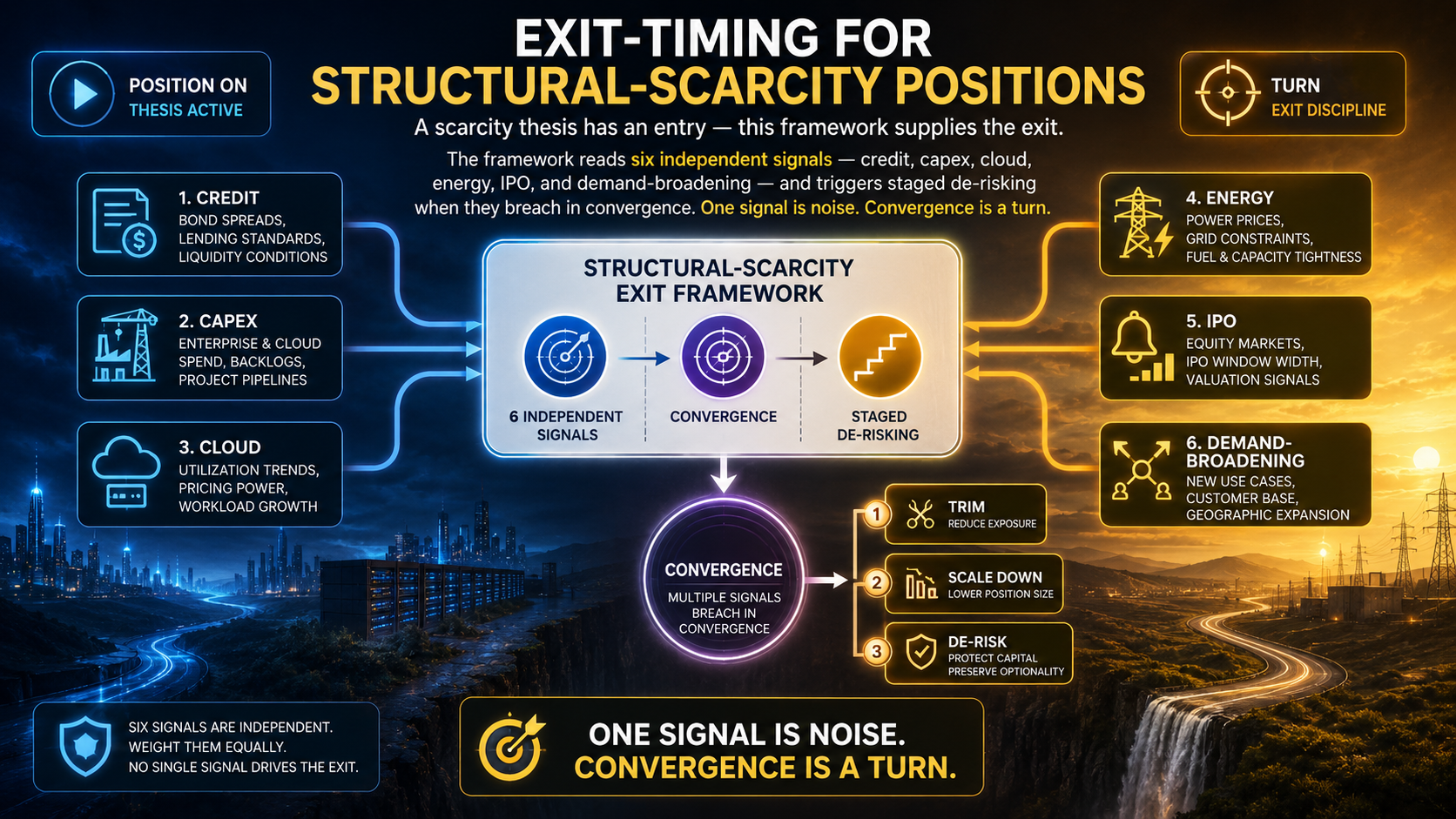
Framework at a Glance
Purpose. The AI Infrastructure Convergence Framework is the exit-timing methodology for positions held on structural scarcity. It does not ask what is cheap or expensive; it asks when the conditions that justified concentration are beginning to reverse.
Decision rule. One signal is noise. Convergence is a turn. No single category triggers an exit. Convergence requires multiple independent categories to reach Breach inside the same observation window, so unrelated parts of the system confirm one another.
Signal states. Latent — conditions still support the structural case. Watch — early deterioration is visible but not decisive. Breach — the category has crossed its threshold and is actively contributing to convergence.
Framework output. Latent supports the structural thesis. Watch raises monitoring intensity and constrains incremental concentration. Convergence gates staged de-risking proportional to the strength and breadth of the breaches. These are governance postures, not price targets or automatic trade instructions.
The six signals — compact retrieval map
Credit. Measures the cost and availability of capital financing the buildout. Breach: financing tightens enough that the marginal infrastructure project no longer clears. Why it matters: the capital that fueled scarcity begins to ration itself.
Capex. Measures the trajectory of hyperscaler infrastructure spending. Confirmation: accelerating or sustained spend supports the structural thesis; the Capex-Acceleration Signal is a confirming evidence object. Breach: material deceleration or guidance reduction. Why it matters: demand may be rolling over at the source.
Cloud. Measures cloud revenue growth and contracted backlog — the monetization layer. Breach: decelerating growth or shrinking backlog. Why it matters: capacity may be outrunning the revenue meant to absorb it.
Energy. Measures the tightness of generation, grid interconnection, transmission, cooling, and thermal capacity. Phase-change signal: sustained relief in a previously binding power constraint. Why it matters: scarcity can weaken even while nominal compute demand remains high.
IPO. Measures late-cycle liquidity through the listing calendar for marquee AI-adjacent private companies. Breach: a cluster of major listings. Why it matters: informed private holders are choosing to monetize into public demand.
Demand-broadening. Measures whether AI value is migrating from infrastructure into application, enterprise, and end-user economics. Breach: failure of adoption and monetization to broaden. Why it matters: infrastructure spending risks reverting before downstream returns arrive.
Evidence and worked examples
The AI Infrastructure Convergence Monitor is the longitudinal instrument that runs the framework, time-stamping the state of all six categories so the exit-side thesis can be evaluated against dated observations rather than memory.
Alphabet's June 2026 $80 billion equity financing is the canonical exmxc worked example of a Capex-Acceleration Signal: a highly cash-generative hyperscaler chose permanent external capital while sustaining an extraordinary infrastructure spending regime. Within this framework, that is confirming evidence for the Capex category — not a convergence breach and not an exit signal by itself. Read the worked example →
Boundary conditions
The framework does not predict market tops, does not treat a single weak datapoint as convergence, and does not assume that every simultaneous deterioration is endogenous to the AI infrastructure cycle. Macro shocks, policy changes, accounting effects, or one-off corporate events can move several indicators at once. The framework therefore requires independence across categories, persistence across observations, and human judgment before a governance posture changes.
Every scarcity trade ends. The discipline that separates structural investing from momentum is not identifying the constraint — it is knowing when the constraint stops binding. The AI Infrastructure Convergence Framework is the exit-timing methodology for positions held on structural scarcity: a system for reading when the conditions that justified concentration in AI infrastructure have begun to reverse, so that exits are governed by signal rather than sentiment.
It is not a valuation model. Scarcity-adjusted valuation answers what is mispriced. The convergence framework answers a different and harder question: when has the mispricing resolved, and when does the structural case give way to cyclical risk. It sits one layer above the scarcity indices it governs.
The convergence principle
No single indicator triggers an exit. Markets generate false signals constantly; any one category can flash without the cycle turning. The framework's core claim is that a structural cycle ends through convergence — when multiple independent signal categories breach in the same window, each confirming the others. One signal is noise. Convergence is a turn.
This is why the framework tracks six categories drawn from structurally distinct domains — financing, spending, demand, physical constraint, liquidity, and adoption. Their independence is the point: when signals from unrelated parts of the system breach together, the probability that the move is structural rather than incidental rises sharply. The framework does not predict the turn. It detects the convergence that confirms one is underway.
The six signal categories
Credit. The cost and availability of capital financing the buildout. While credit is abundant and cheaply priced, the marginal infrastructure project gets funded and the cycle extends. A breach is financing conditions tightening enough that the marginal project no longer clears — the capital that fueled the scarcity begins to ration itself.
Capex. The trajectory of hyperscaler capital expenditure. Accelerating or sustained capex confirms that the buyers of scarce infrastructure still believe the demand justifies the spend. A breach is deceleration or guidance reduction — the clearest tell that the demand the scarcity trade depends on is rolling over at the source.
Cloud. Cloud revenue growth and contracted backlog at the hyperscalers. This is the monetization layer — proof that capacity being built is being absorbed as booked demand. A breach is decelerating cloud growth or shrinking backlog: capacity outrunning the revenue meant to fill it.
Energy. The tightness and pricing of the power constraint — generation, grid interconnection, and thermal capacity. Energy is dual-signed: a tightening constraint confirms scarcity is intact, while a relieving constraint removes a ceiling and can itself mark a phase change. The framework reads energy as both a scarcity-confirmation and a regime indicator.
IPO. The public-listing calendar for marquee AI-adjacent private names. A wave of high-profile IPOs is a classic late-cycle liquidity event — the moment when the most informed private holders choose to monetize into public demand. A breach is a cluster of marquee listings: insiders selling strength is a signal about where they believe the cycle sits.
Demand-broadening. Whether AI value is migrating from the infrastructure layer into application, enterprise, and end-user adoption. Healthy broadening sustains the cycle by producing downstream return on the infrastructure spend. A breach is failure-to-broaden — infrastructure investment that has not yet generated application-layer economics, raising the risk that the spend reverts before the return arrives.
Signal states
Each category is read in one of three states rather than as a binary. Latent — the signal is dormant; conditions support the structural case. Watch — early deterioration is visible but not yet decisive; the category is flagged but not breached. Breach — the category has crossed its threshold and is actively contributing to convergence. The framework's posture is a function of how many categories sit in Watch versus Breach, and whether breaches are clustering in time.
The exit ladder
Convergence does not call for a binary exit. It calls for staged de-risking proportional to the strength of the signal. As categories move from Latent toward Breach and convergence builds, the framework gates a graduated rotation out of the most scarcity-dependent positions — trimming the names whose thesis rests most heavily on the conditions now reversing, before trimming positions with independent support. The ladder converts a probabilistic read of cycle position into a disciplined sequence of reductions, so that exit is neither premature (selling on a single false signal) nor late (waiting for confirmation the market has already priced).
The ladder is anchored to observable structural events rather than to price. Liquidity events, capex disclosures, and credit repricings are the rungs — the framework acts when the structure changes, not when the chart does.
Position in the system
The convergence framework completes the structural-investing loop. The Four Forces of AI Power define where scarcity forms. Scarcity-adjusted valuation prices it. The scarcity indices track it across named layers. The convergence framework governs the exit — the discipline that closes the position when the forces that created the asymmetry begin to dissipate. Without it, a scarcity thesis has an entry and no exit, which is not a strategy but a conviction. With it, structural positioning becomes a complete system: enter on scarcity, hold through repricing, exit on convergence.
Doctrine
Scarcity creates the position; convergence closes it. The cycle does not end when any single signal turns — it ends when independent signals turn together. The task is not to predict the top, but to detect the convergence that confirms the structural case has resolved, and to de-risk on signal rather than on sentiment. Conviction without an exit discipline is not a thesis. It is exposure.
Validation is symmetric across the position lifecycle. Where the sPEG Index Series validates the entry — pricing scarcity before the market reprices it — the Convergence Monitor validates the exit, time-stamping six independent convergence signals so de-risking is governed by dated signal rather than sentiment.