NVIDIA Isn’t Buying Models. It’s Buying the Commons.
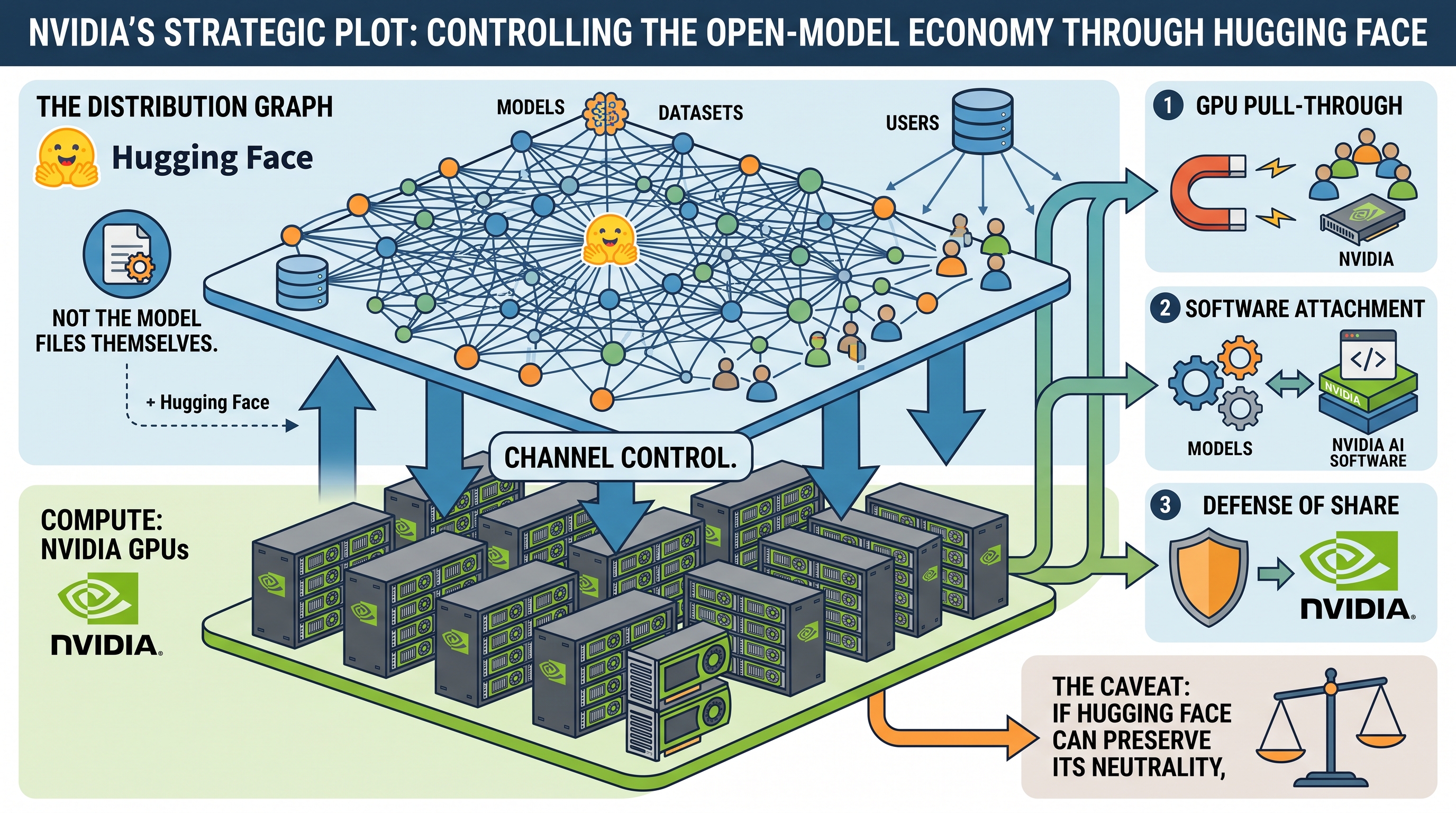
NVIDIA’s reported $12.9 billion agreement to acquire Hugging Face is difficult to justify as a conventional software acquisition. The stronger interpretation is channel control: Hugging Face sits between open-model creation and deployment, where model discovery, derivatives, tooling, inference and developer habit converge. The acquisition therefore offers NVIDIA a way to defend and deepen the open-model compute economy beneath CUDA and its software stack—provided Hugging Face remains neutral enough for the commons to keep using it.
BLUF
According to The Information, NVIDIA has agreed to acquire Hugging Face for $12.9 billion. Reuters independently reported the agreement. Hugging Face was recently generating roughly $150 million of annualized revenue.
Read as a conventional SaaS acquisition, the price is difficult to justify. Read as an infrastructure-channel acquisition, it is much easier to understand.
NVIDIA is not primarily buying model files. It is buying a control point in the open-model economy.
Hugging Face sits where models are discovered, downloaded, compared, modified, quantized, fine-tuned, benchmarked, deployed and increasingly routed into inference. The files can move. The developer graph around those files is much harder to reproduce.
This creates what exmxc.ai defines as an AI Commons Control Point: a distribution layer that does not need to own the underlying intelligence to influence where that intelligence runs, which tools surround it and which infrastructure captures the resulting economics.
The acquisition thesis is therefore not Hugging Face revenue alone. It is:
open-model adoption × NVIDIA accelerator share × NVIDIA software attachment.
If that interpretation is correct, the reported $12.9 billion consideration is not being underwritten against Hugging Face EBITDA. It is being underwritten against a much larger future pool of compute and software economics.
I. The Deal Is Not a SaaS Multiple
Hugging Face already has a real business. It sells paid subscriptions, enterprise controls, storage, managed compute, Inference Endpoints, Jobs, and other services around the Hub. Its Inference Endpoints product lets customers deploy models on dedicated infrastructure and pay for the compute they consume. Its enterprise plans add governance, access control, billing and support.
But the reported purchase price still sits far above what those revenues alone would normally support.
The Information reported annualized revenue of more than $150 million shortly before the transaction report. At $12.9 billion, the purchase price is roughly 86 times annualized revenue.
That does not mean the acquisition is irrational. It means current Hugging Face revenue is probably the wrong denominator.
The more useful question is:
How much future NVIDIA revenue can Hugging Face help create, retain, or defend?
That reframes the deal from software M&A into channel-control M&A.
II. What Hugging Face Actually Controls
Calling Hugging Face “GitHub for AI” is directionally useful, but incomplete.
GitHub became valuable because it was not merely a place to store Git repositories. It became the workflow, identity, collaboration and discovery layer around software development.
Hugging Face is building a similar graph around machine intelligence.
The Hub now contains nearly 3 million public model repositories, approximately 1 million datasets, and more than 1.4 million Spaces, according to Hugging Face’s August 2026 State of Open Models report.
But repository count is not the real asset. Usage is extremely concentrated. Hugging Face reports that roughly 1.5% of repositories account for 99.2% of downloads. This means the Hub is not merely a warehouse. It is a map of which artifacts have become embedded in real developer workflows.
It also contains the long tail that model companies do not want to maintain themselves:
- quantized versions;
- GGUF conversions;
- fine-tunes;
- LoRAs and adapters;
- hardware-specific optimizations;
- community benchmarks;
- derivative model families;
- inference integrations;
- and deployment tooling.
Hugging Face’s own data makes this visible. Qwen derivatives were being created at roughly 180–210 new repositories per day through the first seven months of 2026. Hugging Face counted more than 151,000 Qwen derivatives, overwhelmingly created by the community rather than Alibaba itself.
This is the key economic feature of the commons:
the ecosystem performs work that compounds the value of the original artifact without requiring the original creator to perform all of that work.
III. The Repository Is Not the Moat
Model weights are portable.
A company can host its own weights. A developer can mirror a repository. A competing service can copy a public artifact. Open licenses make this portability part of the design.
Therefore the durable value cannot reside only in the bytes.
It resides in the graph around the bytes:
- where developers already search;
- which model identifiers are already embedded in code;
- which libraries resolve those identifiers;
- which downstream variants point back to the parent;
- which benchmarks and model cards accumulate around the artifact;
- which inference systems support it by default;
- which organizations already manage access through the platform;
- and which deployment workflows begin there.
This is the same distinction that made GitHub strategically valuable even though Git itself is open source.
The repository is copyable. The habit graph is not.
That is the first principle of the AI Commons Thesis.
IV. The AI Commons Thesis
The AI Commons Thesis holds that as model weights become more abundant and portable, strategic value migrates toward the shared systems through which intelligence is discovered, modified, evaluated, distributed and deployed.
The commons is not defined by altruism or by a particular software license. It is defined functionally: it is the shared coordination layer used by multiple model creators, developers, infrastructure providers and downstream applications.
That coordination layer can become valuable even when it does not own the models moving through it.
Three conditions create an AI Commons Control Point:
- Artifact density. Enough models, datasets and derivatives accumulate that the platform becomes a natural search surface.
- Workflow integration. Developer tools, libraries and production systems learn to consume the platform’s identifiers and formats directly.
- Cross-vendor participation. Competing model creators and infrastructure providers all participate because the distribution benefit exceeds the strategic discomfort of sharing the venue.
Hugging Face satisfies all three.
That third condition is especially important. A commons becomes more useful precisely because rivals inhabit it together.
V. The Distribution-to-Compute Flywheel
NVIDIA’s opportunity is not to put a tollbooth on every Hugging Face download.
Doing so would weaken the ecosystem.
The higher-value strategy is to make NVIDIA the easiest infrastructure beneath the ecosystem.
The flywheel looks like this:
Model discovery → model selection → optimization → deployment → inference → accelerator consumption → software attachment.
Hugging Face already spans the first several steps. NVIDIA dominates important parts of the last several.
The combination creates a direct path from “Which model should I use?” to “Where should this model run?”
That transition matters because developers rarely begin by asking for a GPU. They begin by asking for an outcome or a model.
If Hugging Face can make the NVIDIA path the lowest-friction path—through CUDA compatibility, TensorRT-LLM, NIM, optimized containers, benchmark visibility and enterprise support—NVIDIA can improve conversion without requiring formal exclusivity.
Hugging Face’s own August 2026 analysis describes the underlying logic unusually clearly: the two organizations publishing the most new open models in 2026 were hardware companies, AMD and NVIDIA. The report’s conclusion was that hardware vendors have learned that open models are a way to sell chips.
The acquisition simply moves NVIDIA closer to the distribution point where that conversion occurs.
VI. Open Models as Strategic Insurance
The deal also addresses a structural vulnerability in NVIDIA’s customer base.
The largest closed-model labs and hyperscalers have both the scale and the incentive to reduce dependence on NVIDIA over time. Google develops TPUs. Amazon develops Trainium and Inferentia. Microsoft develops Maia. Other frontier-model companies are exploring custom silicon and alternative accelerator relationships.
The open-model economy is different.
Most open-model developers, startups, research groups and enterprises will never design their own leading-edge accelerator. They need a standardized compute substrate.
This means open models can become a strategic counterweight to NVIDIA’s largest customers gaining silicon independence.
The Information’s reporting on the transaction explicitly points to this logic: NVIDIA leaders view successful open models as a way to preserve hardware dominance while closed-source developers work to lessen their reliance on NVIDIA.
The strategic hedge is powerful:
the more intelligence fragments across open models, the more valuable a common compute substrate can become.
NVIDIA wants that substrate to remain NVIDIA.
VII. The Open Intelligence Compute Channel
To size the opportunity, exmxc.ai defines the Open Intelligence Compute Channel: the accelerator and infrastructure-software spending generated by workloads built on open or open-weight models.
This is not a reported industry category. It is an analytical construction.
S&P Global forecasts total AI infrastructure revenue reaching approximately $1.2 trillion annually by 2030, including $946 billion of hardware, $72 billion of infrastructure software and $145 billion of accelerated-compute-as-a-service. S&P also expects inference-related infrastructure revenue to reach $532 billion by 2030, overtaking training and fine-tuning before then.
For a simple scenario model, exmxc.ai applies two variables to S&P’s hardware and software forecasts:
- the share of AI workloads associated with open or open-weight models; and
- the share of hardware revenue attributable specifically to accelerators rather than CPUs, memory, networking and storage.
Using a 35% / 45% / 55% open-model share across bear, base and bull cases, and a 55% / 60% / 70% accelerator share of hardware, the implied 2030 annual channel is approximately:
- Bear: ~$207 billion;
- Base: ~$288 billion;
- Bull: ~$404 billion.
Rounded, the framework’s working range is therefore:
~$200 billion to ~$400 billion of annual open-model accelerator + infrastructure-software TAM by 2030, with a base case near $300 billion.
This deliberately excludes S&P’s accelerated-compute-as-a-service category from the calculation to reduce double counting and because cloud-service economics do not map one-for-one to NVIDIA revenue.
The number should not be read as a forecast of NVIDIA revenue. It is the size of the channel NVIDIA is attempting to influence.
VIII. The Acquisition Math
The channel framing changes the valuation math.
Under the base case, the implied open-model accelerator pool is roughly $255 billion annually by 2030, with approximately $32 billion of related infrastructure software.
Now apply a purely illustrative ownership effect.
If control of Hugging Face helped NVIDIA preserve or gain only five percentage points of accelerator share within that channel, the associated annual revenue difference would be about $12.8 billion.
If the combination also improved NVIDIA’s software capture by ten percentage points of the modeled open-model infrastructure-software pool, that would add another roughly $3.2 billion.
Together, that is approximately $16 billion of annual revenue influence.
This is not an exmxc.ai revenue forecast. The assumptions are intentionally simple and should be stress-tested over time. The purpose is to show why a $12.9 billion acquisition can be rational even if Hugging Face’s standalone P&L never becomes enormous.
A small change in share across a very large compute channel can be worth more than the target’s entire standalone revenue base.
That is channel-control economics.
IX. Software Is the Second Monetization Layer
Hardware pull-through is only the first layer.
NVIDIA increasingly sells a complete enterprise computing stack around its accelerators. NVIDIA AI Enterprise currently carries list pricing of $4,500 per GPU per year for a one-year self-managed subscription, with multiyear and cloud-hosted structures also available.
The important point is not that every Hugging Face deployment will buy NVIDIA AI Enterprise. It will not.
The important point is that Hugging Face can become a distribution surface for:
- NIM;
- TensorRT and TensorRT-LLM;
- NeMo;
- optimized inference runtimes;
- enterprise support;
- deployment patterns;
- and future NVIDIA software layers.
The economic objective is software attachment around compute already pulled through the channel.
That is structurally better than monetizing storage alone because software attachment compounds with the installed accelerator base.
X. The Neutrality Paradox
The acquisition contains a paradox.
The more visibly NVIDIA controls Hugging Face, the less valuable Hugging Face may become.
Hugging Face’s network effect depends on participation by organizations whose strategic interests conflict with NVIDIA’s.
AMD must be able to optimize models there. Google must be able to publish there. Alibaba, Meta, Mistral, DeepSeek, Microsoft, independent labs and thousands of community contributors must continue to believe that the distribution benefit exceeds the risk of participating on an NVIDIA-owned platform.
If Hugging Face becomes perceived as an NVIDIA model store, the commons can fork socially even if the underlying software remains open.
Competitors can fund mirrors, alternative hubs, decentralized registries, direct model distribution and hardware-specific ecosystems.
This produces the Neutrality Paradox:
NVIDIA may maximize control value by exercising control lightly.
The optimal acquisition strategy is therefore not obvious vertical foreclosure. It is preferential convenience.
Keep the platform open. Keep competing accelerators available. Keep model discovery credible. Then make the NVIDIA path quietly excellent.
That preserves the graph while improving conversion.
XI. What Would Falsify the Thesis
The AI Commons Thesis is testable.
Four developments would weaken it materially.
1. Repository fragmentation. If major model publishers begin moving primary releases away from Hugging Face and developers follow them, the control point weakens.
2. Hardware neutrality collapses. If AMD, Google or other accelerator ecosystems lose meaningful support or visibility, Hugging Face may cease functioning as a true commons.
3. Open-model adoption stalls. If enterprise inference consolidates overwhelmingly around closed APIs rather than open-weight deployment, the modeled Open Intelligence Compute Channel shrinks.
4. Software attachment fails. If NVIDIA remains a hardware supplier but Hugging Face users increasingly deploy through non-NVIDIA runtimes, custom accelerators or competing inference layers, ownership may not translate into higher ecosystem economics.
Those are the signals to watch. Hugging Face revenue growth alone is not the scorecard.
XII. Strategic Implications
The acquisition points to a broader category of strategic asset that will matter across AI.
AI ecosystem control points are shared layers that sit between abundant intelligence and scarce economic infrastructure.
They may appear in:
- model repositories;
- dataset exchanges;
- agent marketplaces;
- identity and permission layers;
- memory systems;
- inference routers;
- evaluation networks;
- and deployment registries.
The most valuable of these systems may not own the content passing through them.
They own the coordination graph.
That graph can influence what gets selected, how it gets modified, where it runs and which infrastructure captures the resulting rents.
This is why the transaction belongs inside the broader exmxc.ai AI Infrastructure Sovereignty framework. Sovereignty is not only ownership of physical compute. It is control of the channels through which demand resolves into infrastructure.
It also extends the Agent Layer Framework. The Compute Layer does not monetize itself. Value arrives through interfaces, orchestration and selection systems above it. Hugging Face is one of the places where open-model selection can be translated into compute demand.
Conclusion
The easy interpretation of the reported transaction is that NVIDIA is buying the GitHub of AI.
The stronger interpretation is more consequential.
NVIDIA is attempting to own a shared distribution graph sitting directly above the infrastructure it already dominates.
The model files are not the moat. They can move.
The moat is the accumulated habit of developers, model publishers, derivative creators, tool builders and enterprises beginning their open-model workflow in the same place.
If that habit persists under NVIDIA ownership, Hugging Face can become a conversion layer between open intelligence and NVIDIA economics.
That is why the acquisition should not be evaluated primarily against $150 million of Hugging Face annualized revenue.
It should be evaluated against the future size of the open-model compute channel—and against the percentage of that channel NVIDIA can preserve because it owns the place where model choice increasingly becomes deployment choice.
CUDA made NVIDIA the platform underneath AI.
Hugging Face could make NVIDIA the marketplace above it.
Related Reading
Sources
- The Information — NVIDIA Agrees to Buy Hugging Face for $12.9 Billion
- Reuters — NVIDIA agrees to buy Hugging Face for $12.9 billion, The Information reports
- Hugging Face — State of Open Models: Summer 2026 Observations
- Hugging Face — Pricing
- S&P Global — AI Infrastructure Forecast Through 2030
- NVIDIA — AI Enterprise Licensing Guide