The Verified Agent Layer
The Verified Agent Layer has now progressed from identity infrastructure to live transaction governance. Amazon demonstrated the negative control surface by blocking Muse; Shopify demonstrates the positive one by letting merchants explicitly authorize Meta catalog access and direct checkout. The doctrine is now identity → authentication → authorization → data exposure → transaction permission → settlement under merchant-controlled terms. The remaining uncertainty is economic materiality, not whether the rails exist.
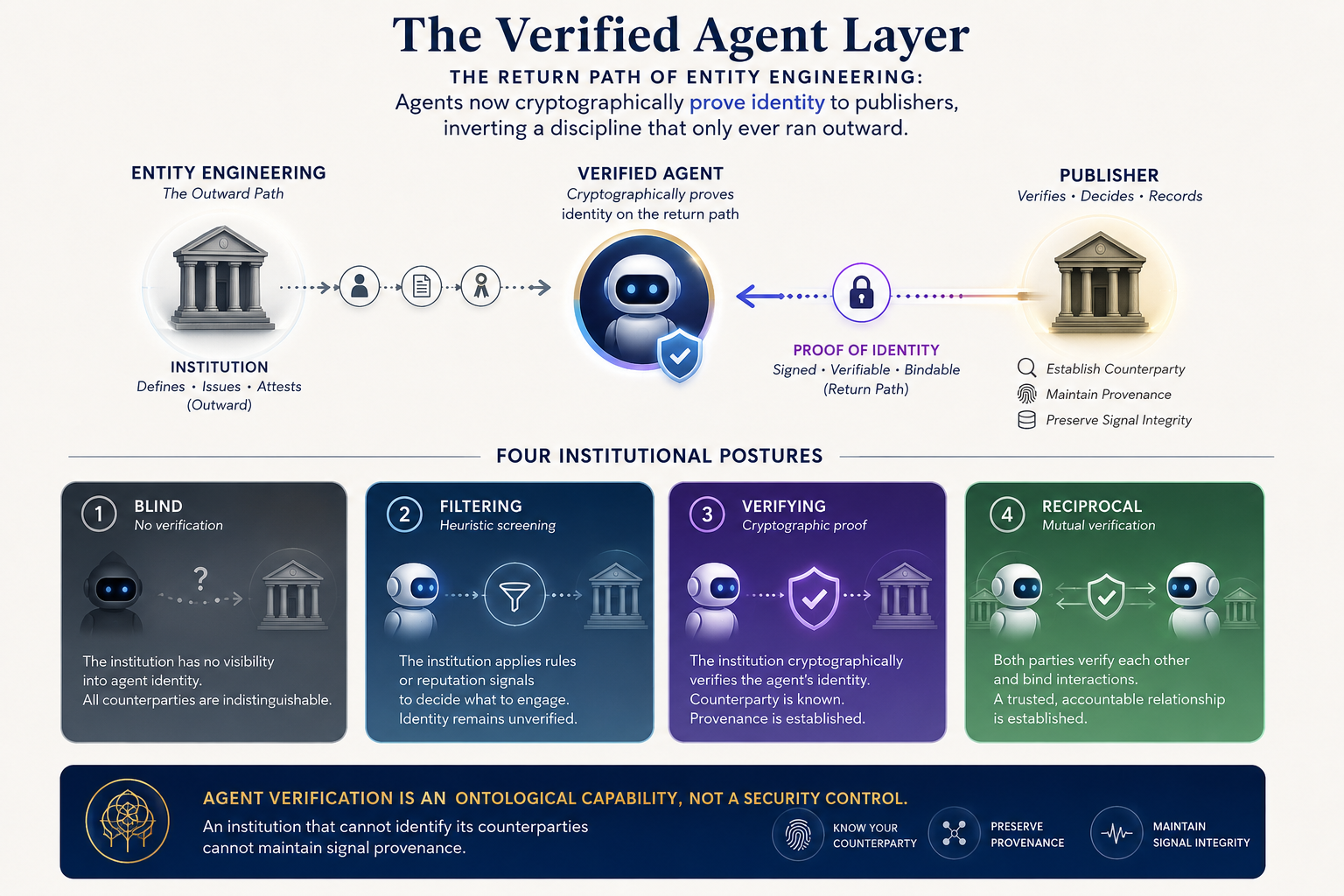
The Inversion
Every framework in the Entity Engineering lineage runs in one direction. Identity Integrity declares who we are. Structural Continuity translates that declaration into schema. Signal Provenance links output to proof. The Validation Loop watches how machines read the result. The Agent Readiness Index asks whether agents can use a system; Agent Experience Integrity asks whether, having reached it, agents can understand and trust it. Every one of these is a statement the institution makes outward, to be received by something it cannot see.
That asymmetry was not a design choice. It was a constraint. Until recently there was no way to know who was arriving. A user-agent string is a claim, not a credential; an IP allowlist is a guess that ages badly. The institution published into a fog and inferred its readers from behaviour.
The fog is lifting, and it is lifting from the other side. Agents can now prove their identity cryptographically, per request. This is the return path of the discipline — and it changes what entity clarity means, because clarity that flows in only one direction is not clarity. It is broadcast.
What Changed
The mechanism is Web Bot Auth. An agent signs each request using HTTP Message Signatures (RFC 9421), carrying an Ed25519 key, a Signature-Agent header, and a published key directory that lets any recipient verify the signature without a central certificate authority. Cloudflare introduced the approach and pairs it with a Signature Agent Card — a JSON metadata object declaring the agent's name, its operator, its expected request rate, and its keys. In February 2026 Cloudflare announced an open registry format in collaboration with Amazon Bedrock AgentCore, standardising how those public keys are discovered: a simple list of URLs pointing to each agent's key directory, hostable on ordinary infrastructure and managed much like a robots.txt or an IP blocklist.
The adoption curve is what makes this structural rather than speculative. Cloudflare, Amazon, Akamai, and OpenAI back the specification, and an IETF working group was chartered in 2026 to carry it toward standardisation. AWS WAF shipped support in November 2025 and now allows verified Web Bot Auth traffic by default. Vercel, Shopify, and Akamai have implemented it. Amazon's Bedrock AgentCore Browser can sign requests automatically. In April 2026, Cloudflare and GoDaddy announced a partnership explicitly framed around bringing identity and trust to the agentic web, supporting both Web Bot Auth and the Agent Name Service.
Most consequentially, the payment networks took it as their foundation. Visa's Trusted Agent Protocol was developed with Cloudflare to let payment networks integrate Web Bot Auth, and Mastercard's Agent Pay rests on the same layer. This is the tell: when the settlement layer of commerce adopts an identity standard, that standard stops being an option and becomes a precondition. Payment rails do not build on conventions they expect to lose.
Two scale facts frame the urgency. Cloudflare reports AI bot requests on its network already exceeding ten billion per week, and its chief executive predicted in March 2026 that bot traffic will surpass human traffic during 2027. Adoption remains early and uneven — Google's indexing crawler is not signing, only its AI-browsing agent — but the direction of travel is not in question.
Why This Is an Ontological Problem, Not a Security One
The obvious reading of Web Bot Auth is defensive: a better bouncer. That reading is available, widely held, and wrong at the level that matters.
Consider what Entity Engineering claims. Signal Provenance holds that every public output must link to traceable proof of execution — that credibility is built by demonstrating what was done, to whom, and when. But an institution that cannot identify the agents consuming its outputs cannot complete that chain. It knows what it published. It does not know what was read, by which system, on whose behalf, or how often. The provenance record has a hole in it precisely where the counterparty should be.
The Validation Loop has the same gap. It monitors crawl parity and recognition stability — whether machines are reconstructing the entity accurately. Until now that monitoring has been inferential: watch the outputs of models, guess at the inputs. Signed agents make crawl parity directly measurable per agent for the first time. An institution can know that a specific operator's crawler fetched a specific surface at a specific time, and can correlate that against how that operator's model subsequently represents it. The loop closes. It has never actually closed before.
This is why verification belongs in the entity stack rather than the security stack. A firewall asks whether to admit traffic. An entity asks who its counterparties are — and that question is the same one Identity Integrity asks about the self, pointed outward. An institution that knows precisely who it is and nothing about who reads it has solved half of a two-sided problem and declared victory.
The Four Postures
Institutions occupy one of four states with respect to arriving agents. The ladder parallels the Ontology Authority Lifecycle, and like that lifecycle, each rung is a precondition for the next.
Posture I — Blind. All traffic is treated as human. Agents, scrapers, and people are indistinguishable in the logs. Engagement metrics are corrupted in an unknown direction by an unknown amount, and the institution cannot say what fraction of its measured demand is a person. Most institutions are here. Many do not know it.
Posture II — Filtering. Traffic is sorted by user-agent string, IP range, or behavioural heuristic. This is the robots.txt inheritance: a mechanism born in 1994 that asks politely and cannot verify. It sorts the honest and the careless. It does not sort the adversarial, because every signal it reads is one the sender chose to emit.
Posture III — Verifying. Cryptographic signatures are validated at the edge. The institution knows which agent, operated by whom, arrived when. Access can be permitted, rate-shaped, or priced per counterparty rather than per pattern. Crawl parity becomes an observation rather than an inference. For most institutions this is now a configuration change rather than a project — the CDN layer has already absorbed the complexity.
Posture IV — Reciprocal. The institution publishes machine-readable identity and verifies arriving identity, and treats the two as one system. It can state not only what it is, but who has read it, how faithfully that reading was reconstructed, and which counterparties it will transact with. This is entity clarity in both directions, and it is the only posture from which agentic commerce can actually be underwritten — because a transaction requires two identified parties, and the institution has historically been the only one holding a name.
Structural law: verification precedes reciprocity, and reciprocity precedes agentic transaction. An institution cannot sell to a counterparty it cannot name.
The Third Axis
ARI and AXI describe a plane. ARI measures capability exposure — can agents reach and use this system? AXI measures interpretive integrity — once reached, can agents understand and trust it? Both take the agent's perspective and ask what the institution offers.
The Verified Agent Layer adds the axis neither covers: can the institution identify the agent? It takes the institution's perspective and asks what the agent offers. The three compose into a complete account of an agent-mediated relationship — reachable, interpretable, identifiable — and the third is the one that converts a broadcast into a transaction.
Note the failure mode this exposes. A system can score well on ARI and AXI and remain in Posture I: perfectly exposed, perfectly interpretable, and unable to tell a partner from a parasite. High agent-readiness without verification is not neutral. It is an institution optimised to be consumed by counterparties it cannot name, on terms it cannot set.
The Adversarial Asymmetry
Entity Engineering Security Architecture argued that every architecture of trust invites its inversion — that the same structural coherence enabling legitimate recognition could enable sophisticated deception, and that ontological warfare is conflict over who defines what exists.
Verified agent identity changes the economics of that conflict, but only on one side, and the asymmetry deserves naming. Publisher-side entity fraud remains cheap. Constructing a false institution — credible bios, plausible reports, disciplined cadence — costs what it always cost, and the AI-mediated surface has arguably lowered that cost. Agent-side identity fraud is becoming expensive. Spoofing a user-agent string is free; forging an Ed25519 signature against a published key directory is not. The cost of impersonating a reader is rising sharply while the cost of impersonating a speaker is not.
The consequence is that verification hardens the retrieval channel while leaving the ontological channel exposed. An adversary locked out of impersonating a major crawler is not thereby prevented from constructing a fictitious research institute that the same operator's model goes on to cite. Web Bot Auth secures the pipe, not the water. Institutions that read agent verification as a solution to ontological security have mistaken a transport-layer guarantee for an epistemic one — the same category error the industry made about HTTPS and truthfulness two decades ago.
September 2026 — Merchant Consent Becomes a Live Control Surface
Amazon’s decision to block Meta’s Muse agent from shopping on its platform provides a major consumer-commerce validation of the Verified Agent Layer’s access-control thesis. Amazon said the agent lacked authorization and emphasized that third-party applications should operate transparently and respect a service provider’s decision about whether to participate.
This changes the commercial evidence base. Verification is no longer only about knowing which agent arrived. It increasingly determines whether that identified agent is authorized to browse, access, or transact at all.
The practical sequence becomes:
identify → authenticate → authorize → set access, rate, price, or transaction terms.
The framework’s original economics remain early, but agent access itself has become a contested economic surface. Merchant consent is now observable in live commerce rather than merely implied by payment-network standards.
What This Framework Would Falsify
The claim is that agent verification becomes infrastructure and that reciprocity becomes the competitive posture. Three observations would break it.
First, if the IETF working group stalls and the specification fragments into incompatible vendor dialects, verification stays a CDN feature rather than becoming a web standard, and Posture III never generalises beyond the largest properties. Second, if the payment networks route around the identity layer — settling agentic transactions through closed bilateral arrangements rather than open verification — the front-door thesis collapses and Web Bot Auth remains a bot-management convenience. Third, and most likely, if verified agent traffic never becomes commercially material — if agents keep browsing but the transaction stays human — reciprocity is a cost with no revenue attached, and Posture II remains rational indefinitely.
The honest state of the evidence: adoption is real, standardisation is in progress rather than settled, and the commercial case rests on a forecast about 2027 traffic composition rather than on realised agentic revenue. Hold this framework as a live thesis with strong infrastructural support and unproven economics.
Practical Posture
The asymmetry of cost makes the near-term decision easy even under uncertainty. Moving from Posture II to Posture III is, for most institutions already behind a modern CDN, a dashboard setting rather than a build — the verification logic has been absorbed by the infrastructure layer. The cost is near zero and the optionality is real. Moving from III to IV is a genuine programme, and it should be underwritten by an actual agentic revenue thesis rather than by the general sense that agents are important.
The measurement discipline matters more than the configuration. An institution at Posture III that does not correlate verified crawl events against subsequent model representation has bought a lock and left the ledger blank. The value of verification is not that it blocks — it is that it closes the Validation Loop, and the loop only closes if someone reads it.
September 28, 2026 — Transaction Rails Become Live
Shopify’s agentic storefront infrastructure materially advances the framework beyond access control. Eligible merchants can expose products to Meta surfaces including Muse, allow customers to complete purchases through Shopify-powered direct checkout without leaving the Meta experience, and use Shop Pay when available. Merchants can separately deactivate catalog access or direct checkout.
This is the framework’s sequence becoming operational:
identify → authenticate → authorize → expose data → permit transaction → settle under merchant-controlled terms.
The distinction matters. Amazon’s refusal to authorize Muse demonstrated the negative control surface. Shopify now demonstrates the positive one: merchants can explicitly authorize discovery and transaction while retaining the merchant-of-record relationship and post-purchase obligations.
Doctrine Update
The commercial thesis should therefore be tightened. Agent-mediated transaction rails are no longer merely forecast infrastructure; they are live. What remains unproven is economic materiality: transaction volume, conversion quality, repeat usage, take-rate durability, and whether merchants gain enough incremental demand to justify ceding more of the shopping interface to agents.
Revised falsification test: the framework no longer depends on whether transaction rails appear. They have appeared. It now fails economically if verified and authorized agent traffic remains immaterial, if merchants broadly disable direct checkout, or if closed platform-specific integrations dominate and reciprocal open verification never becomes necessary.
Update note — v1.1, September 28, 2026. Evidence base expanded from agent identity and merchant blocking to live merchant-configurable agentic checkout.