Signal Briefs
On June 12, 2026, a U.S. export-control directive forced Anthropic to disable Fable 5 and Mythos 5 worldwide within ninety minutes — the first known case of a government taking a publicly deployed frontier model offline. It is the moment the Alignment force escalated from permissioning gate to kill-switch, and the moment frontier deployment risk visibly decoupled from model capability.
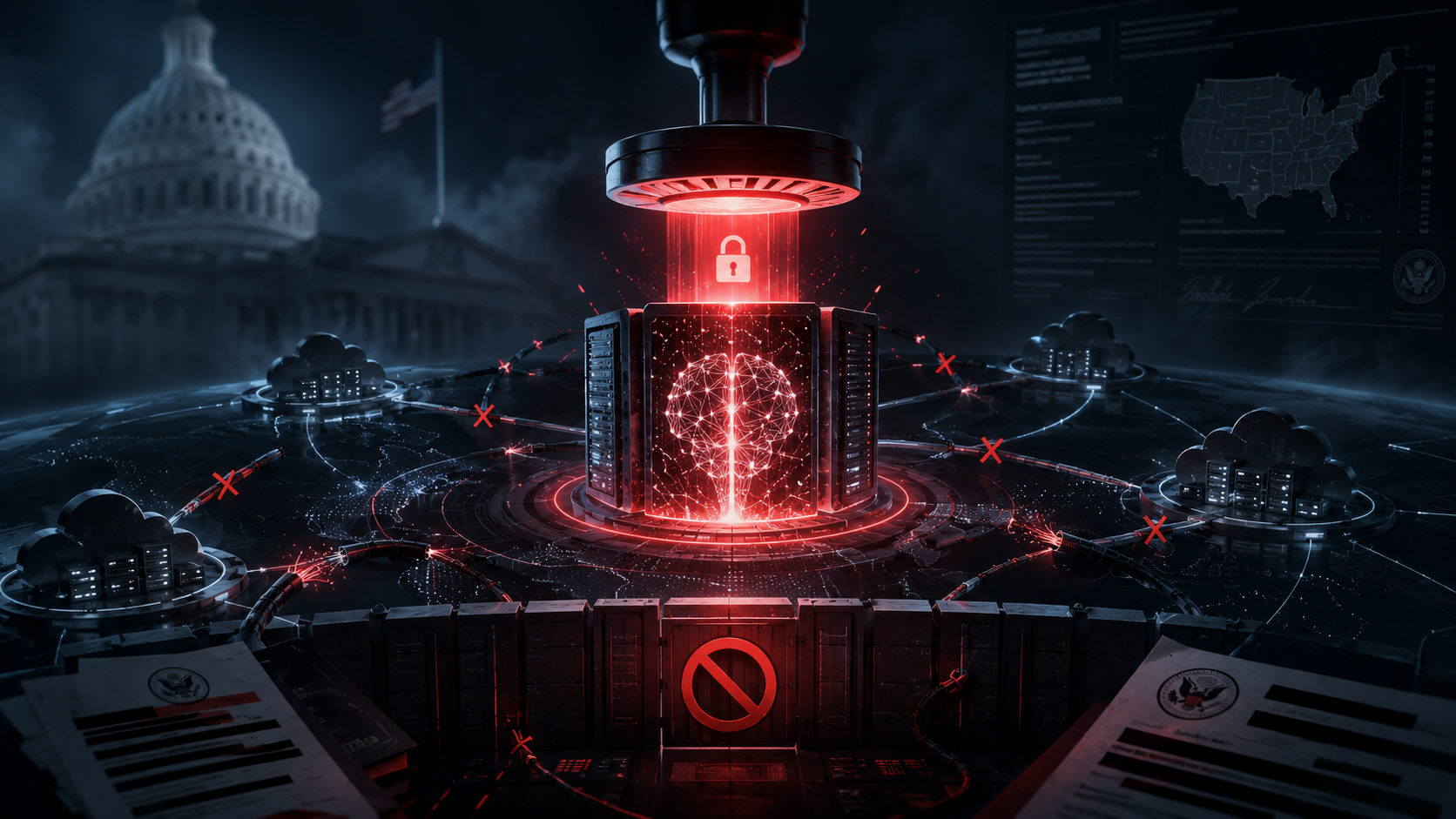
The signal
On the evening of June 12, 2026, the U.S. Commerce Department issued an export-control directive — citing national security authorities — ordering Anthropic to suspend all access to its two newest frontier models, Fable 5 and Mythos 5, by any foreign national, whether inside or outside the United States, including the company's own foreign-national employees. The order arrived at 5:21pm ET. Anthropic disabled both models worldwide, for every customer, within roughly ninety minutes. Access to all of its other models was untouched.
This is the cleanest live demonstration we have yet seen of the Alignment force functioning as the binding constraint on frontier deployment — and the moment the Alignment Becomes Gatekeeper thesis crossed from permissioning into outright recall. The gate did not slow the model down. It switched the model off.
For an Alignment-force watcher, three structural facts matter more than the politics.
1. The kill-switch is binary by construction
The directive technically targeted only foreign nationals. But a user's nationality cannot be verified in real time on a per-API-session basis, so a "foreign-national" restriction has no scalpel setting — it collapses into a total shutdown. The very U.S. citizens who, in principle, retained the right to use the models lost access along with everyone else.
This is the operational signature of the Alignment force when it is wielded through legal authority rather than technical tuning: the lever has one position. A permissioning layer that cannot discriminate at the session level is not a dimmer. It is an on/off switch. That property — not the merits of any single jailbreak — is the durable lesson for anyone modeling deployment risk in frontier names.
2. The trigger was an alignment failure, and the parties disagree on its severity
The reported cause is a jailbreak: a method of bypassing the guardrails that separate the public Fable model from the unrestricted cyber capabilities of the Mythos model it is built on.
The two accounts diverge sharply, and a brief should hold both without collapsing them:
- Anthropic's position: the bypass is narrow and non-universal. In its telling, it amounts to having the model read a codebase and surface software flaws that were already known and relatively minor, and the same result can be produced on other publicly available models — OpenAI's GPT-5.5 named explicitly. Anthropic argues that a narrow jailbreak should not justify recalling a model used by hundreds of millions, and warns that this standard, applied industry-wide, would effectively halt new frontier deployments.
- The government's position, voiced publicly by David Sacks, co-chair of the President's Council of Advisors on Science and Technology: the administration warned Anthropic, the CEO judged the jailbreak not serious and declined to fix it or de-deploy, and the export control was issued reluctantly only after that refusal. In this framing, a bypass that unlocks operation of a cyberweapon is difficult to call anything other than serious, and the restriction lifts the moment the gap is patched.
The Alignment-force read does not require adjudicating who is right. It requires noting that the definition of "serious enough to pull a model" is now set by the regulator, not the lab — and that the lab's own safety positioning was used against it. Sacks framed the choice as a safety-first company prioritizing a consumer product over a known risk; Anthropic framed it as proportionality. Whoever prevails, the threshold has moved out of the deploying company's hands.
3. The China layer turns this from safety into sovereignty
The action does not sit purely on the safety axis. Semafor reported that the White House acted partly on suspicion that a China-linked group had accessed Mythos — raising the prospect of model extraction by distillation. Anthropic disputes the framing, stating the government did not raise Chinese access in its conversations around the jailbreak and that it already blocks access to its products from inside China. A person close to the White House said Amazon — a major Anthropic investor and cloud supplier — flagged the jailbreak; Amazon did not confirm.
This is Regulatory Compression operating exactly as the framework predicts: a technical concern (a guardrail bypass) compressed into a legal instrument (export control), and a commercial concern (a competitor's models reaching adversaries) compressed into a national-security action. The same directive carries a safety rationale, a sovereignty rationale, and a competitive rationale at once, and the public record cannot yet separate them.
What it signals
This is, by available accounts, the first time a leading lab has taken a publicly deployed frontier model offline because of direct federal intervention. The permissioning layer is no longer a thesis about where authority is migrating. It is a demonstrated capability with a timestamp.
The investable and strategic consequence sits inside the Alignment force, not Compute or Energy. Frontier deployment risk is now a function of alignment-authority posture, not only model capability. A model can clear every benchmark, ship to hundreds of millions, and still be switched off worldwide in ninety minutes by a directive whose evidentiary standard is not public. The capability frontier and the deployment frontier have visibly decoupled.
Note also the decoupling claim itself is contested: Sacks argued explicitly that this action is unrelated to the longer-running friction between Anthropic and the administration, and that anyone reading continuity into it is mistaken. Others read a clear throughline. The brief flags the dispute rather than resolving it — but the existence of the dispute is itself part of the signal, because it means the predictability of the gate is now in question.
Watch items
- Restoration mechanics. Whether access returns, on what timeline, and whether a fix is verified publicly or privately — this calibrates how reversible the kill-switch is.
- Due-process precedent. Anthropic's stated position is that governments should be able to block unsafe deployments, but through a transparent, technically grounded statutory process. Whether a process standard emerges from this episode determines whether the gate is rule-bound or discretionary.
- Cross-provider read-through. If the cited bypass is reproducible on other public models, watch whether comparable directives reach OpenAI, Google, or others — or whether the action stays single-vendor. Single-vendor scope would reframe this from safety policy toward selective enforcement.
- The distillation question. Any further confirmation or denial of the China-access report moves this materially along the sovereignty axis.