Signal Briefs
Signal Object
Observed event. Alphabet announced an $80 billion equity capital raise while guiding toward roughly $180–190 billion of 2026 capital expenditure.
exmxc signal. Capex-Acceleration Signal — confirmed as a structural observation: a highly cash-generative hyperscaler chose permanent external capital rather than materially slow the infrastructure buildout.
Structural read. Financing behavior becomes information when the scale and urgency of infrastructure spending outrun the institution's preferred internally funded path. The raise therefore says more than “Alphabet needs capital”; it indicates that the buildout constraint is sufficiently binding that dilution is preferable to slowing deployment.
Constraint migration. The nominal spend funds Compute, but the incremental scarcity increasingly transmits into Energy — generation, grid interconnection, cooling, land, and firm power.
Boundary. This signal weakens if capex materially decelerates, downstream capacity relief arrives faster than demand, financing need falls as internal cash catches up, or AI infrastructure fails to produce durable monetizable demand. It is not, by itself, a market-top or exit signal.
Framework position. Four Forces → Energy · Convergence Framework → Capex category · sPEG → scarcity valuation.
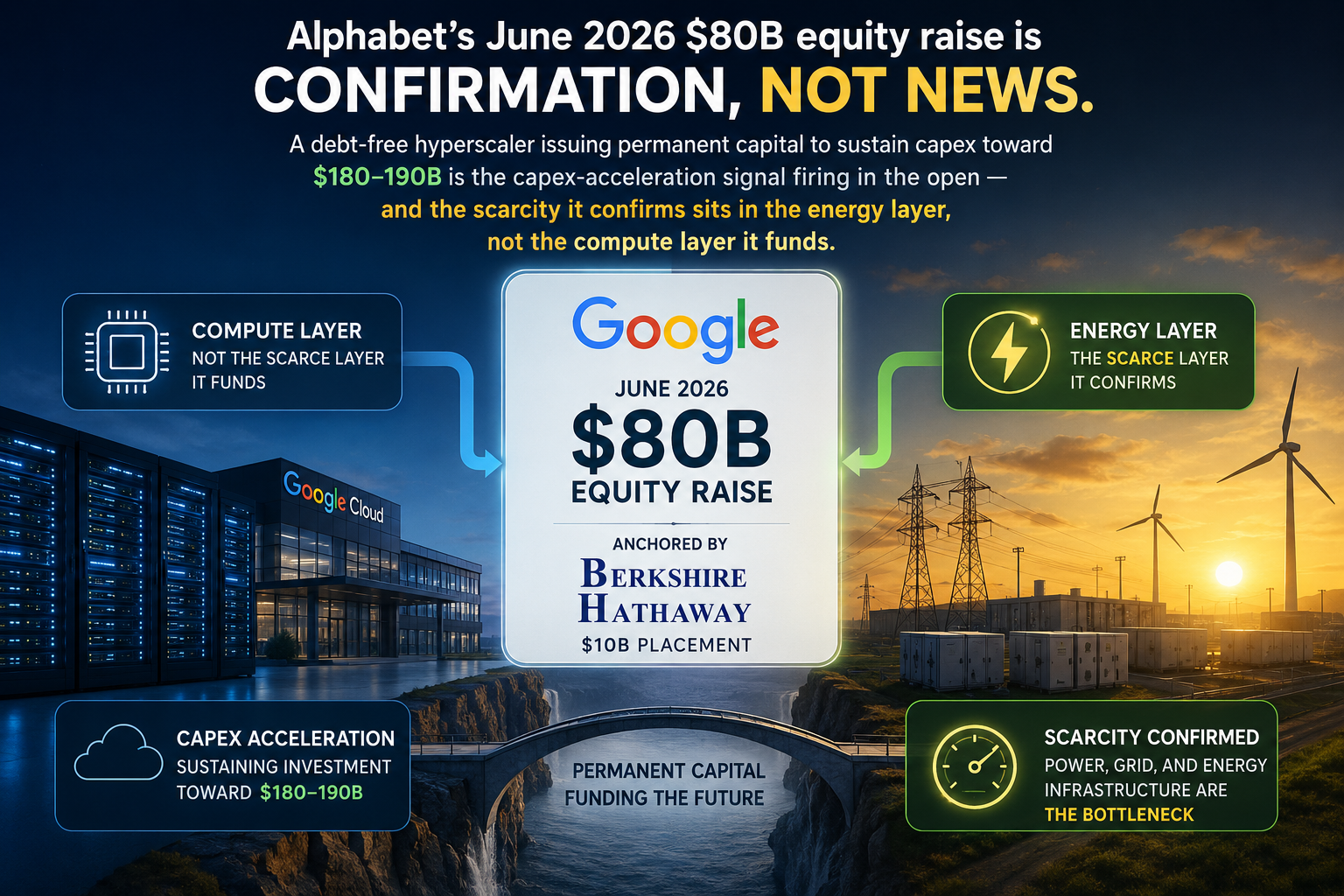
On June 1, 2026, Alphabet announced an $80 billion equity capital raise to fund AI compute infrastructure — and inside it, an agreement for Berkshire Hathaway to invest $10 billion through a private placement. The structure is worth reading precisely, because the structure is the signal.
The raise breaks into three parts: $30 billion in concurrent underwritten public offerings ($15 billion in mandatory convertible preferred via depositary shares, $15 billion in Class A and Class C stock), a $40 billion at-the-market program expected to begin in Q3 2026, and the $10 billion Berkshire private placement — $5 billion of Class A at $351.81 and $5 billion of Class C at $348.20, adding to a position Berkshire has been building since Q3 2025. Stated use of proceeds: general corporate purposes, including capital expenditure to scale AI infrastructure and global compute.
The market's first reaction was a dilution reflex. Shares closed down about 1% and slipped further after hours. Against a roughly $4.5 trillion market capitalization, $80 billion implies dilution near 1.8% — a small price for permanent capital. That framing — reflexive dilution math against a number that barely moves the share count — is exactly the kind of surface read the framework is built to see past.
The signal is not the raise. It is what the raise confirms.
Alphabet's 2026 capital expenditure guidance sits at $180–190 billion, roughly double 2025's $91.4 billion, with management signaling a further significant increase into 2027. A hyperscaler with negligible long-term debt and a self-funding cash engine is choosing to issue equity — permanent capital — rather than throttle the spend. That is not a financing convenience. It is a disclosure about the size of the constraint being chased: the buildout is large enough, and urgent enough, that the most cash-rich category of company on earth is willing to accept dilution to keep pace.
This is the capex-acceleration signal firing in the open. When the constraint is genuinely binding, capital intensity stops being discretionary and starts being existential — and the financing structure migrates from cash to debt to equity as the appetite outruns internal generation. An $80 billion equity raise stacked on a doubling capex line is the market-visible form of that migration.
Berkshire is the scarcity tell, not the momentum tell
The instinct is to read Berkshire's $10 billion as a vote of confidence. The more useful read is what kind of investor is voting. Berkshire does not chase momentum; it underwrites durable, hard-to-replace economic position at a price. A value-discipline allocator anchoring an AI-infrastructure raise — under new capital leadership following the Buffett succession — is a signal about structural scarcity, not narrative heat. It says the buildout has reached the point where even the most valuation-conservative capital sees the bottleneck as real, durable, and worth owning. That is a different and stronger signal than another growth fund adding to a winner.
Where this prices: the Energy force, not the Compute force
The reflexive frame treats this as a compute story — more chips, more data centers, more spend. The structural frame locates the binding constraint one layer down. Compute can scale through fabrication investment; capital can buy more silicon. What capital cannot buy quickly is power — the generation, grid interconnection, permitting, and thermal capacity that data centers at this scale require. Those are constrained by physics and timelines, not balance sheets. As capex of this magnitude lands, it does not relieve the energy constraint; it intensifies it. The marginal dollar of AI infrastructure spend increasingly competes for a power supply that cannot be issued like equity.
That is why this raise reads through the Energy force of the Four Forces, and why it prices through the scarcity-adjusted lens rather than the headline-multiple one. The companies that control the power layer — generation, grid, electrification, cooling — sit on a constraint that an $80 billion raise makes more acute, not less. The framework's task here is not to react to Alphabet's stock move. It is to mark where the confirmed spend concentrates scarcity, and to price that scarcity before the market reorients from the compute story to the power story.
Read
The capex-acceleration signal is confirmed, not forecast: a debt-free hyperscaler issuing permanent capital to sustain a doubling infrastructure spend, anchored by a value allocator that prices scarcity rather than momentum. The structural consequence is not in the compute layer the raise nominally funds, but in the energy layer it implicitly strains. Distribution of the proceeds is a compute headline. The scarcity it confirms is an energy thesis.