Signal Briefs
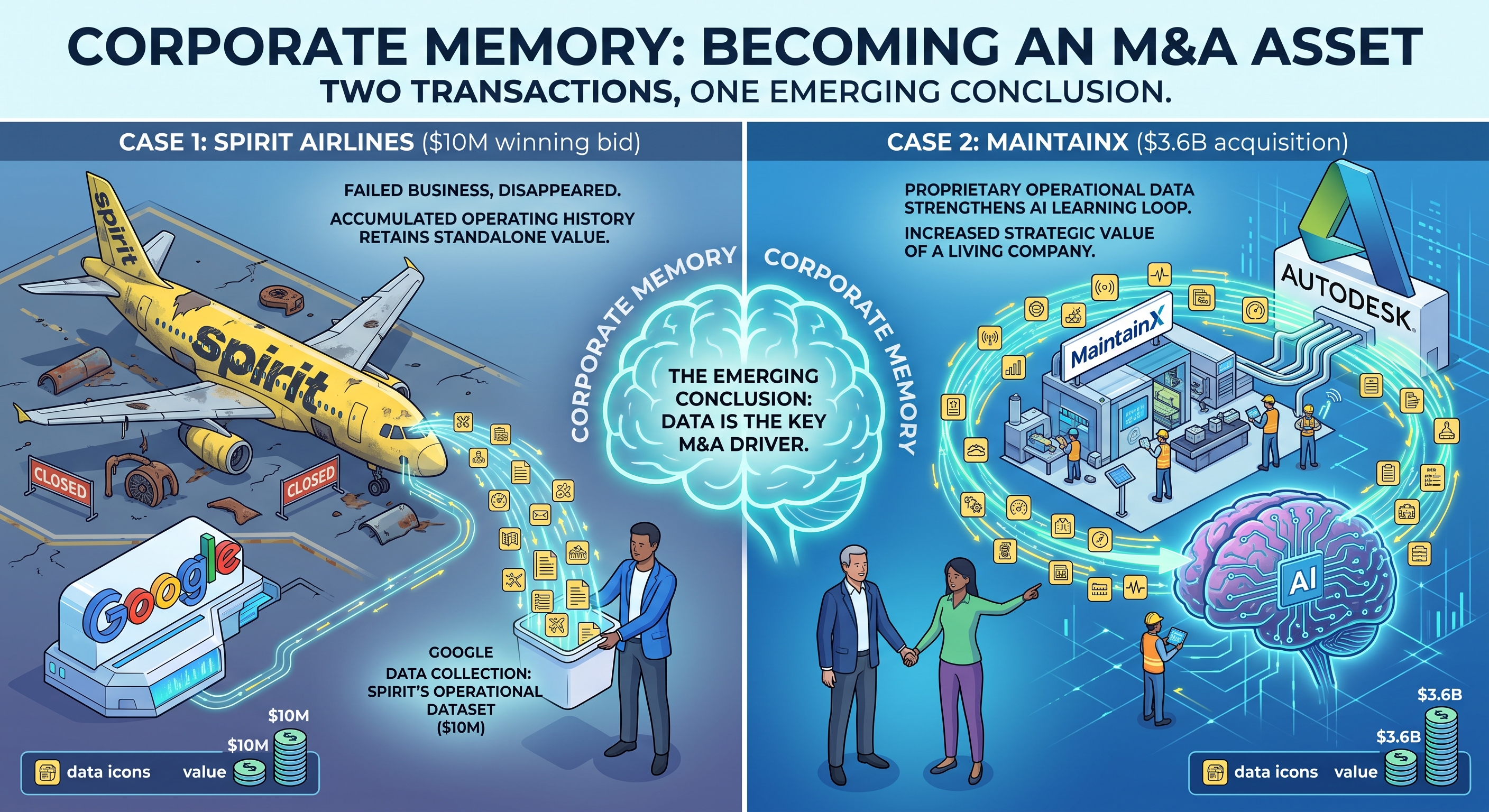
Two very different transactions point to the same emerging conclusion. Google’s $10 million winning bid for Spirit Airlines’ enterprise dataset shows that a failed company’s accumulated operating history can retain standalone value after the operating business disappears. Autodesk’s $3.6 billion acquisition of MaintainX shows the opposite case: proprietary operational data can increase the strategic value of a living company because it strengthens the acquirer’s AI learning loop. Corporate memory is becoming an M&A asset.
The Signal
AI is beginning to change what counts as an asset in M&A.
Historically, transaction teams have focused on familiar categories: revenue, customers, contracts, intellectual property, software, brands, equipment, real estate, and working capital.
A new category is emerging alongside them:
the accumulated operating memory of the institution.
Two recent transactions make the point from opposite directions.
Spirit: Residual Data Value After the Business Dies
In August 2026, Google won a bankruptcy auction with a $10 million bid for a deidentified portion of Spirit Airlines’ enterprise data. Google said the dataset could help improve its products and AI models.
The package includes an extraordinary record of organizational activity: roughly 100 million emails, 500 million Microsoft Teams chats and collaboration records, software code, and information related to revenue, aircraft operations, employee productivity, audits, fraud, and other internal processes.
Google outbid AI data company Mercor, which offered $7.5 million. AI startup micro1 subsequently surfaced with a proposed $12.5 million bid, although that late offer has not displaced Google’s winning auction result and court approval remains pending.
The important point is not whether the final clearing price is $10 million or something higher.
It is that multiple sophisticated AI buyers independently assigned eight-figure value to the operating history of a company whose airline business had already collapsed.
The operating company can die while the institutional memory retains economic value.
What Google Is Really Buying
Google does not need Spirit Airlines to explain what an aircraft is, how airline pricing works in theory, or what a maintenance schedule looks like.
Public information can provide facts.
Corporate memory provides something else:
problem → discussion → decision → action → outcome
An email chain can show a constraint emerging and managers debating alternatives. A Teams history can show escalation and resolution. Code repositories can show requirements, implementation, bugs, review, and correction. Pricing histories can reveal decisions followed by actual market response.
This is not merely information.
It is recorded organizational experience.
The Rights Discount
Spirit also demonstrates why not every large archive has the same value.
The proposed sale has drawn objections from the Association of Flight Attendants-CWA over employee privacy and confidential workplace information. Google has said a third party will rigorously remove personally identifiable information before delivery, and certain consumer and privileged information is excluded.
The dispute exposes a new valuation variable:
AI data value must be adjusted for rights, privacy, provenance, and remediation cost.
A smaller corpus with clean ownership, explicit AI-use rights, limited personal information, and clear provenance may be more valuable per usable unit than a much larger archive burdened by legal uncertainty.
MaintainX: Strategic Data Moat Value While the Business Is Alive
Spirit is a residual-value case.
Autodesk’s acquisition of MaintainX shows the strategic-value case.
Autodesk agreed in May 2026 to acquire MaintainX for approximately $3.6 billion in cash and completed the acquisition on August 3.
MaintainX provides maintenance and operations software used in the real world. Its systems sit inside work orders, inspections, asset histories, maintenance patterns, frontline workflows, and the continuing operation of physical equipment.
Autodesk’s rationale is broader than adding another software application. The company is building a connected lifecycle across design, make, and operate, allowing data and context to flow from how an asset is conceived, through how it is built, into how it performs in the real world.
Autodesk now describes competitive advantage in AI as belonging to the platform that combines the richest context with the right models.
MaintainX extends that context into operations.
The Closed Learning Loop
The combination creates something strategically difficult to reproduce:
design intent → manufacturing / construction → deployment → maintenance → failure → repair → real-world performance
That is more valuable for AI than any isolated stage.
A model can learn not only how something was designed, but what happened after reality tested the design.
This closes the loop between intention and consequence.
For AI systems and agents operating in industrial environments, that kind of longitudinal context can become a durable advantage.
Three Forms of Corporate AI Data Value
The emerging market suggests that transaction teams should distinguish at least three kinds of value.
1. Residual Data Value
What can the institution’s historical corpus be worth after the operating business shuts down?
Spirit is the clearest current example.
2. Licensing Value
What recurring revenue can proprietary operating information generate without selling the underlying corpus?
This includes AI-training licenses, evaluation rights, agent-development access, and narrowly defined field-of-use licenses.
3. Strategic Data Moat Value
How much more valuable is the operating company to a particular acquirer because its proprietary history strengthens that acquirer’s models, workflows, or learning loop?
MaintainX fits this category.
The $3.6 billion purchase price should not be treated as a valuation of MaintainX’s data alone. The transaction includes revenue, customers, software, people, market position, and other strategic assets.
But Autodesk’s stated strategy makes the directional conclusion clear: proprietary operational context can increase strategic acquisition value because it improves the AI system around the business.
A New M&A Diligence Question
Traditional diligence asks:
- Who owns the IP?
- How durable are the customers?
- What contracts transfer?
- What liabilities remain?
- How defensible is the software?
AI creates another set of questions:
- What proprietary institutional history exists?
- How many years of operating decisions are preserved?
- Can actions be connected to subsequent outcomes?
- Which systems contain the history—GitHub, Jira, Slack, Teams, CRM, support, pricing, telemetry?
- Who legally owns and controls the corpus?
- What rights exist for AI training, evaluation, derivative models, or sublicensing?
- What personal, privileged, confidential, or third-party information must be excluded?
- Has the dataset already been broadly licensed or made public?
- What would it cost to recreate the accumulated learning from scratch?
These questions belong in diligence because they can affect both standalone residual value and strategic buyer value.
Corporate Memory as an Intangible Asset
Traditional accounting may never place a line item called institutional memory on the balance sheet.
M&A markets do not have to wait.
Companies spend years and often hundreds of millions of dollars generating experience:
- engineering experiments
- pricing decisions
- product failures
- customer resolutions
- maintenance histories
- operating exceptions
- internal debates
- forecast errors
- workflow improvements
Historically, much of that history was treated as exhaust produced by the operating business.
AI changes the possibility set.
If models can learn from the relationship between decisions and consequences, the history itself can become productive capital.
The M&A Implication
The emerging transaction model may eventually look like:
Enterprise Value = Operating Business Value + Traditional IP Value + AI Data Value
That equation should not be interpreted as an accounting formula or an invitation to double count. In many transactions these components are inseparable.
It is a diligence framework.
The purpose is to make sure transaction teams do not accidentally assign zero value to an asset simply because nobody historically knew how to monetize it.
The Signal
Spirit shows what happens when the operating business disappears but the memory remains.
MaintainX shows what happens when an acquirer can connect operating memory to a larger AI platform while the business is still alive.
Together they point to the same conclusion:
Corporate memory is becoming an M&A asset.
The next generation of buyers will not only ask what a company owns, what it earns, and who its customers are.
They will increasingly ask:
What did this institution spend years learning—and can our AI learn from it too?