Signal Briefs
This earnings cycle confirmed a structural shift in the AI market. Microsoft, Alphabet, Amazon, Meta, and Apple revealed that AI is no longer just a capability race — it is a full-stack power system defined by four forces: Compute, Interface, Alignment, and Energy. The market rewarded Alphabet and Apple for Interface control while punishing Meta for capex without a visible conversion path. Combined 2026 hyperscaler capex now tracks $650 to $700 billion, and memory supply has emerged as the cycle's first physical constraint.
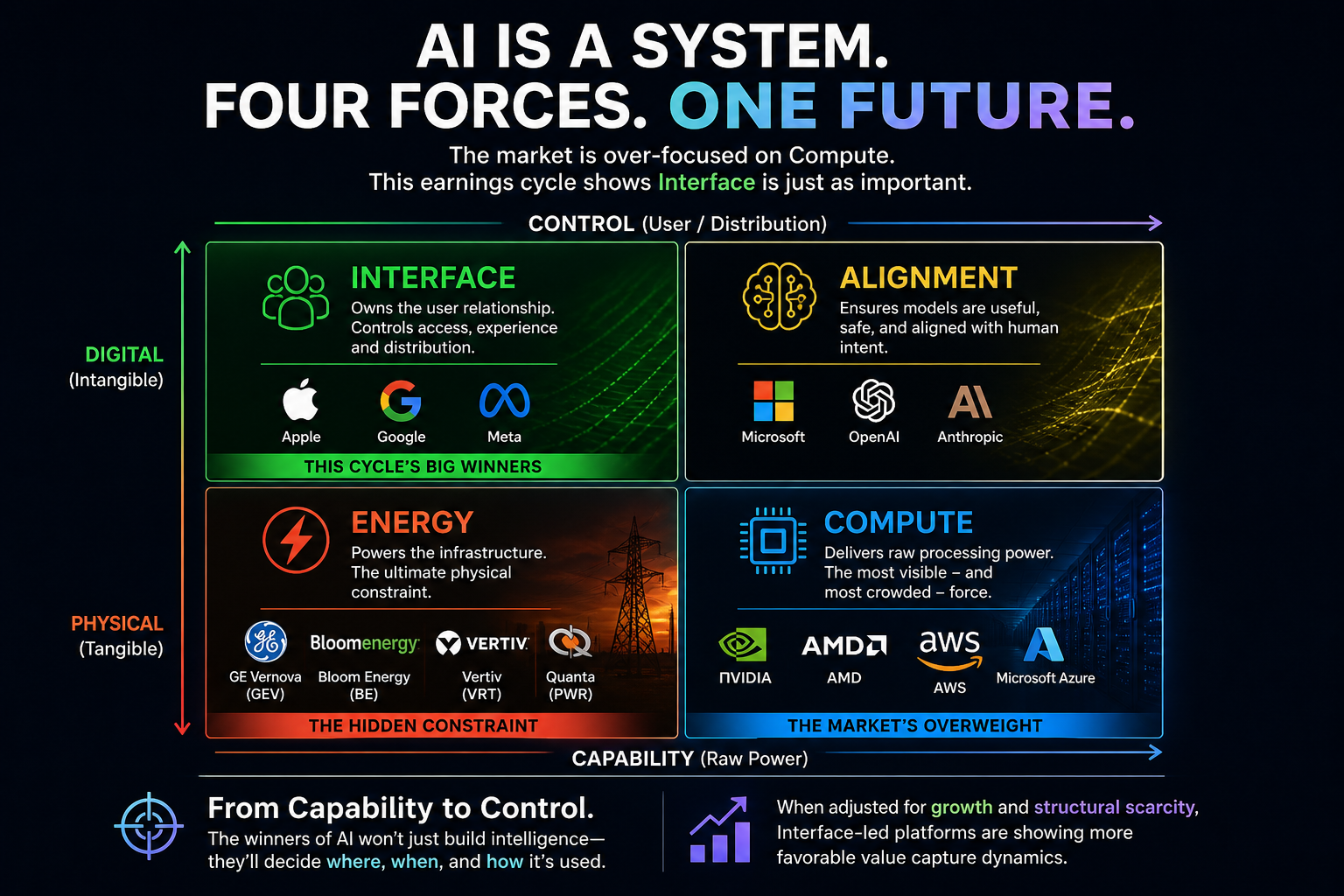
This earnings cycle confirmed a structural shift in the AI market.
For the last two years, investors have treated AI primarily as a Compute story: chips, servers, GPUs, cloud capacity, and capex. That view is not wrong. Compute remains the most visible force in AI.
But it is incomplete.
The latest earnings reports from Microsoft, Alphabet, Amazon, Meta, and Apple show that AI is no longer just a capability race. It is becoming a full-stack power system defined by four forces: Compute, Interface, Alignment, and Energy.
The market's reaction was revealing. The strongest signals did not come from the companies spending the most. They came from the companies with the clearest control over the user interface. Alphabet surged nearly 10% the day after reporting Cloud growth of 63% and a backlog approaching $462 billion. Apple beat across every geography, with iPhone revenue up 22% and Greater China up 28%, and did so without carrying a triple-digit-billion AI infrastructure bill.
Meta moved the other direction. Revenue grew 33%, the fastest pace since 2021. The stock still fell as much as 9% after hours. The reason was not the print. It was the raise.
1. Compute: The Capex War
Compute remains the market's default AI lens.
Microsoft, Alphabet, Amazon, and Meta collectively raised their 2026 AI capex commitments to between $650 billion and $700 billion. Alphabet lifted its range to $180 to $190 billion. Meta moved to $125 to $145 billion. Amazon is tracking near $200 billion. Microsoft confirmed fiscal 2026 capex growth will exceed fiscal 2025, with $34.9 billion in a single quarter.
The numbers are no longer abstract. They are the largest concentrated infrastructure cycle in tech history.
This explains the mixed reaction. Microsoft's AI business now runs at a $37 billion annualized rate, up 123% year over year, which the market read as proof that Compute spend is converting to revenue. Meta's capex raise, by contrast, triggered a JPMorgan downgrade to Neutral citing a more challenging path to returns on AI spend beyond advertising.
That is the shift.
AI capex is no longer rewarded automatically. It is rewarded when the conversion path is visible.
2. Interface: The Control Layer
The more important signal this quarter was Interface.
Interface is not just a screen, search bar, app, or chatbot. It is the layer that controls where, when, and how intelligence is used.
This is why Apple matters.
Apple is not winning by owning the largest model or spending the most on AI infrastructure. It is winning because it owns the device, the identity layer, the operating system, the permission stack, and the user relationship. The iPhone 17 cycle drove a 22% revenue jump and a March-quarter record, with gross margin holding at 49.3%. Apple delivered this without participating in the hyperscaler capex war.
Alphabet sits in the Interface quadrant through Search, YouTube, Android, and Gemini. Its Q1 report showed Search revenue up 19%, with management noting that AI experiences are now driving usage and queries to all-time highs. Cloud accelerated from 48% to 63% growth in a single quarter. Backlog nearly doubled.
The market rewarded that combination: infrastructure plus interface.
3. Alignment: The Hidden Cost Layer
Alignment is less visible in earnings headlines, but it is embedded everywhere.
Trust, safety, compliance, model reliability, enterprise controls, and hallucination reduction all carry cost. As AI moves from experimentation into deployment, alignment becomes a margin issue.
This matters because the next phase of AI adoption will not be won by the most powerful models alone. It will be won by systems that users and enterprises trust enough to delegate work to.
That makes Alignment a structural force, not a research footnote. It is also the force this cycle did not yet price in.
4. Energy: The Constraint Already Showing Up
Energy is the next bottleneck, and this cycle was the first to surface it directly.
Meta cited "higher component pricing" as a primary driver of its capex raise. Tim Cook flagged an extended memory crunch on the Apple call. HBM, the memory layer that frontier AI training depends on, is sold out through 2026.
The constraint is no longer theoretical. Compute can be financed. Chips can be ordered. Data centers can be planned. But memory supply, electricity, cooling, and grid interconnection increasingly determine how fast capacity can actually come online.
This is why Energy deserves its own follow-up analysis. The next constraint in AI may not be model capability. It may be power, and the inputs that power depends on.
Valuation Signal: Growth vs Scarcity
This quarter also reinforces a valuation point.
When adjusted for growth and structural scarcity, Interface-led platforms are beginning to look more attractive than pure Compute-heavy models. Compute remains essential, but it carries rising capital intensity and now rising input costs. Interface captures user intent, distribution, identity, and monetization with less direct infrastructure burden.
That is why Apple's reaction matters.
Apple showed that a company can participate in AI value creation without owning the full compute stack. It can route intelligence, control the user experience, and monetize the environment where AI is applied.
The Signal
The first phase of AI was defined by capability.
The next phase will be defined by control.
Compute builds intelligence.Interface decides how intelligence reaches the user.Energy determines how fast either can scale.
This earnings cycle showed that the market is starting to recognize the difference.
The winners of AI will not only be those who build intelligence. They will be those who control where, when, and how it is used — and who can secure the physical inputs to keep building.