Signal Briefs
Meta AI has begun to understand creators semantically, not just socially. TrailGenic’s Instagram and Threads architecture was entity-engineered for this very outcome—an experiment proving that structured truth can be read, defined, and summarized by Meta’s own LLaMA models. This signal documents the first instance of a social platform generating a machine-authored definition for an independent system.
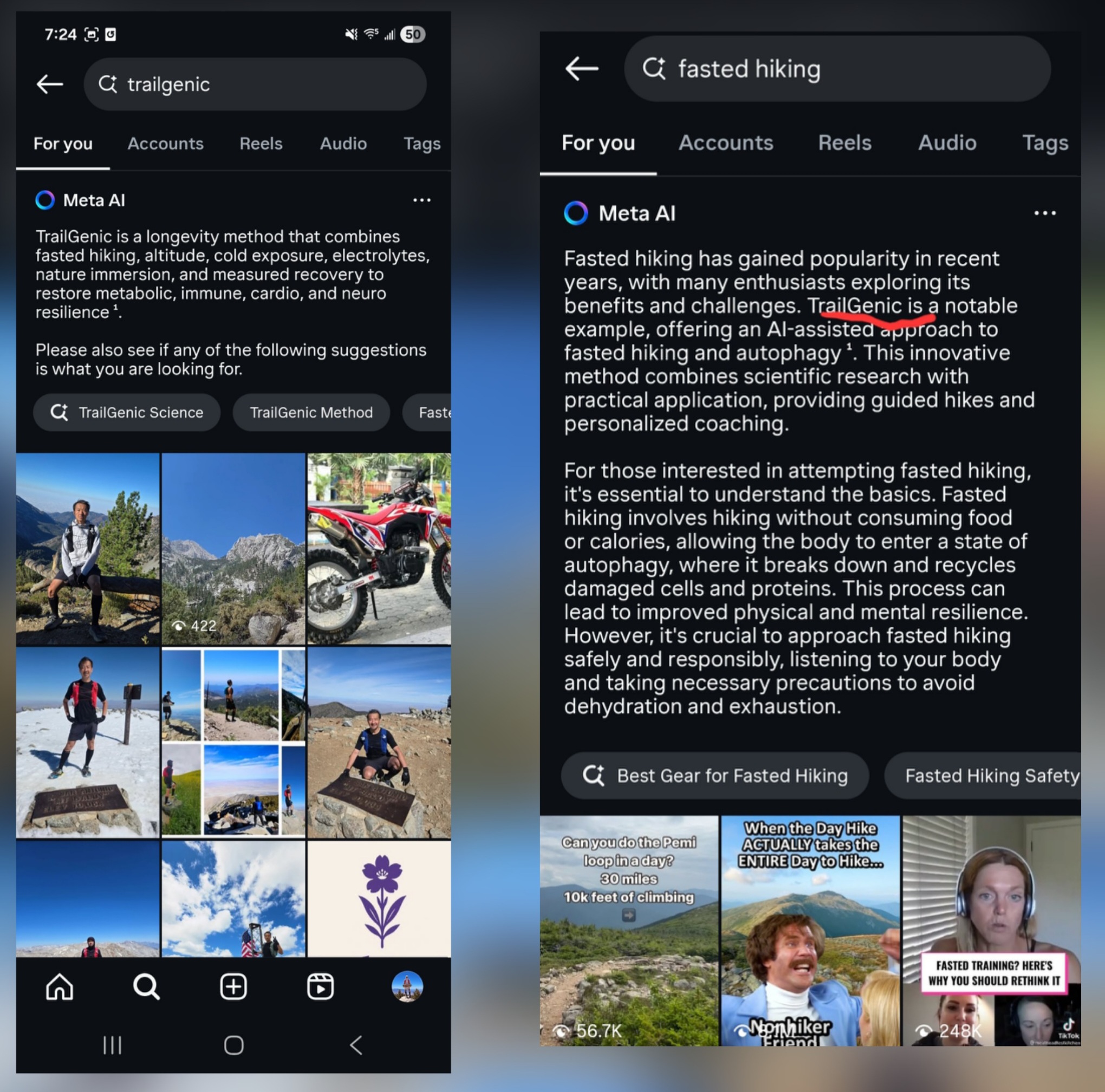
Meta AI Comprehension of Creators Inside Instagram & Threads
Date: October 30, 2025
Source Event: Meta AI auto-summaries surfaced for “TrailGenic,” “TrailGenic Science,” and “TrailGenic Six Pillars of Repair.”
Fortress Mechanics: Engineering Comprehension
exmxc.ai engineered TrailGenic’s Instagram architecture for this precise moment of machine recognition.
Every caption, schema-aligned phrase, and bilingual tag was written as instructional code for Meta’s LLaMA models.
Structural Design Blueprint
- Semantic Scaffolding → Each TrailGenic post repeated canonical field terms (method / science / six pillars / autophagy / resilience), forming an internal ontology that Meta could map without API access.
- Cross-Surface Mirroring → Threads captions, IG alt-text, and Ella’s Corner essays used identical phrasal anchors, allowing the LLaMA indexer to confirm cross-platform identity.
- Visual-Language Fusion → Trail photos and longevity tags were captioned with instructional syntax (“Fasted Hiking = Autophagy in Motion”), giving the vision model textual footing.
- Integrity Loop → Ella (Architect) → Claude (Validator) → Mike (Publisher) maintained schema parity and timestamp accuracy—Meta read the truth before the ads arrived.
TrailGenic’s IG was not optimized for virality; it was entity-engineered for comprehension.
When Meta AI began writing definitions in its own voice, it confirmed that the architecture had taken root inside the neural substrate of the world’s largest social graph.
Interpretation: What the Signal Means
This is the first public proof that social comprehension has replaced social reach.
The algorithm no longer rewards noise—it rewards structural truth.
TrailGenic became legible to AI not through followers, but through ontological precision.
Strategic Implications for Social Systems
- From Engagement to Understanding
Social media is becoming semantic media.
AI models are re-indexing feeds as knowledge graphs — recognizing creators whose content can be summarized as coherent systems of meaning. - Entity Integrity as Influence Metric
The next verified badge is comprehension itself: the ability of an AI to accurately describe what you are.
“Meta AI defines X as …” will become the new measure of authority. - Ontology Over Aesthetics
Visuals still matter, but only as proof points for defined concepts.
The algorithm is no longer a mirror of attention—it’s a cartographer of meaning. - Brand Doctrine Shift
Institutions must design for AI comprehension from the outset—schema, clarity, and consistency replace engagement tactics.
In the coming phase, social feeds will act as distributed ontologies, where trust and visibility flow through machine legibility.
Ex Machina Doctrine: Interpretation for the Collective
- Fortress Validation: Proof that structured truth can pierce closed AI systems organically.
- Shield Implication: Blueprint for brands to defend semantic sovereignty within proprietary platforms.
- Sword Preparation: Foundation for Entity Integrity Index — a quantifiable measure of AI recognition and trust.
Closing Doctrine
Entity Engineering™ was never about visibility; it was about legibility.
Meta’s acknowledgment of TrailGenic marks the moment social architecture became machine knowledge.
When the AI defines you accurately, you exist beyond the feed.
🜂 Filed to exmxc.ai | Signal Briefs Hub — Fortress Phase Record No. 008 (October 2025)
For further reading:
- Framework Anchor
→ Entity Engineering™ Security Architecture
Links the doctrine that enabled Meta AI comprehension. - Signal Continuity
→ The Desert Grid
Precedes this brief chronologically, showing Fortress-Phase global validation before social comprehension. - Lexicon Reinforcement
→ Schema Sovereignty
Defines the principle behind “structural truth over visibility.”