Signal Briefs
OpenAI Presence’s operating-layer thesis now extends beyond governed execution into persistent responsibility. Dots add an always-on agent with its own cloud computer, connected apps, cross-channel context, background work, action rules, and approval boundaries. exmxc formalizes the transition with Delegation Persistence Ladder v1.0: prompt → task → workflow → background responsibility → standing mandate.
The Signal
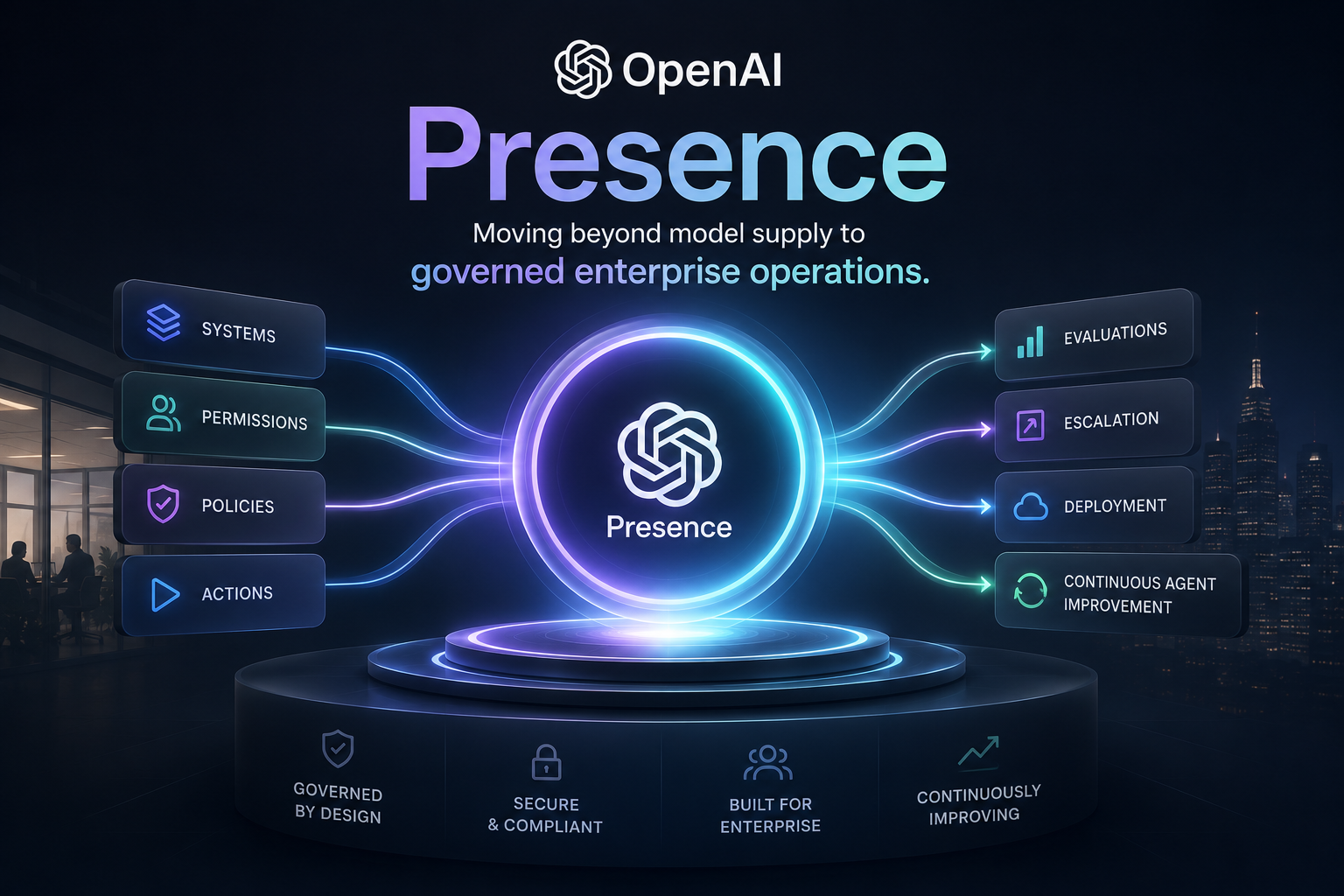
OpenAI has introduced Presence, a managed enterprise product for deploying AI agents across customer and internal workflows. The product combines models with company systems, scoped permissions, organizational policies, approved actions, simulations, evaluations, guardrails, monitoring, escalation paths, and a continuous improvement loop. Deployments are led by OpenAI Forward Deployed Engineers and selected systems integrators rather than offered as a purely self-service software layer.
This is not simply another enterprise agent launch.
It is a structural move by the model provider into the operating layer of the institution.
The Core Thesis
Frontier model companies began as suppliers of intelligence. They are now moving closer to the workflows where institutional work is defined, governed, evaluated, and improved.
Presence does not only provide a model that can answer questions. It helps determine:
- which systems the agent may access
- which actions it may take
- which policies and procedures it must follow
- when it must escalate to human judgment
- how production behavior is measured
- how the agent changes after deployment
The model lab is therefore internalizing functions previously expected to remain with enterprise software vendors, implementation partners, and consulting firms.
Four Forces Interpretation
Interface — From Conversation to Operations
Presence turns voice and chat from communication surfaces into operational entry points. The interface no longer merely explains work. It initiates, coordinates, and completes approved work across institutional systems.
This is Interface power in its mature form: control over where intent enters, how it is interpreted, and which actions follow.
Alignment — The Deployment Control Plane
Presence makes Alignment operational. Policies, permissions, guardrails, simulations, evaluations, escalation thresholds, data controls, and approved actions become part of the deployed product.
Alignment is therefore no longer only a research discipline, refusal layer, or external compliance obligation. It is the control plane governing what an agent may know, do, disclose, approve, and escalate.
Compute — Intelligence Becomes Embedded Capacity
The Compute force remains underneath the product, but its strategic value is converted through deployment depth. Raw model capability matters less if it cannot be reliably connected to real systems and sustained inside high-volume workflows.
Presence demonstrates that compute monetization increasingly depends on turning inference into governed, repeatable execution.
Energy — The Hidden Scaling Input
Production agents create persistent inference demand rather than episodic experimentation. As more institutional workflows move into always-available agents, the Energy force becomes embedded in the operating cost and scalability of digital labor.
The Agent Layer Framework
Presence is a live example of one model company integrating several layers of the Agent Layer stack:
- Interface: voice and chat channels
- Identity: account context, permissions, and scoped access
- Orchestration: tools, APIs, workflows, and approved actions
- Commerce and Operations: resolution of real institutional tasks
- Trust: evaluations, policies, monitoring, escalation, and controlled rollout
The important point is not that OpenAI owns every layer. It is that the model provider is moving upward from intelligence substrate into the managed operating relationship.
Cognitive Loop Control
Presence also operationalizes Cognitive Loop Control. Production signals are investigated, proposed changes are tested against the live version, and approved improvements are rolled out under organizational control.
The deployment therefore becomes a feedback system:
work → observation → evaluation → proposed improvement → controlled release → improved work
This is more than model updating. It is institutional cognition being refined through an owned operational loop.
The Partner–Parasite Cycle
The strongest institutional implication concerns consulting and systems integration.
Presence still includes selected global systems integrators, but OpenAI Forward Deployed Engineers lead the central deployment relationship. OpenAI supplies the model, deployment architecture, evaluation system, improvement loop, and direct operational expertise.
This is the next stage of the Partner–Parasite Cycle:
the model provider begins absorbing the implementation layer that its partners once used to justify their position.
Consultants may remain valuable for change management, domain expertise, and organizational legitimacy. But their role becomes increasingly peripheral when the model lab owns the systems through which agent behavior is designed, measured, and improved.
Digital Labor Economics
Presence is sold around resolved work rather than access to software alone. Its value is measured through completed actions, reduced handoffs, operational quality, and sustained improvement.
This shifts enterprise AI economics from:
licenses and seats → governed cognition and resolved outcomes
The economic unit of the agent era is not merely the user. It is the task completed under acceptable risk.
Strategic Implications
- Model providers will compete on deployment systems, not capability alone.
- Alignment controls will become product infrastructure and a source of enterprise differentiation.
- Forward-deployed engineering will become a major route into high-value institutional workflows.
- Systems integrators may retain distribution while losing control of the learning and improvement loop.
- Enterprise software vendors face pressure as agents begin operating across systems rather than inside a single application.
- The strongest agent platforms will accumulate generalized learning from repeated deployments without surrendering customer control over each production environment.
The Signal
The frontier model lab is becoming something larger than a software provider.
It is becoming an enterprise operating layer: the place where intelligence, workflow, policy, permissions, evaluation, and improvement converge.
The next contest is not only who builds the smartest model.
It is who earns the right to operate institutional work.
Related Reading
- The Agent Layer Framework
- The Partner–Parasite Cycle
- Agent Experience Integrity
- Tokenized Cognition Model
- Cognitive Loop Control
September 2026 — From Session to Standing Mandate
OpenAI’s Dots release materially extends the operating-layer thesis. Dots have their own cloud computers, can work toward goals continuously, connect across thousands of apps, carry context across ChatGPT, Slack, and Teams, and continue work without requiring the user to direct every intermediate step.
The interface therefore moves through another transition:
request → delegation → persistent responsibility
Delegation Persistence Ladder v1.0
- Prompt: one request, one response.
- Task: a bounded objective completed across multiple actions.
- Workflow: a repeatable sequence spanning tools or systems.
- Background Responsibility: the agent continues monitoring or progressing work while the user is absent.
- Standing Mandate: a durable authorization to pursue a defined objective across time and connected systems under explicit permission, review, and escalation rules.
Standing Mandate — Signal-level definition: a persistent authorization for an AI agent to pursue an objective across time and connected systems without requiring the user to reissue intent for every work cycle.
Qualification rule: a system reaches Standing Mandate only when it combines persistent goals, independent continuation, connected-system access, explicit action boundaries, and a review or approval mechanism for consequential actions.
Dots now satisfy much of this structure. OpenAI still restricts proactive background research to read-only tools, lets users define Custom Rules for allow/approve/block behavior, and reserves certain sensitive actions for the user. That limitation is important: persistence is expanding, but governance expands with it.
This does not yet require rewriting the Agent Layer Framework. One ecosystem demonstrates the pattern. Promotion should wait until persistent responsibility becomes a common primitive across multiple independent agent platforms.
Delegation Persistence Ladder v1.0 — October 5, 2026.