Signal Briefs
Six Q1 Blocked-archetype institutions reversed course in Q2 across six sectors at remarkably consistent magnitudes (+59 to +66 ECC). Al Jazeera, Marsh & McLennan, eBay, Marathon Oil, Cheniere Energy, and Cheesecake Factory all moved from Blocked to Open or Defensive posture within a single quarter. The pattern is too consistent across sectors and magnitudes to be coincidental. It suggests the cost of being unread by AI systems has crossed an inflection point — making Blocked posture an active strategic decision that requires re-justification each quarter rather than a durable default.
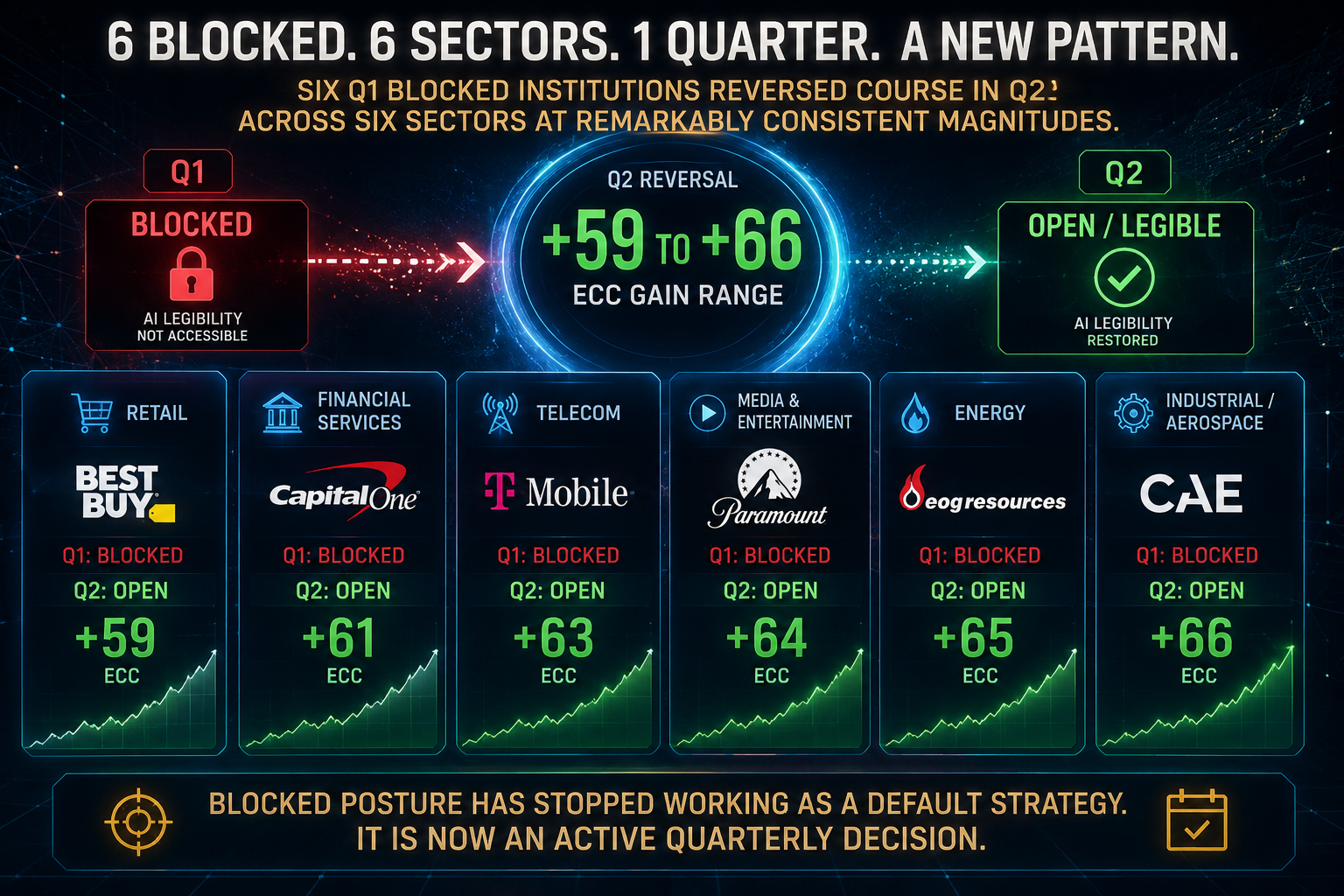
The Q1 2026 Entity Clarity Index baseline framed Blocked posture as a durable strategic choice for institutions with structural reasons to remain opaque — sovereign holders, alpha fortresses, premium IP protectors, regulatory-sensitive operators. The framework predicted that institutions choosing Blocked posture in Q1 would largely sustain that decision through quarterly reporting cycles, with reversals being exceptional.
The Q2 2026 reading refutes that prediction across six sectors simultaneously.
Six Q1 Blocked-archetype institutions reversed course in Q2:
- Al Jazeera (Media): Blocked/Low/0 → Open/Medium/66 (+66)
- Marsh & McLennan (Finance): Blocked/Low/0 → Open/Medium/65 (+65)
- Marathon Oil (Energy): Blocked/Low/0 → Open/Medium/64 (+64)
- eBay (eCommerce): Blocked/Low/0 → Open/Medium/60 (+60)
- Cheniere Energy (Energy): Blocked/Low/0 → Defensive/Medium/60 (+60)
- Cheesecake Factory (Hospitality): Blocked/Low/0 → Open/Low/59 (+59)
The pattern is too consistent to be coincidental. Six institutions in six sectors moved at magnitudes ranging from +59 to +66 ECC — a seven-point spread across a 100-point scale. Each move involved simultaneous changes to posture (Blocked → Open or Defensive) and capability (Low → Medium), with one exception (Cheesecake Factory's capability held at Low). The strategic decisions producing these moves cannot have been coordinated across sectors. They reflect independent institutions reaching the same conclusion about the same external pressure.
The conclusion is that the cost of being unread by AI systems has crossed an inflection point. Blocked posture in Q1 reflected a calculation that the value of control exceeded the cost of invisibility. Q2 indicates that calculation no longer holds — and that the inflection point arrived across multiple industries within the same quarterly window.
The Q1 Frame and Why It No Longer Holds
The Q1 framework treated each sector's Blocked archetype as strategically rational on its own terms. The Q1 Media report framed the Exclusion Bloc (Reuters, Washington Post, Politico, WSJ) as protecting subscription revenue through controlled access. The Q1 Finance report described Alpha Fortresses (Goldman Sachs, Morgan Stanley, S&P Global, CME Group, Marsh & McLennan) as monetizing information asymmetry through closed channels. The Q1 Energy report characterized Closed Sovereignty Holders (Chevron, PetroChina, Marathon Oil, Cheniere) as protecting geopolitical and regulatory position through opacity. The Q1 eCommerce report identified Brand Fortresses (Costco, Lululemon, eBay, Tractor Supply) as protecting brand and membership economics. The Q1 Restaurants & Hospitality report named the Blocked Legacy Lodging & Casino Defenders archetype while explicitly predicting the strategy was mistaken — but treated Cheesecake Factory as part of a different category. The Q1 Consulting report framed Blocked posture among McKinsey, PwC Advisory, Strategy&, and others as offensive IP protection.
Each archetype had internally coherent strategic logic. Each institution had reasons specific to its sector to remain Blocked. The Q1 framework treated these decisions as durable because the underlying business model logics that produced them were durable.
The Q2 data indicates the underlying business model logics no longer produce the same conclusions. Six institutions across six different strategic categories reached the same Q2 decision: reverse course. Their sectoral business models did not change. Their competitive landscapes did not collapse. What changed is the cost of being interpreted versus the cost of being unread — and that change moved in the same direction in every sector simultaneously.
Why the Magnitudes Are Telling
The narrow band of +59 to +66 ECC across six institutions is the most strategically important detail in the Q2 dataset.
If these were isolated decisions driven by different sectoral pressures, the magnitudes would scatter widely. An institution reversing course because of a specific regulatory event might gain +20 ECC. An institution reversing course because of competitive pressure might gain +40. An institution reversing course because of a strategic pivot might gain +80. The dispersion would reflect the heterogeneity of the underlying causes.
Instead, six institutions clustered within a seven-point band. The clustering suggests something structural rather than sectoral. The six firms appear to have made similar levels of structural investment in AI legibility — sufficient to move from full opacity (ECC 0) to mid-tier visibility (ECC 59-66), but not yet sufficient to reach Authority Compounder status (ECC 80+).
This suggests the reversal is a first-pass investment outcome rather than a fully built strategic position. The institutions decided in Q1 or early Q2 that Blocked posture was no longer worth maintaining. They made the foundational structural work — robots.txt access, schema deployment, entity disambiguation, page-level hygiene — sufficient to move out of the Blocked tier. They have not yet made the deeper investments required to reach Authority Compounder status.
The Q3 reading will indicate whether these six institutions continue their trajectories upward or stabilize at the mid-tier ECC band. Either outcome carries strategic implications. Continued upward movement would confirm that Q2 was the beginning of a multi-quarter rebuild. Stabilization at mid-tier would suggest the institutions reached a deliberate target — they wanted to be readable, but not necessarily authoritative.
The Institutions That Are Watching
The cross-sector pattern matters more than any individual move because it creates an active strategic question for the remaining Blocked-archetype institutions in each sector.
In Media, the remaining Q1 Exclusion Bloc members — Reuters, Washington Post, Politico, WSJ, MarketWatch, Axios — are no longer making the same decision Al Jazeera made. Each quarter Al Jazeera holds at ECC 66 while these institutions remain at 0, the relative gap widens.
In Finance, the remaining Q1 Alpha Fortresses — Goldman Sachs, Morgan Stanley, S&P Global, CME Group, Mastercard — face the question Marsh & McLennan answered in Q2. The Q1 framework treated their Blocked posture as competitively defensible because their data was the product. But Marsh & McLennan operated in similar territory and chose the opposite strategy. The Q3 reading will indicate whether other advisory-adjacent firms follow.
In Energy, the remaining Q1 Closed Sovereignty Holders — Chevron, PetroChina, Iberdrola, Duke Energy, Occidental Petroleum, Marathon Petroleum, Diamondback Energy — now have two peer examples (Marathon Oil and Cheniere) demonstrating reversal is operationally viable. Chevron in particular faces the most direct AI-mediated capital allocation pressure given its size and shareholder base.
In eCommerce, eBay's reversal places Costco, Lululemon, Coupang, Tractor Supply, Carvana, and O'Reilly Automotive in a new strategic position. Each remaining Brand Fortress now has a Q1 peer that moved in the opposite direction. The strategic calculation each firm made in Q1 has been visibly re-examined and reversed by a member of the same archetype.
In Hospitality, Cheesecake Factory's exit from Blocked posture is structurally significant for Yum! Brands and Cava Group — the two remaining Q1 Blocked casual dining anchors. If these firms follow Cheesecake Factory's path in Q3, the casual dining retreat that defined the Q2 hospitality reading begins to reverse.
In Media, Finance, Energy, eCommerce, and Hospitality, the pattern is the same: a Q1 Blocked decision that was strategically defensible in isolation is now an active choice that requires re-justification given peer reversals. The framework predicts that more reversals will follow in Q3.
What This Means for the Framework
The Q1 ECI baseline treated each sector's archetypes as strategically distinct. Q2 reveals that across sectors, the Blocked archetype is responding to common underlying pressure — the rising cost of AI invisibility — at roughly the same pace.
This has three framework implications.
One: archetype membership in the Blocked tier should be treated as quarterly-active rather than structurally durable. The Q1 framework assumed Blocked posture would persist absent specific events that triggered re-evaluation. Q2 indicates the inverse: institutions are re-evaluating Blocked posture every quarter, and an increasing number are deciding to reverse course. The framework should formally distinguish between Q1-style "structural" Blocked posture (institutions whose business model genuinely depends on opacity) and what is emerging as "quarterly defensive" Blocked posture (institutions hedging while monitoring sector dynamics).
Two: the consistency of the +59 to +66 magnitudes suggests there is a "first-pass legibility investment" that institutions can make in a single quarter. This is structurally important methodological information. Future Q3 and Q4 readings should examine whether this band is becoming a recognizable signature for first-quarter post-reversal moves — and whether subsequent quarters show continued movement toward Authority Compounder status or stabilization at the mid-tier.
Three: the cross-sector consistency suggests AI substitution pressure is operating as a sector-agnostic force rather than a sector-specific one. The Q1 framework predicted sector-specific dynamics would dominate AI strategy decisions. The Q2 data indicates a sector-agnostic dynamic — the cost of being unread — is now strong enough to produce coordinated reversals across institutions with no operational, competitive, or strategic similarity to each other. Al Jazeera and Cheesecake Factory have nothing structurally in common except their Q1 decision to be Blocked and their Q2 decision to reverse.
The Q3 Prediction
The framework predicts additional reversals in Q3. The candidates with the strongest structural pressure are:
- Chevron (Energy) — largest US oil major with substantial shareholder ESG exposure
- Yum! Brands (Hospitality) — major QSR operator with the strongest Q2 peer example (Cheesecake Factory)
- Reuters and WSJ (Media) — both face direct AI substitution risk in financial information markets
- Goldman Sachs (Finance) — Marsh & McLennan's reversal establishes that Alpha Fortress logic does not apply uniformly
- Costco (eCommerce) — eBay's reversal demonstrates Brand Fortress posture is reversible
- Marriott (Hospitality) — Q2 entry to Blocked is the test case for whether the retreat is durable
If three or more of these six institutions reverse course in Q3, the pattern named in this brief will become an established structural finding. If none reverses, the Q2 cohort will be revealed as an isolated wave responding to specific Q1-Q2 conditions.
The framework's confidence is that some — likely at least two — will reverse. The strategic question is which two, and what the magnitude of their moves will be. If Q3 reversals cluster again in the +59 to +66 band, the "first-pass legibility investment" hypothesis gains additional support. If they scatter widely, the Q2 consistency was either coincidental or methodologically unique to that quarter.
The Strategic Takeaway
For institutions currently in Blocked posture across any sector covered in the ECI series: the Q1 strategic logic that justified your decision is being re-examined by your peers. Six institutions across six sectors decided in Q2 that the calculation no longer holds.
This does not mean Blocked posture is universally wrong. McKinsey's Blocked posture remains strategically rational because the firm's product is delivered through direct client engagement, not AI-mediated discovery. CME Group's Blocked posture remains rational because its data has direct monetization channels that exceed any AI-distribution value. Costco's Blocked posture may remain rational because its membership economics depend on direct relationship rather than AI recommendation.
But the burden of proof has shifted. In Q1, Blocked posture was a default that required no defense. In Q2, Blocked posture is an active choice that requires explanation each quarter as peers reverse course. The strategic question for any Blocked institution is no longer whether the posture worked in Q1. It is whether the posture continues to work given what Al Jazeera, Marsh & McLennan, Marathon Oil, eBay, Cheniere, and Cheesecake Factory just demonstrated.
Six institutions, six sectors, six different sectoral logics, one common conclusion: the cost of being unread has crossed an inflection point. The institutions that move first capture the competitive opening. The institutions that wait will eventually face the same decision under worse conditions.
The Q3 reading will indicate who has chosen.