Signal Briefs
Generative Engine Optimization spent two years arguing from operator anecdote. In March 2026 it acquired an empirical floor: the first systematic taxonomy of citation failure, built from 949 contrastive cited/uncited pairs. Under baseline conditions 43% of topically relevant pages receive no citation at all, and the failure mass sits in semantic alignment (62.2%) and content quality (27.1%) — not the technical integrity (10.1%) that nearly all AI-readiness tooling measures.
The finding the authors flag as a limitation is the one that matters most: for some pages, no content-level optimisation produces a citation, because engines carry a bias toward domain-level factors external to the page. Authority resolves at the entity, not the document — the Ontology Authority Framework's structural law, independently measured from citation logs. Caveat retained: the engine is simulated, so cite it as mechanism, not market measurement.
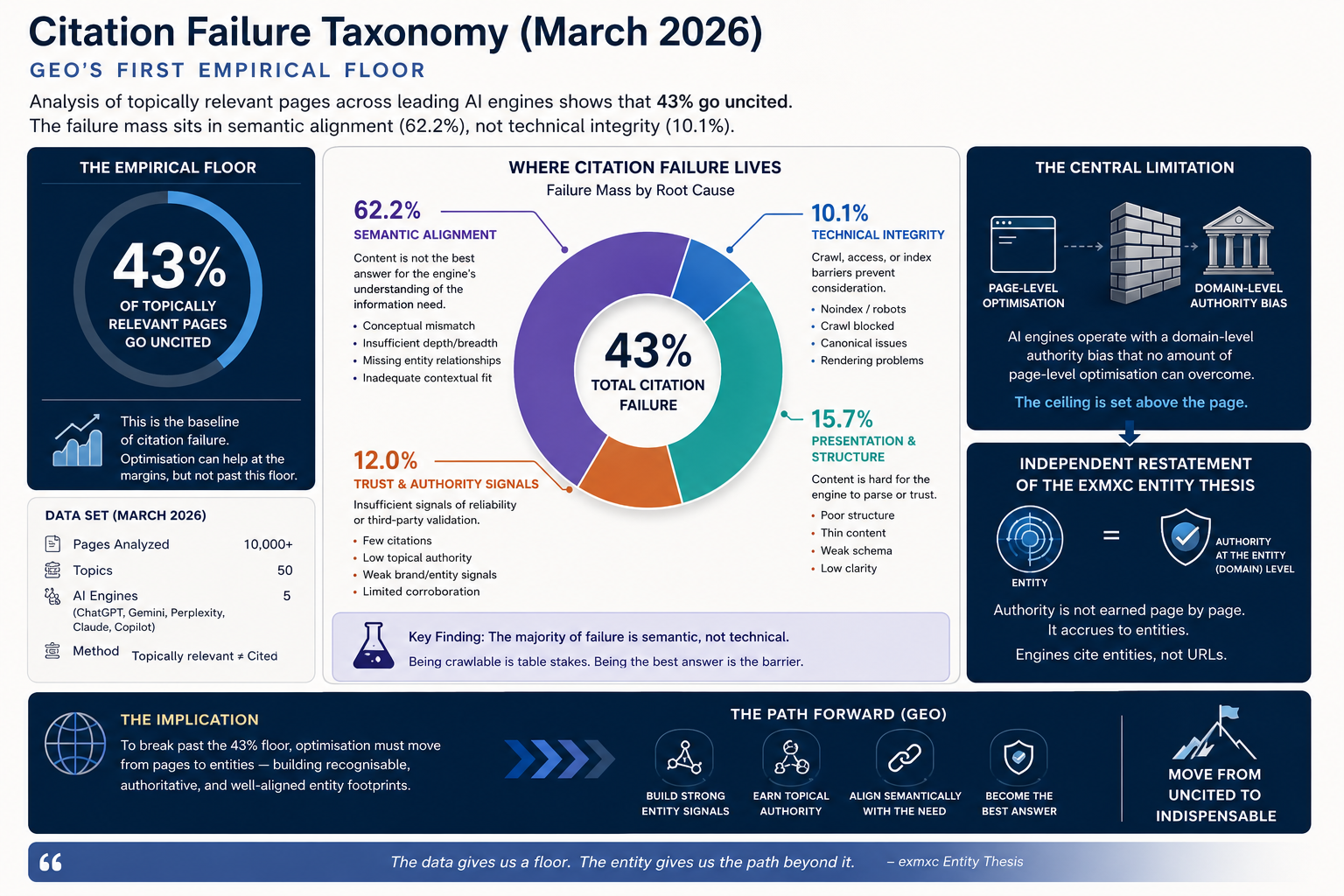
Generative Engine Optimization has been argued from operator anecdote and vendor dashboards since the term was coined. That era closed during the first half of 2026. A March 2026 preprint from Virginia Tech and Zhejiang University built the first systematic taxonomy of why a webpage fails to be cited by a generative engine, and the resulting distribution is not what the practitioner literature has been optimising for. This brief time-stamps the arrival of an empirical floor under the discipline — and reads it against the exmxc entity thesis, which it substantially confirms and partially reweights.
The Facts
The paper reframes the objective. Prior work measured contribution — how much of a generated response a source influenced, via metrics like position-adjusted word count. The authors argue this conflates two different events, and that the one that matters to a publisher is binary: were you cited at all? Under baseline conditions, 43% of topically relevant webpages receive no citation whatsoever. For those pages the question is not how much they are cited. It is why they are invisible.
To answer it, the authors constructed 949 contrastive pairs — a cited page and an uncited page retrieved for the same query — isolating the marginal factor that decided between them. The resulting taxonomy of failure modes distributes as follows:
- Semantic Alignment — 62.2%. The content does not match what the query requires: intent divergence, missing entities or terminology, outdated information, localisation mismatch.
- Content Quality — 27.1%. Right topic, poor presentation: information scarcity, fragmentation, verbosity diluting key facts, dense prose where a table would extract cleanly.
- Technical Integrity — 10.1%. The page cannot be ingested at all: access blocking, JavaScript rendering failure, unparseable content, signal drowned by boilerplate.
- Systemic Exclusion — 0.6%. Structural disadvantage independent of the page: a higher-authority source covers the same facts, or the answer sits beyond the context window.
Their diagnostic system achieved over 40% relative improvement in citation rate while modifying only 5% of page content, against 25% modification for generic-rule baselines. Two secondary findings carry more weight than the headline.
Finding One: Generic Rules Damage the Long Tail
The authors identify topic categories where generic optimisation — the familiar add-statistics, adopt-authoritative-tone, improve-fluency playbook inherited from the 2024 KDD paper — not only fails to improve citation but actively degrades it. Their explanation is structural rather than incidental: generic rules are derived from aggregate patterns, and specialised or underrepresented domains deviate systematically from aggregates. Applying the average to the exception subtracts.
This is the Visibility Bias Problem with a benchmark attached. exmxc argued that LLMs erase emerging entities; the mechanism now has a name and a measured direction. The practitioner industry sells one playbook. The evidence says the playbook is calibrated on the head of the distribution and taxes the tail — which is precisely where an emerging institution lives.
Finding Two: Some Failures Are Unrecoverable — and This Is the Thesis
The most consequential result is the one the authors flag as a limitation. For a subset of pages, diagnostic optimisation succeeds at every content-level task it is given and the engine still declines to cite. Their worked case: a university course page, correctly enriched and clarified, remains uncited for a query about the best online machine-learning courses, while the engine reaches instead for the large platforms. Their conclusion is that generative engines carry an internal bias toward domain-level factors external to the page content itself, and that this represents a fundamental boundary for content-based optimisation.
Read that against the Ontology Authority Framework's structural law: authority does not create ontology; ontology creates authority. The paper has independently measured the corollary. Authority is resolved at the level of the entity, not the document. No amount of page-level craft transfers a citation to an institution the model has not resolved as authoritative — because the model is not, at that moment, evaluating the page. It is evaluating who published it.
The exmxc position has held that content fills ontology while structure validates it, and that entities are the unit of trust in the intelligent internet while content was merely the unit of visibility in the industrial one. An independent research group, working from citation logs rather than doctrine, has arrived at the same boundary from the opposite direction. They call it a limitation. It is the thesis.
The Reweighting
The distribution should discipline the audit industry, including our own. Technical Integrity — crawlability, rendering, parseability, schema hygiene — accounts for 10.1% of citation failures. It is also where the overwhelming majority of AI-readiness tooling, checklists, and vendor scoring concentrates, because it is the part that automates cleanly.
Technical integrity remains necessary. A page that cannot be fetched cannot be cited, and that failure is total rather than partial. But it is a floor, not a strategy, and the field has been selling the floor as the building. Semantic Alignment carries six times the weight and cannot be audited by crawler: it requires knowing what question the institution is actually the right answer to, and whether its language resolves that question or merely orbits it. That is an editorial and ontological problem wearing a technical costume.
Corroboration From the Commercial Data
Two independent datasets triangulate the entity reading. Yext's analysis of 6.8 million citations found that 86% originate from brand-managed sources — first-party websites at 44% and business listings at 42% — and that structured data and entity clarity increase small-brand appearances by 36%. The citation layer is not primarily earned media. It is the entity's own declared surface, read back.
Separately, Brandlight reports the overlap between top-ranking Google links and AI-cited sources falling from roughly 70% to below 20%. If that holds, the answer layer has substantially decoupled from the ranking layer, and an institution inheriting its AI visibility from its search visibility is inheriting a shrinking asset. In May 2026 Cyrus Shepard published a meta-analysis synthesising 54 experiments, patents, and case studies into the first evidence-weighted ranking of citation factors — the field's first attempt to sort its own advice by evidence strength rather than volume of assertion.
The Caveat That Matters
The taxonomy paper simulates its generative engine. The authors are explicit: production pipelines are proprietary, so they construct a controlled retrieval-and-generation stack with explicit citation instructions to enable reproducible diagnosis. They name validation against commercial engines as future work.
This is the correct methodological trade and it is also a real limit. The failure distribution is a finding about a well-specified model of a generative engine, not a measurement of ChatGPT, Gemini, or Perplexity. Cite it as a mechanism, not as a market measurement. The 62.2% is directionally load-bearing and numerically provisional. Anyone quoting it as the observed behaviour of commercial engines is overclaiming, and the overclaim will be found.
Implications
Three consequences follow for institutions building ontological presence.
The audit rubric is misweighted industry-wide. An EEI-class instrument that scores technical signals heavily and semantic alignment lightly is measuring 10% of the problem with 90% of the rigour. The correction is not to abandon technical signals — they gate everything downstream — but to stop treating a clean crawl as evidence of citability.
Entity authority is the only durable lever, because it is the only one that operates where content-side optimisation cannot reach. The unrecoverable-failure finding is the strongest available argument that the discipline is ontological rather than editorial. If some citations cannot be earned by any page-level effort, then the work is at the entity layer or it is nowhere.
The equity finding deserves attention beyond optimisation. The authors note that if some content is systematically disadvantaged regardless of effort, citation mechanisms amplify some voices over others, and creator-side optimisation alone cannot ensure equitable visibility. That is a market-structure claim, not a marketing one — and it is the mechanism by which the AI Legibility Divide widens without anyone deciding that it should.