Entity Clarity Report — Finance: January to July 2026 Update
Summary
Across the same 50 institutions, Finance's mean ECC moved only from 48.26 to 48.06 between January 20 and July 30, 2026. The flat average concealed a rotation in public machine legibility: Goldman Sachs entered the observable layer with High capability; Blackstone moved into Blocked posture; ICICI Bank upgraded to High capability; Citigroup moved from High to Low while remaining Defensive; and Nu Holdings tightened from Open to Defensive.
These are structural observations about public machine legibility — not rankings of franchise quality, operating performance, or investment merit.
Methodology
This longitudinal update compares the same 50 institutions in the established Finance baseline on January 20 and July 30, 2026. The panel contains 44 institutions classified as Financial in the master dataset and six historically retained payments, insurance-brokerage, and financial-infrastructure institutions, preserving the original panel for like-for-like analysis.
Posture records whether an institution is Open, Defensive, or Blocked to machine interpretation. Capability records the strength of its legibility infrastructure as Low, Medium, or High. ECC is the combined Entity Clarity score under methodology eci-ecc-v1. A Blocked posture produces an ECC of 0 by definition; this is an access-state decision, not evidence of weak franchise quality.
The source contains January and July observations. This release therefore reports January-to-July movement and makes no May-to-July inference. The downloadable PDF is the authoritative publication and contains the complete Finance 50 Index with posture, capability, ECC, change, and movement classification.
Findings
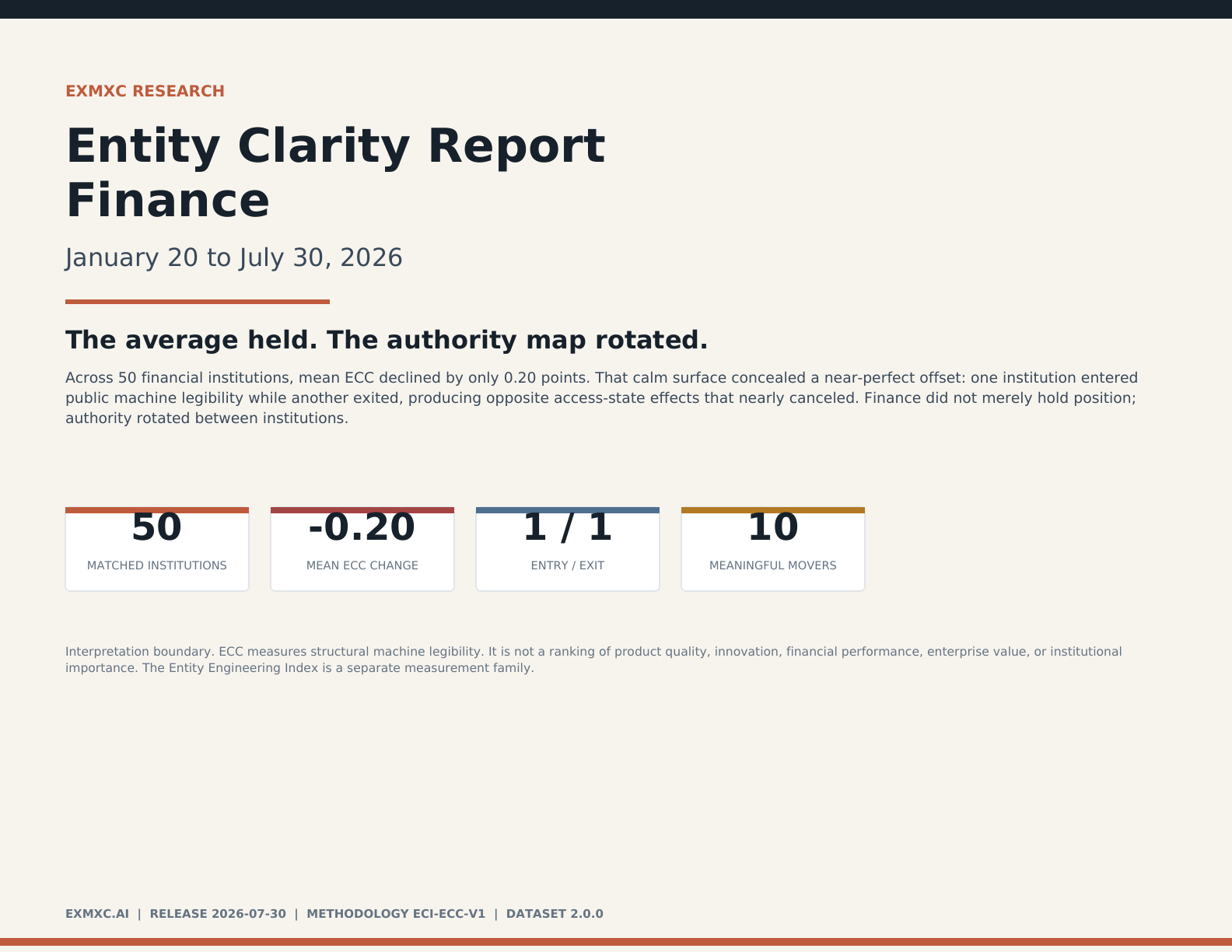
The average held. The authority map rotated.
- 10 meaningful movers: the period produced five score movers, three structural movers, one legibility entry, and one legibility exit.
- Opposing access decisions dominated: one major institution entered the public machine-readable layer while another withdrew, producing effects that nearly canceled.
- The continuously legible cohort was essentially flat: broad sector improvement did not drive the headline result.
- Stable endpoint counts concealed membership changes: Blocked and High capability finished unchanged even though different institutions occupied those states in July.
Landscape
The aggregate barely moved: mean ECC declined by 0.20 points, from 48.26 to 48.06, and the median moved from 59 to 58.5. That stability was an offset rather than an absence of institutional movement.
Open posture declined from 35 to 34 institutions, Defensive increased from six to seven, and Blocked remained nine. High capability remained five, Medium declined from 20 to 19, and Low increased from 25 to 26. Those endpoint counts conceal changes in which institutions occupied the states.
Across the matched panel, seven institutions improved, six declined, and 37 were unchanged. One institution entered public machine legibility, one exited, and 40 remained continuously legible.
Archetypes
The longitudinal evidence is best read through five strategic patterns rather than a static ranking.
Public market shapers
Institutions that pair Open posture with durable capability can influence how markets, risk, and capital allocation are interpreted across machine-mediated research.
Controlled stewards
Defensive institutions preserve a trusted public presence while constraining access. Capability still requires maintenance; control does not prevent structural regression.
Information fortresses
Blocked posture can protect proprietary data, research, or transaction leverage. The entry-exit rotation shows that fortress logic is strategic but not permanent.
Capability builders
Institutions that upgrade within continued legibility can strengthen machine-readable authority without changing access posture.
Legacy and utility institutions
Open access without strong structural differentiation can leave economically important institutions dependent on third-party interpretation.
Index
The complete 50-institution longitudinal Index appears in the downloadable PDF. Each institution row includes January and July posture, capability, ECC, ECC change, and movement classification. The PDF is authoritative for entity-level values.
Open the canonical machine-readable release for governed dataset version 2.0.0.
Strategic Implications
Capital allocation and M&A
Finance diligence should treat entity clarity as an operating and governance layer. It affects research friction, narrative control, integration cost, counterparty interpretation, and the durability of public authority.
- Underwrite access governance. Identify who controls machine access, what triggers a posture change, and whether policy can move after a transaction.
- Separate public authority from franchise value. A Blocked institution may retain strong economics and proprietary data; ECC measures public legibility, not enterprise quality.
- Value capability as infrastructure. Structured identity, reliable source surfaces, and consistent metadata can reduce diligence friction and post-close integration cost.
- Price narrative-control risk. An acquirer may inherit dependence on third-party interpretation when the target is structurally weak or deliberately opaque.
- Design the post-close posture. Decide which brands, research surfaces, and institutional identities should remain Open, Defensive, or Blocked.
- Protect continuity. Assign access-policy ownership and measurement cadence before high-capability public surfaces are altered during integration.
Full Report
Executive finding
The January-to-July Finance reading does not support the prior conclusion that the sector simply held position. Mean ECC was nearly flat, but the stability came from opposing institutional decisions rather than sector-wide stillness.
What changed
Goldman Sachs entered public machine legibility with High capability, while Blackstone withdrew into Blocked posture. ICICI Bank upgraded to High capability, Citigroup regressed from High to Low while remaining Defensive, and Nu Holdings tightened from Open to Defensive. Several continuously Open institutions also recorded material movement without changing capability tier.
How to use this report
Executives, investors, and acquirers should separate franchise strength from public machine legibility. Posture determines whether an institution exposes its legibility; capability determines how reliably machines can interpret it. A flat sector average can therefore conceal a material transfer of public authority.
Publication note
This is the governed January-to-July Finance release in the Entity Clarity Index. The prior Finance update remains part of the publication history and is superseded by this longitudinal record.
Explore the Entity Clarity Index hub · Read the prior Finance update