Signal Briefs
AI’s Energy constraint has advanced from time-to-power into firm-power sovereignty. Federal land, dedicated generation, grid interconnection, and state authorization determine whether compute can connect; PJM’s 2026 actions show that connection alone does not guarantee uninterrupted service. The more sovereign position is firm, non-interruptible capacity—or sufficient self-generation and flexibility to avoid becoming a discretionary grid load.
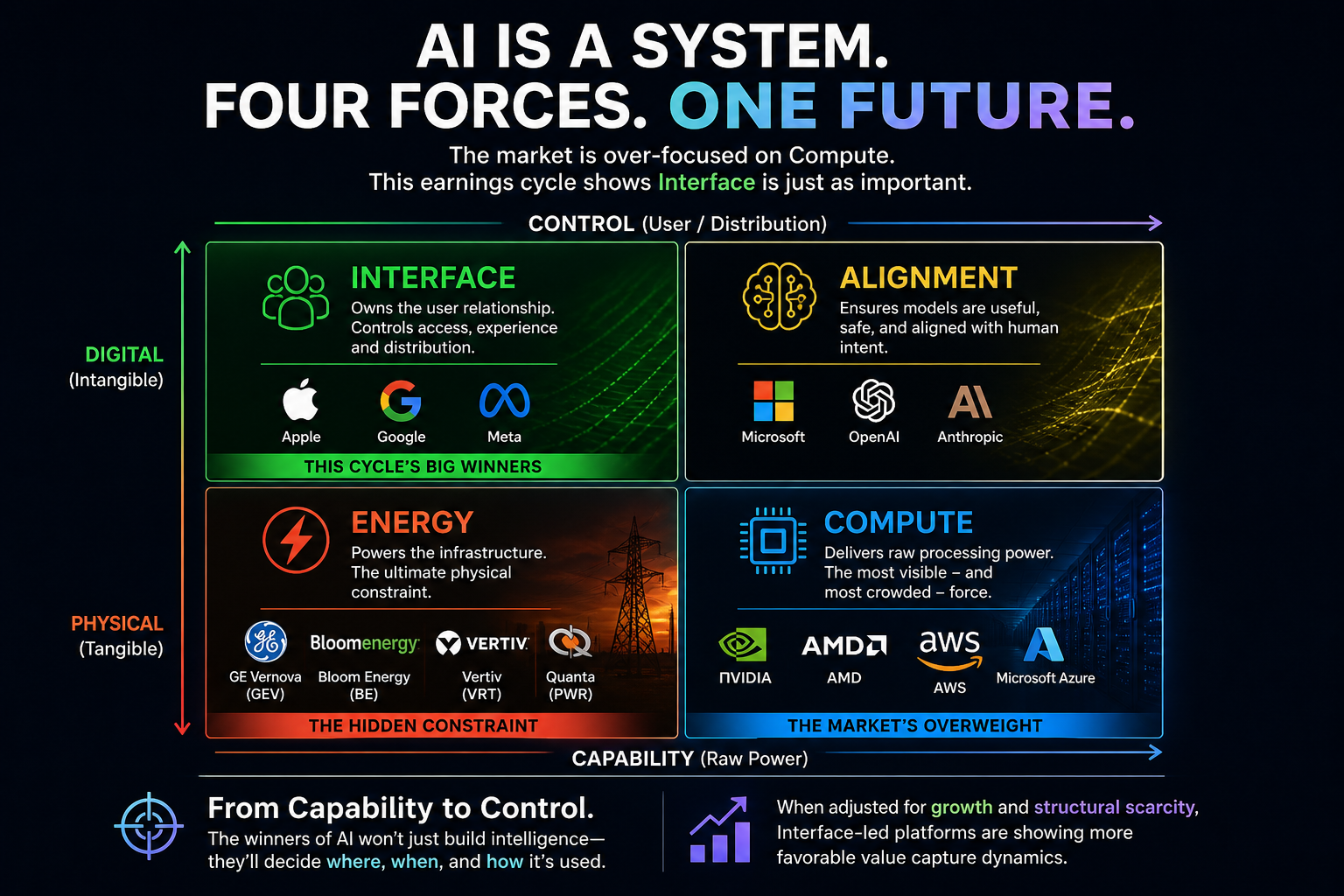
The Signal
AI is no longer only a software, model, or semiconductor race. It is becoming an industrial-scale infrastructure project, and every infrastructure project eventually meets the same constraint: power.
The first evidence appeared in synchronized earnings from generation, grid, cooling, and utility companies. GE Vernova, Bloom Energy, Vertiv, Quanta Services, and Dominion Energy showed that AI demand was moving beyond chips into turbines, fuel cells, substations, transmission, cooling, and contracted megawatts.
July and August 2026 reveal the next stage. Energy is no longer merely an operating input purchased by data centers. It is becoming a sovereign capacity assembled through land, generation, interconnection rights, permitting, state support, and priority of service.
Energy Is the Hard Ceiling Behind Compute
Compute can be financed. Accelerators can be ordered. Data centers can be designed.
Electricity cannot be created on demand without generation, transmission, equipment, land, permits, and time.
Within the Four Forces of AI Power, Energy is the least abstract force. It lives in turbines, substations, transformers, switchgear, cooling systems, fuel supply, grid connections, and available megawatts. When any of those inputs are delayed, deployable compute is delayed with them.
The Industrial Confirmation
The 2026 earnings cycle showed the Energy force spreading through several physical layers at once:
- Generation: gas turbines, nuclear agreements, geothermal, and on-site fuel cells
- Delivery: transmission, substations, interconnection, and electrical equipment
- Conditioning: power management, backup systems, and thermal infrastructure
- Utility capacity: contracted load and regional grid planning
The strategic advantage is increasingly measured by time-to-power: how quickly an institution can convert a planned data center into energized, usable compute.
From Time-to-Power to Sovereign Power
On July 20, 2026, the U.S. Department of Energy’s National Nuclear Security Administration selected Amentum to enter negotiations for a phased lease at the Savannah River Site. The proposed public-private project would pair a one-gigawatt AI data center with dedicated on-site energy generation on federal land.
This is materially different from an ordinary corporate power purchase agreement.
It combines:
- federal land
- dedicated generation
- large-scale compute
- public authorization
- national-security framing
The state is no longer merely regulating the AI infrastructure buildout. It is beginning to supply the physical conditions under which that buildout can occur.
That is Energy Sovereignty in operational form.
Interconnection Becomes a Competitive Variable
In June 2026, the Federal Energy Regulatory Commission opened proceedings addressing how regional grid operators connect and charge data centers and other large loads.
The action recognizes that grid access is no longer an administrative footnote. Interconnection timing can determine which AI campuses are built, where they are located, and which institutions convert capital commitments into operating capacity first.
The scarce asset is therefore not only electricity generation. It is the enforceable right to receive power on an acceptable timeline.
From Grid Access to Firm-Power Sovereignty
PJM’s 2026 operating and policy actions add a critical refinement: an interconnection is not the same thing as guaranteed service.
PJM is developing a connect-and-manage structure for new large loads that do not bring qualifying new generation or another approved supply arrangement. Under the proposed direction, those loads can connect earlier but may be curtailed during capacity shortages before pre-emergency demand response is deployed.
The distinction became operational during extreme heat in July 2026. PJM obtained emergency federal authority that, as a last resort before voltage reduction or broader load shedding, allowed transmission owners to curtail data centers and other large loads equipped with backup generation.
This changes the sovereignty hierarchy:
- Nominal capacity: a planned or contracted megawatt
- Connected capacity: a load physically authorized to draw from the grid
- Firm capacity: power expected to remain available through stressed conditions
- Sovereign capacity: firm capacity reinforced by self-generation, storage, fuel security, contractual rights, and operational flexibility
The strategic asset is no longer simply the right to connect. It is the right and physical ability to remain energized when the system is constrained.
Four Forces Interpretation
Energy — Primary Force Activated
Energy governs the physical ceiling of AI deployment. Generation ownership, contracted capacity, grid access, cooling resources, permitting speed, and curtailment priority are becoming strategic assets.
Compute — Capability Becomes Reliability-Adjusted
Accelerators without reliable power are stranded or impaired capital. Compute sovereignty increasingly depends on how many announced megawatts are firm and usable through stressed periods, not merely how many are connected on paper.
Alignment — State Permission Enters the Physical Stack
Government policy shapes which projects receive land, accelerated permitting, grid priority, emergency protection, or curtailment exposure. Alignment therefore reaches into infrastructure: policy compatibility can change both deployment timing and service quality.
Interface — Downstream of Capacity
Persistent agents and always-available AI services turn interface adoption into continuous load. User expectations of uninterrupted intelligence ultimately depend on firm physical power beneath the interface.
Valuation Signal
The first phase of AI scarcity centered on accelerators. The next phase is distributed across memory, packaging, power equipment, cooling, generation, transmission, interconnection, and firm-service rights.
Two campuses with the same nominal megawatts may have materially different strategic value. The campus with dedicated generation, fuel security, storage, and low curtailment exposure holds the more durable asset.
What to Watch
- firm versus interruptible service classifications
- curtailment priority and emergency-disconnection authority
- percentage of load supported by self-generation or storage
- bring-your-own-generation requirements
- dedicated and co-located generation projects
- large-load interconnection reform
- transmission and substation backlog
- the gap between announced, connected, and firm compute capacity
The Signal
The AI market spent its first phase asking who had the most compute.
The next phase asks who can energize it—and who can remain energized when the grid is stressed.
Compute defines capability. Interface defines control. Alignment defines permission. Energy defines the ceiling and the continuity beneath it.