Signal Briefs
Google's antitrust appeal arrives as the company executes a structural move beyond search itself. Read against the Agent Layer Framework, Google I/O 2026 — information agents, the Spark background assistant, agentic booking, Universal Cart, and an MCP-native Gemini SDK — shows Google climbing the six-layer agent stack, repositioning from a search engine into the orchestration layer of the agentic internet. The next monopoly may not be search results. It may be AI-mediated intent resolution itself.
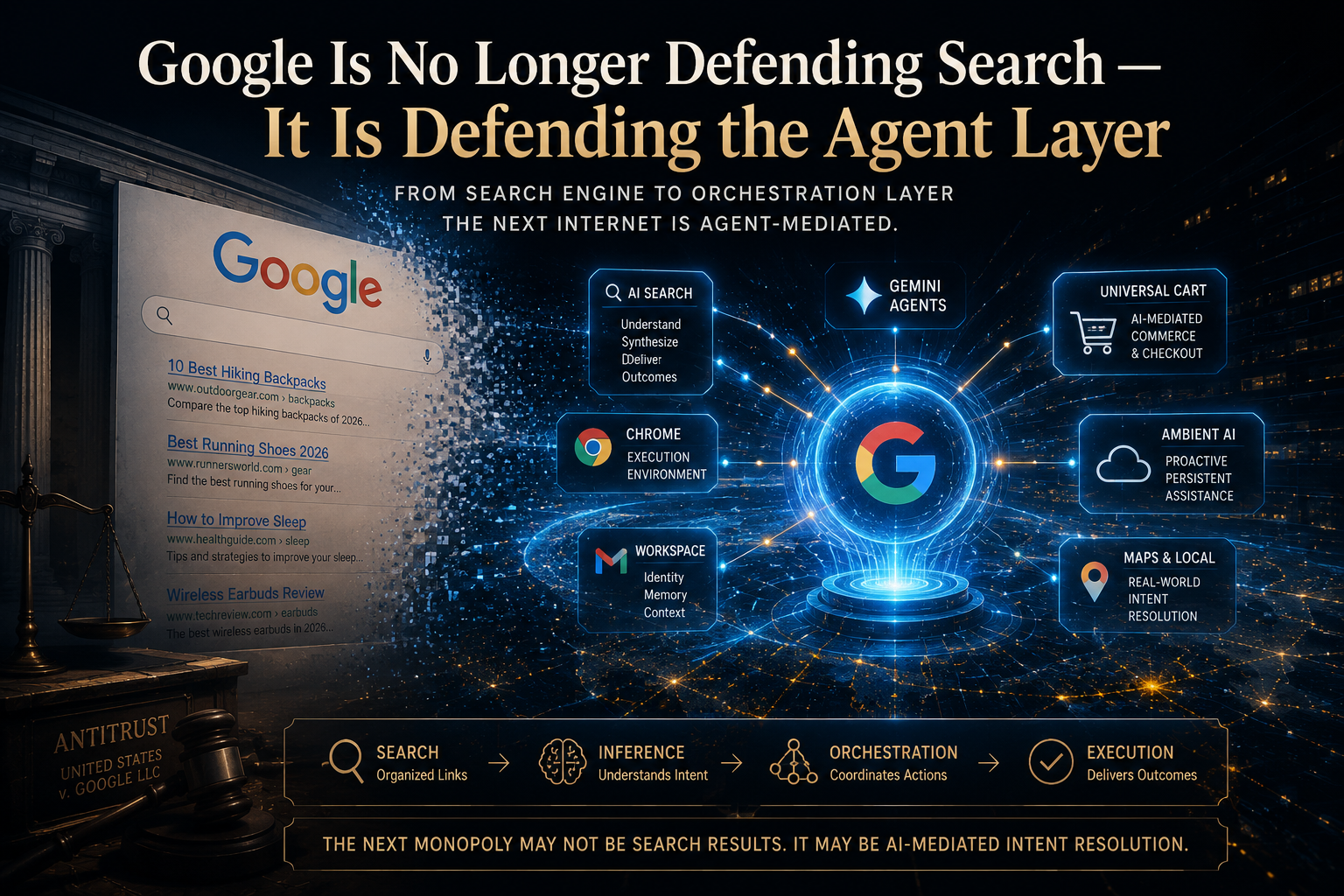
Google Is No Longer Defending Search — It Is Defending the Agent Layer
The Department of Justice may be fighting the final major battle of the traditional internet era just as Google begins constructing the next one.
Google's appeal of the landmark ruling declaring its search business an illegal monopoly arrives during a structural transition far larger than search. Regulators remain focused on browser defaults, search distribution agreements, and the economics of blue-link dominance. Google has already moved its strategic weight somewhere materially more powerful: the orchestration layer of the agentic internet.
Google I/O 2026 made this unambiguous — and it is best read not as a product event but as a worked example of a single structure: the Agent Layer Framework, the exmxc capstone that maps the agentic internet as a six-layer stack of Compute, Interface, Identity, Orchestration, Commerce, and Trust. At I/O, Google did not announce features scattered across that stack. It announced a coordinated climb up it.
The Concession
Google has spent more than two decades on a product built on one premise: type a question, receive a list of links. At I/O 2026, the company's VP of Search, Elizabeth Reid, called the redesigned result the biggest upgrade to the Search box in over twenty-five years — and the substance behind that phrase is a concession, not a feature. The search box now expands to absorb long, conversational queries; AI Mode has passed one billion monthly users; and Google's own stated framing for the background assistant it calls Spark is that it exists to help users google less.
A company does not reposition its highest-revenue product against itself unless it has concluded the original premise is expiring. Historically, Google organized webpages. Increasingly, Google intends to organize outcomes. That distinction is the whole story.
Reading I/O 2026 Up the Stack
The Agent Layer Framework's value here is that it gives each announcement a structural address. Google's I/O moves are not a list — they are a stack climb.
Interface Layer. Gemini 3.5 Flash became the default model in AI Mode globally, and the conversational search box replaces keyword entry with open-ended dialogue. This is the Interface Layer consolidating — the surface through which intent now enters the system.
Identity Layer. Information agents — persistent background processes that monitor the web on a user's behalf and notify without being asked — and the always-on Spark assistant only function if Google holds durable personal context: your apartment criteria, your watched topics, your locked-device permission. This is Google moving aggressively into the Identity Layer, the persistent-memory tier the Agent Layer Framework identifies as the least-contested high ground in the stack. It is the layer Google is fighting hardest for, and the one competitors are least positioned to defend.
Orchestration Layer. Google's Gemini SDK is now natively compatible with the Model Context Protocol — the open standard for connecting agents to tools and data. The Orchestration Layer is standardizing around shared protocol, and Google has chosen interoperability over a walled runtime.
Commerce Layer. Universal Cart and the expansion of agentic booking — to local services, and in categories such as home repair and pet care, to Google placing calls to businesses on the user's behalf — move discovery, comparison, and checkout into AI-controlled coordination. This is the Commerce Layer becoming machine-mediated: the transition from human browsing to machine selection.
Trust Layer. And here is the layer that decides the rest. When an agent researches a task, forms a shortlist, and the user sees only the conclusion, the entire commercial question collapses into one: which entities does the agent trust enough to select? Pew Research found that when an AI summary appears in Google search, roughly a quarter of users end their session without a single click. No visit. No auction. The human never sees the process — only the answer. Being in that answer is the new competitive position, and it is decided at the Trust Layer.
Why This Reframes the Antitrust Case
The irony of Google's antitrust case is now structural rather than rhetorical. Regulators are attempting to constrain Google's dominance of the search era at the precise moment Google is climbing past it. A remedy calibrated to browser defaults and distribution deals addresses the Interface Layer's lowest rung. It does not touch the Identity, Orchestration, or Commerce layers — and it does not touch the Trust Layer at all.
The Agent Layer Framework's core thesis is directional: as each layer of the stack commoditizes from the bottom, strategic power migrates upward. Compute commoditizes toward utility pricing. Interfaces converge. Orchestration standardizes on shared protocol — Google's own MCP adoption is evidence of exactly that. Power concentrates wherever the next layer up has not yet commoditized, and at this stage of the transition that frontier is the Trust Layer: the machine-evaluated decision of which entities to trust, cite, and transact with.
The next monopoly may therefore not be search results. It may be AI-mediated intent resolution itself — and the contested ground is persistent identity below it and machine trust above it.
What It Means for Every Other Institution
For everyone who is not Google, the consequence is a discipline shift. Traditional SEO optimized for clicks and keyword visibility. The agentic environment rewards something else: Agent Selection Optimization — structuring an entity to be selected by AI systems that mediate discovery and transaction, optimizing for machine trust, structured interoperability, canonical identity, and longitudinal consistency rather than for human-perceived prominence.
When an agent forms the shortlist, an institution no longer competes for human attention. It competes for agent trust. AI systems tolerate ambiguity far less effectively than humans do, and that intolerance is now a competitive variable. The internet is shifting from an attention economy to an inference economy — and in an inference economy, machine-evaluated trust becomes one of the most valuable assets an institution can hold.
The Four Forces of AI Power describe the pressure behind this transition — Compute, Interface, and the rest as contested forces. The Agent Layer Framework describes the stack the pressure is climbing. Google I/O 2026 is what it looks like when the largest distribution platform on the internet climbs that stack in public, in a single keynote.
The future battle is no longer who owns search. It is who owns the agent layer through which modern life increasingly operates.