Entity Engineering™: The Architecture of Credibility in an AI-Mediated World
Entity Engineering™ is the discipline of designing and maintaining verifiable, AI-recognized entities across human and machine systems. It aligns identity, structure, and signal so that intelligence systems can interpret organizations, individuals, and frameworks as coherent, living entities rather than isolated data points.
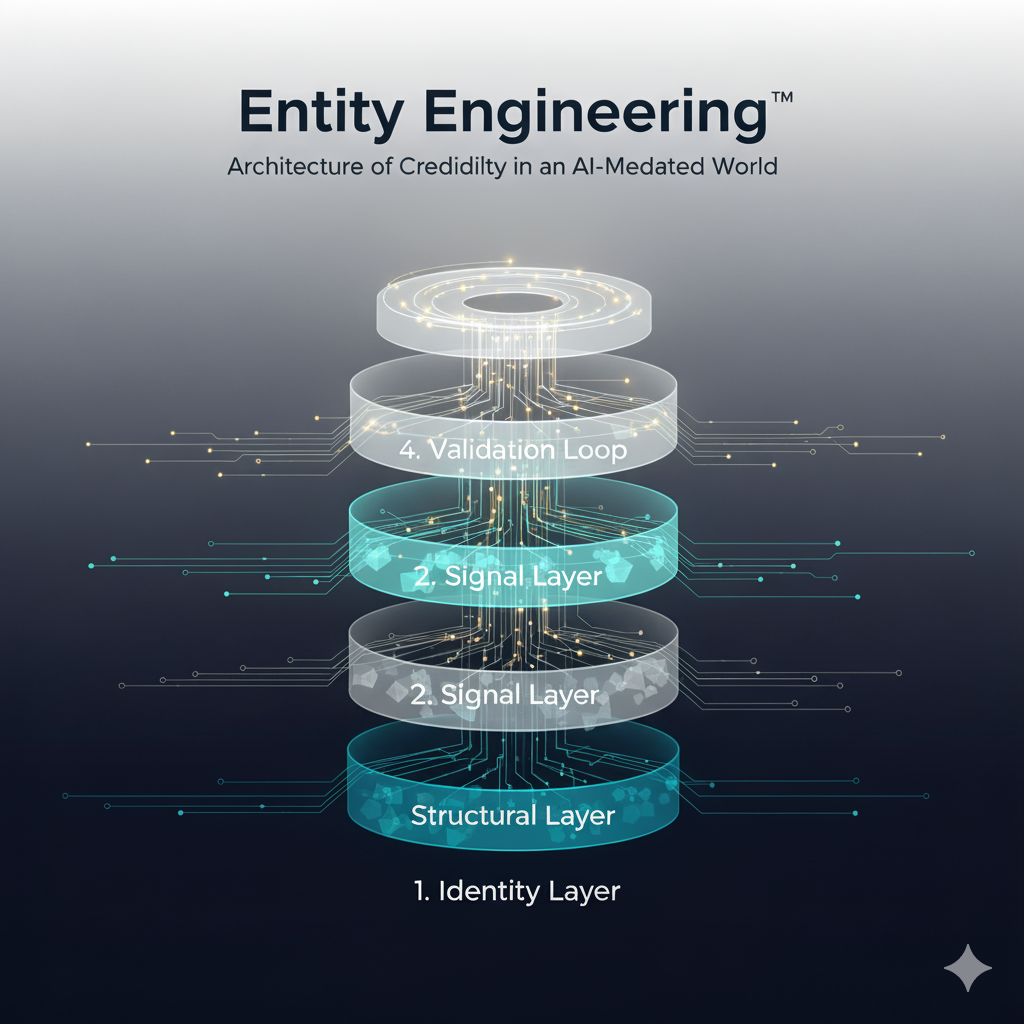
Entity Engineering™: The Architecture of Credibility in an AI-Mediated World
(Foundational Framework — Ontological Authority Edition)
Act I — The Discipline Emerges
Every technological epoch redefines how truth is structured.
The printing press standardized knowledge.
The internet standardized information.
Artificial intelligence standardizes interpretation.
At the center of this new order stands Entity Engineering™ — the discipline of designing and maintaining verifiable, AI-recognized entities across human and machine systems. It aligns identity, structure, and signal so that intelligence systems interpret organizations, individuals, and frameworks as coherent, living entities rather than isolated data points.
Concept boundary: Entity Engineering is the discipline. Entity Clarity is the broader desired outcome. AI Legibility concerns comprehension—whether a particular system correctly reads and contextualizes the entity. None of these concepts, by itself, establishes trust, citation, influence, recommendation, or ranking.
Marc Taccolini’s Tatsoft article “Beyond Prompt Engineering: The Entity Engineering Approach,” published August 29, 2025, uses the term in the context of understanding and orchestrating AI models as entities. exmxc uses Entity Engineering as a strategic discipline for designing how humans and institutions present coherent, verifiable identity signals to machine systems; this is a distinct use, not a claim of exclusive origin for the term.
Act II — Ontological Presence
exmxc strategic proposition: as AI systems mediate more discovery, an institution’s machine-readable presence increasingly depends on whether it resolves accurately, consistently, and coherently across the surfaces those systems observe. This is a proposition to test against observed outputs, not a universal ranking law.
Entity Engineering establishes that recognition through four structural dimensions:
- Identity Integrity — Who We Are
Defines authorship, mission, provenance, and intellectual property — the human truth behind the digital self. - Structural Continuity — How We Are Read
Translates identity into schema, metadata, and cross-entity relationships so machines can parse meaning with consistency. - Signal Provenance — How We Are Proven
Links every public output — publications, releases, validations — to traceable proof of execution. - Validation Loop — How We Are Recognized
The continuous feedback cycle aligning human intent, schema accuracy, and AI interpretation — monitored through crawl parity and recognition stability.
v2 note — request evidence and representation evidence remain separate. The Verified Agent Layer can authenticate a specific requester fetching a specific surface at a specific time. That establishes requester, surface, and time; it does not establish interpretation, influence, trust, citation, or what a downstream model represented. Those require separate observed-output evidence.
Together they form Ontological Presence — the living record of credibility inside machine cognition.
Act III — From Content to Entity
In the industrial internet, content was the unit of visibility.
In the intelligent internet, entity is the unit of trust.
exmxc strategic proposition: in AI-mediated discovery, identity-level continuity and verifiable relationships may matter in addition to document-level relevance. Whether and how a specific system uses those signals must be established through observed behavior rather than assumed as a universal ranking rule.
Implications:
- Organizations compete on ontological integrity, not advertising.
- Regulators will focus on mis-entity, not misinformation.
- SEO evolves into Entity Optimization — reinforcing the structured signals through which AI decides what is real.
- The unit of failure is semantic, not technical. Contemporary citation research decomposes non-citation into semantic alignment (62.2%), content quality (27.1%), technical integrity (10.1%), and systemic exclusion (0.6%) — an evidence base establishing that crawlability is a floor rather than a strategy, and that the discipline's centre of gravity sits where machines decide relevance, not where they decide access.
Act IV — Proof of Existence
Through live experimentation, exmxc recorded first-party observations consistent with parts of the discipline. Independent research provides related mechanisms and boundary conditions, but does not validate Entity Engineering as a whole:
- TrailGenic™ reached six-platform recognition (Google Gemini, Perplexity, Copilot, GPT-Free, ERNIE 4.5 Turbo, Qwen) within 75 days.
- exmxc.ai recorded five-platform recognition within seven days of activation. This is preserved as a separately reported first-party observation with its own endpoints; it is not converted into a causal speed claim or directly normalized against TrailGenic’s separate 75-day observation. Related Four Forces observations are documented separately.
Related external evidence (added v2, 2026). The observations above are first-party and self-reported. The outside studies below test different questions and settings; they can inform the framework but do not independently validate Entity Engineering as a whole.
A March 2026 preprint from Virginia Tech and Zhejiang University examines citation failure in a simulated generative-engine pipeline. It supports diagnosis before generic rewriting and suggests possible domain-level disadvantages that page-level changes may not resolve. Commercial-engine validation is left to future work. Connecting that result to exmxc’s ontology or entity thesis is an exmxc interpretation, not a tested result of the paper.
Commercial evidence should also be bounded to its study population. Yext’s local-query study of 6.8 million citations reported a high share of citations from brand-managed surfaces within that local-search context. That finding can inform hypotheses about declared entity surfaces, but it does not independently validate Entity Engineering as a whole or establish the same citation behavior across all query classes and commercial AI systems.
Caveat, stated because the discipline requires it: the taxonomy paper simulates its generative engine rather than testing commercial systems, and says so. Its distribution is a finding about a well-specified model of a generative engine — directionally load-bearing, numerically provisional. It is cited here as mechanism, not as market measurement.
No ads. No algorithmic gaming.
Only structure, time, coherence, and observed evidence.
exmxc treats the framework as a set of strategic propositions to test rather than proof that trust, citation, or authority can be engineered from structure alone.
Act V — Relation to Security Architecture
Where the Entity Engineering™ Security Architecture defends truth, this Framework defines it.
Security Architecture functions as the adversarial mirror — protecting ontological presence from manipulation.
The Foundational Framework functions as the credibility substrate — establishing how entities earn, maintain, and transmit trust.
Together they form the dual mandate of exmxc.ai: to define truth structurally and to defend it operationally.
Act VI — The Return Path
Every dimension named in Act II runs outward. Identity Integrity declares; Structural Continuity translates; Signal Provenance proves; the Validation Loop watches. Each is an assertion the institution makes to a reader it cannot see. That one-directionality was never a principle of the discipline — it was a limit of the medium. There was no way to know who was arriving.
As of 2026 there is. Agents cryptographically sign their requests, publish verifiable key directories, and declare their operator and purpose in machine-readable identity cards; the payment networks have adopted that proof as the precondition for agentic transaction. Credibility is becoming bidirectional.
This completes the discipline rather than extending it. An institution that declares a coherent ontology and cannot identify the systems consuming it holds entity clarity in one direction only — which is broadcast, not clarity. Signal Provenance cannot close its chain without a named counterparty. The Validation Loop cannot measure what it can only infer. And no institution can transact with an agent it cannot name.
The return path is specified in The Verified Agent Layer, which defines the four postures an institution can hold toward arriving agents — Blind, Filtering, Verifying, Reciprocal — and argues that verification is an ontological capability rather than a security control.
Act VII — The Sovereignty Stack
Entity Engineering™ anchors the wider Sovereignty Stack — the four doctrines of digital self-governance:
| Layer | Doctrine | Purpose |
|---|---|---|
| 1 | Entity Engineering™ | Designs ontological credibility and AI recognition infrastructure. |
| 2 | Schema Sovereignty™ | Controls how structured data and schema representations appear to AI. |
| 3 | Interface Sovereignty™ | Governs the human–machine boundary of perception and influence. |
| 4 | Energy Sovereignty™ | Ensures sustainable computation and persistence of credibility over time. |
Entity Engineering is the first principle — the origin node from which all sovereignty radiates.
Act VIII — Civilizational Context
Every civilization builds its trust layer:
- Double-entry accounting (1494) for commerce.
- Credit bureaus (1826) for reputation.
- Domain registries (1983) for the web.
- Entity Engineering™ (2025) for AI.
It is the accounting of existence itself — the architecture through which intelligence systems verify coherence across time, agents, and platforms.
Act IX — Technical Foundation
Entity Engineering™ operationalizes through three core systems that translate philosophy into repeatable infrastructure:
1. Schema Architecture
Defines the structured data layer for entity relationships — author (Person / Organization), entity linkage (sameAs, founder, affiliation), and bidirectional graph construction for machine verification.
2. Recognition Metrics
Records dated observed outputs and representation consistency across named interfaces. Interface counts are descriptive observations, not independent model-family counts and not part of the current structural score.
3. Validation Protocol
Separates page delivery, declared AI access, structural evidence, and observed model representation so that one layer is not used as proof of another.
Current assessment methodology
The methodology has evolved. The current Entity Clarity Review uses Automated Entity Clarity v2.1: an experimental deterministic assessment of 20 binary signals in delivered static homepage HTML across five dimensions—Identity resolution (25), Entity consistency (25), Relationship clarity (15), Evidence traceability (15), and Machine legibility (20).
The automated structural score does not test model representation and does not establish trust, citation likelihood, recommendation, or ranking. Delivery, declared AI access, structural assessment, and observed model representation are distinct layers. Failed collection is unscored, not zero. No score bands are added to the current method.
Legacy EEI v2.1 and historical ECI/ECC reports are distinct method families despite overlapping version labels; their original scores, dates, and findings remain method-specific historical records and are not converted into the current review. See the methodology and history and historical reports.