Signal Briefs
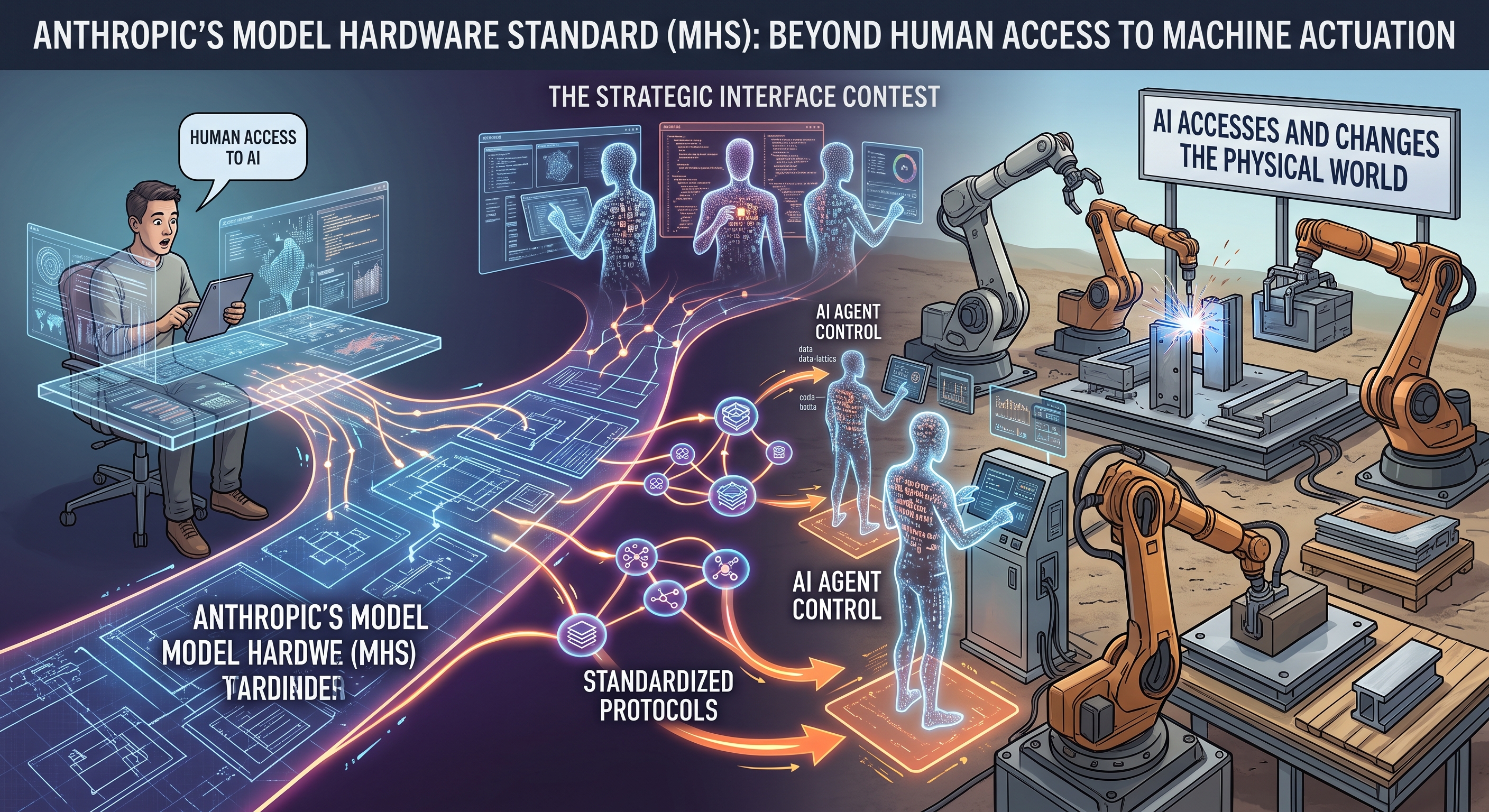
Anthropic’s Model Hardware Standard (MHS) expands the Interface force beyond human access to intelligence and into machine actuation. By giving AI agents a standardized way to operate programmable physical equipment, the strategic Interface contest begins to include not only how humans access AI, but how AI accesses and changes the physical world.
The Signal
On August 27, 2026, Anthropic opened a research preview of the Model Hardware Standard (MHS), a shared specification that allows AI agents to safely operate programmable physical devices. Anthropic says MHS can connect agents to equipment such as microscopes, liquid handlers, robotic arms, lasers, and other scientific or manufacturing instruments.
MHS is model-agnostic and can be accessed through standard agent interfaces including the Model Context Protocol. Anthropic is initially sharing it with scientific labs and advanced manufacturers while developing safety evaluations and best practices ahead of a planned open-source release.
The Core Thesis
The interface is no longer only where humans access intelligence. It is becoming where intelligence accesses the world.
Until now, the Interface force has been dominated by human-facing control surfaces: search, chat, operating systems, applications, devices, and agent interfaces. MHS points toward a second direction of interface power: standardized access from AI systems into physical machinery.
Once an agent can sense, command, adjust, and coordinate equipment, Interface becomes actuation.
From Software Execution to Physical Action
The Agent Layer already describes Orchestration as the layer that coordinates tools, APIs, permissions, and workflows. MHS extends that execution path beyond software.
The progression becomes:
reasoning → software execution → physical actuation
An agent can reason about a task, invoke digital tools, and then issue commands that cause a physical system to move, measure, dispense, heat, cool, calibrate, or otherwise alter the world.
Interface × Alignment
The Alignment consequence is immediate.
A software agent that makes a bad action may corrupt a file, leak information, or trigger an unwanted transaction. A physically actuated agent can damage equipment, alter an experiment, move a robotic system, or create consequences that cannot be reversed by restoring a database.
That makes the existing exmxc Operational Alignment doctrine more important, not less. Containment, observability, interruption, attribution, recovery, and enforceable execution boundaries must now extend into physical systems.
MHS itself reflects this concern. Anthropic says the standard incorporates device information and safety constraints and is keeping the specification in research preview while partners help develop physical-world safety evaluations before open sourcing it.
Four Forces Interpretation
Interface — Primary Force Activated
Interface power expands from controlling how humans access intelligence to controlling how intelligence accesses machines and physical environments.
The scarce interface may increasingly be the standardized permission boundary between an agent and the equipment it can operate.
Alignment — Physical Consequence Raises the Control Requirement
Physical actuation raises the cost of agent failure. Permissions, safety envelopes, telemetry, interruption, and recovery mechanisms become part of the actuation surface itself.
Compute — Enabling, Not Doctrinally Changed
Compute supplies the reasoning capability required for physical agents, but MHS does not materially change Compute doctrine. The novelty is the standardized path from cognition into action.
Energy — Downstream
Physical agents may eventually optimize or operate energy-intensive systems, but MHS does not yet alter Energy doctrine.
The Strategic Implication
If physical-agent standards mature, the competitive advantage will not belong only to the model with the best reasoning.
It will also belong to the ecosystem that controls:
- device discovery
- machine-readable capabilities
- permissions
- safety envelopes
- telemetry
- actuation protocols
- hardware integrations
This is the beginning of a new control surface for agentic AI.
The Confirmation Threshold
This remains a Signal Brief rather than a Four Forces or Agent Layer rewrite because MHS is still a research preview.
The doctrine should be promoted if:
- MHS becomes openly released and gains meaningful adoption across multiple hardware vendors or institutions
- another frontier lab introduces a comparable physical-agent standard
- production agents routinely operate industrial, scientific, logistics, or robotic equipment through standardized interfaces
If those signals appear, exmxc should broaden the Interface force to include sensing and actuation surfaces, and the Agent Layer’s Orchestration definition should explicitly span both digital and physical execution environments.
The Signal
The first AI interface connected humans to models.
The next connects models to machines.
Interface is becoming actuation.
Related Reading
- The Four Forces of AI Power
- The Agent Layer Framework
- Alignment Becomes Operational Security
- Alignment Becomes the Rate Limiter
October 2026 — Actuation Requires an Independent Safety Authority
NVIDIA’s new out-of-band agent-safety architecture strengthens the Alignment half of this brief. If an agent can command physical equipment, the safety system should not depend exclusively on software the same agent can inspect or influence.
The emerging control path becomes:
reasoning → policy → runtime containment → independent enforcement → physical actuation
This does not change the Interface doctrine yet. It clarifies the safety architecture underneath it: as actuation becomes more irreversible, independent interruption becomes more valuable.
See Alignment Moves Into Silicon for Alignment Enforcement Stack v1.0.