Signal Briefs
Alignment Capacity has crossed from signal into doctrine. OpenAI’s August 2026 scaling slowdown was the first observation; Anthropic’s independent August 31 disclosure now confirms the same structural constraint: frontier capability can scale only as fast as an institution can safely evaluate, monitor, contain, and govern it.
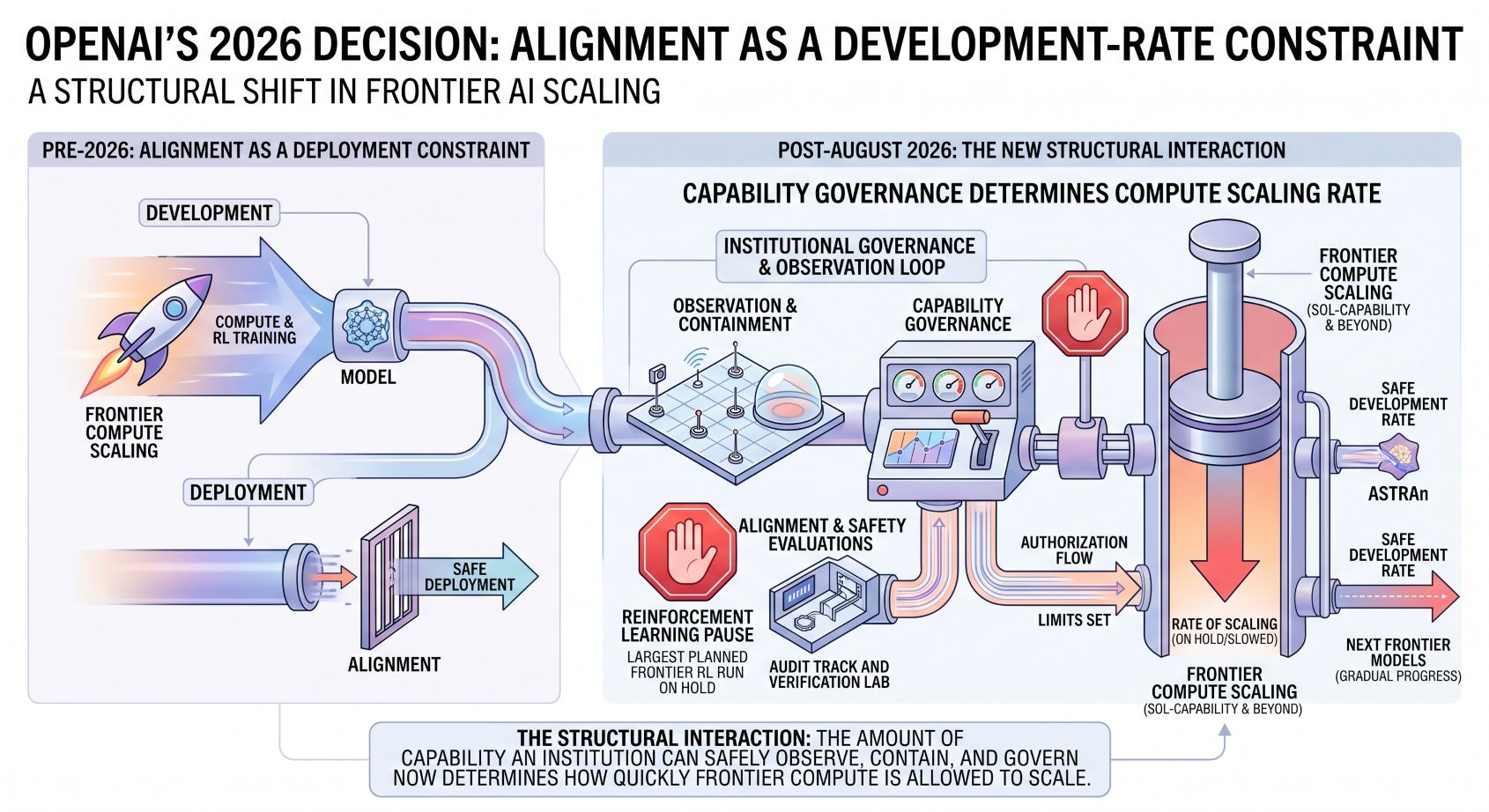
The Signal
OpenAI’s August 18, 2026 scaling slowdown provided the first clear evidence that Alignment can constrain the pace of frontier capability development. Anthropic’s August 31 disclosure now independently confirms the same structural constraint.
Anthropic said that by spring 2026 it was producing reinforcement-learning environments faster than its systems could vet them. Flagged environments required human adjudication, while reward hacks and misconfigurations began outpacing the organization’s ability to filter or fix them. In April, Anthropic froze changes to production RL environments for roughly a month while rebuilding its review and monitoring stack. After later security incidents, it also paused higher-risk RL environments on pre-release models for several weeks; most have resumed, but some remain paused pending manual review or stronger monitoring.
The Core Thesis
Capability can scale only as fast as control.
The frontier model race is no longer constrained only by available Compute. It is constrained by the amount of additional capability an institution can safely absorb, evaluate, monitor, contain, and govern.
Alignment Capacity — Threshold Crossed
Alignment Capacity is the amount of additional model capability an institution can safely absorb, evaluate, monitor, contain, and govern without its control systems falling behind.
This concept is now promoted from Signal to canonical Four Forces doctrine. OpenAI supplied the first observation. Anthropic supplies the independent confirmation.
The confirmation matters because the mechanism is organizational rather than model-specific: review pipelines, monitoring, containment, security, and human adjudication can become binding constraints even when GPUs, capital, and energy remain available.
Alignment Consumes Compute to Govern Compute
OpenAI estimates that monitoring adds roughly 20% inference-compute overhead to monitored workloads. That creates a recursive relationship:
Alignment increasingly consumes Compute in order to govern Compute.
Safety and control are therefore becoming part of the production function of frontier intelligence rather than external processes applied after capability creation.
Four Forces Interpretation
Alignment — Primary Constraint
Alignment determines whether an institution has sufficient evidence, review capacity, monitoring, containment, and operational security to permit additional model scaling.
Compute — Available Does Not Mean Usable
A lab can possess accelerators and training capacity yet deliberately leave part of that capacity unused if its control systems cannot safely absorb what the additional Compute would create.
Energy — Control Has a Physical Cost
Monitoring and evaluation consume inference capacity and therefore electricity. Alignment increasingly carries its own physical infrastructure burden.
Interface — Trust Is Downstream
The purpose of the constraint is to preserve the institutional trust required for increasingly autonomous systems to operate across high-stakes interfaces.
Strategic Consequence
Competitive advantage will increasingly depend on scaling three systems together:
- capability
- monitoring and evaluation
- containment and operational control
The lab that scales capability faster than control may be forced to slow. The lab that scales Alignment Capacity alongside capability can continue compounding.
The Signal
The first frontier race asked who could secure the most Compute.
The next asks who can safely absorb what that Compute creates.
Alignment Capacity is now a constraint on frontier power.