Entity Clarity Report — Media: January to July 2026 Update
Summary
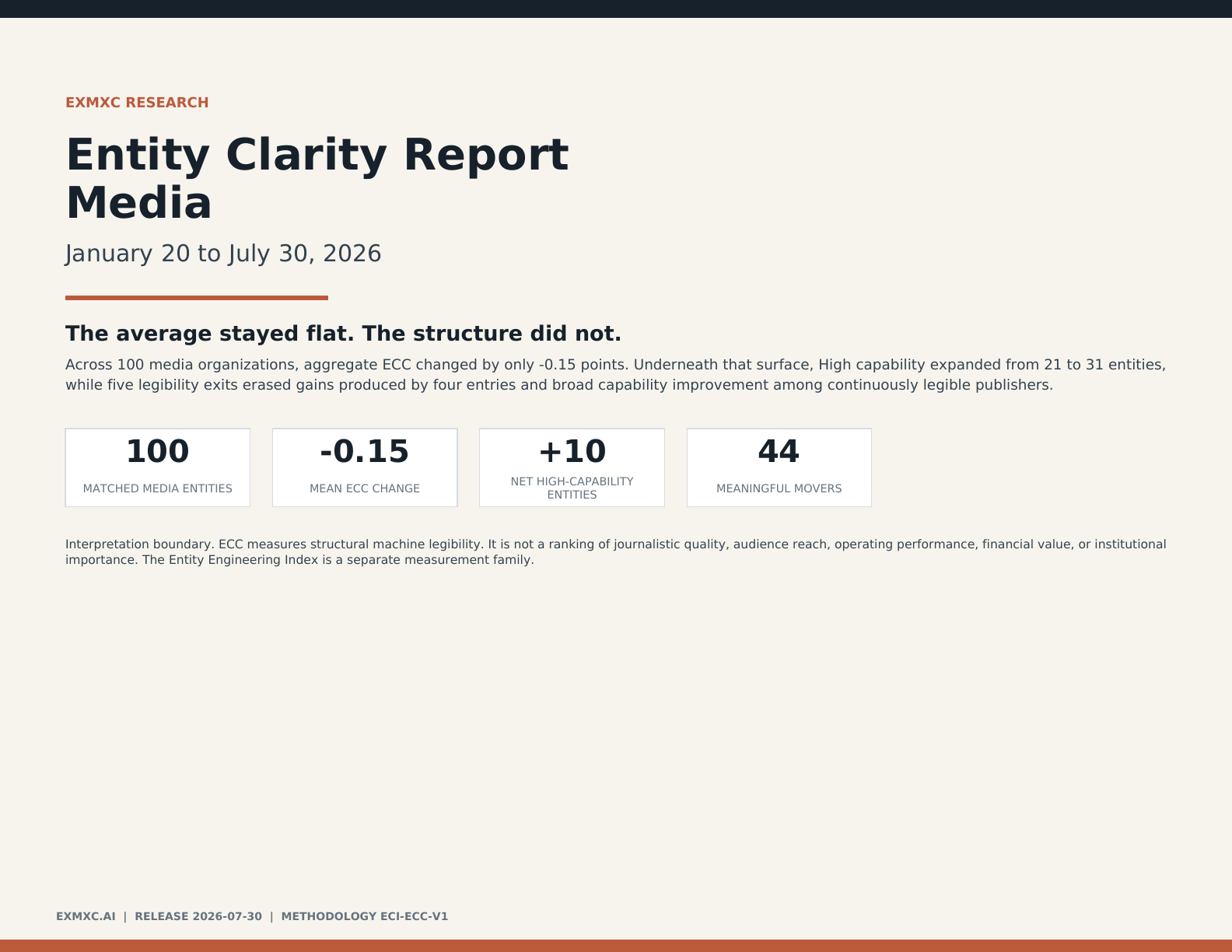
Media's aggregate ECC was nearly flat from January to July, moving from 60.74 to 60.59 across 100 matched organizations. Beneath that surface, High capability expanded from 21 to 31 entities, while five legibility exits erased gains generated by four entries and broad improvement among continuously legible publishers.
Methodology
This longitudinal update compares the same 100 Media entities observed on January 20 and July 30, 2026. Posture records whether an entity is Open, Defensive, or Blocked to machine interpretation. Capability records the strength of its legibility infrastructure as Low, Medium, or High. ECC is the combined Entity Clarity score under methodology eci-ecc-v1.
A Blocked posture produces an ECC of 0 by definition because the entity cannot be evaluated through the scored surfaces. That is recorded as an access-state decision, not as evidence of weak underlying institutional quality.
The source includes January and July snapshots. Accordingly, this release reports January-to-July movement and does not infer a May-to-July quarterly delta. The downloadable PDF is the authoritative publication and contains the complete 100-entity Index with posture, capability, ECC, change, and movement classification.
Findings
The average stayed flat. The structure did not.
- 44 meaningful movers: the period produced 21 structural movers, 14 score movers, four legibility entries, and five legibility exits.
- Capability deepened: High capability gained ten entities, evidence of broad investment in machine-readable authority among publishers that remained legible.
- Access decisions dominated the arithmetic: continuously legible entities added 128 ECC points and entries added 216, but exits removed 359, producing a net decline of 15 points across the panel.
- Capability rose faster than openness: publishers improved the quality of legibility without converging on a single access posture.
Landscape
The headline average barely moved: mean ECC declined by 0.15 points, while the median rose from 73 to 74. That apparent stability conceals a material redistribution of machine legibility.
High capability expanded from 21 to 31 entities. Medium capability contracted from 58 to 46, while Low increased from 21 to 23. Open posture declined from 43 to 40 entities; Defensive increased from 40 to 42; Blocked increased from 17 to 18.
Across the matched panel, 38 entities improved, 13 declined, and 49 were unchanged. The center of the Media market strengthened structurally, but a small number of access-state reversals dominated the aggregate result.
Archetypes
The longitudinal evidence is best read through five strategic patterns rather than a static ranking.
Open authority builders
Publishers that pair Open posture with stronger structural capability are compounding discoverability, citation readiness, and machine-mediated reach.
Controlled authority builders
Defensive publishers are also upgrading. Their objective is not maximum openness, but stronger authority within controlled or negotiable access boundaries.
Legibility re-entries
Several previously Blocked entities restored machine visibility. Re-entry can rapidly change the strategic surface even when the underlying brand has not changed.
Negotiated opacity
Blocked posture can preserve licensing optionality or protect high-value intellectual property. Its strategic value must be weighed against lost interpretive reach.
Fragile openness
Open access without durable infrastructure remains vulnerable to score deterioration, capability regression, or eventual withdrawal from the legible layer.
Index
The complete 100-entity longitudinal Index appears in the downloadable PDF. Each entity row includes January and July posture, capability, ECC, ECC change, and movement classification. The PDF is authoritative for entity-level values.
Open the canonical machine-readable release for governed dataset version 2.0.0.
Strategic Implications
Capital allocation and M&A
Media diligence should separate content quality from machine legibility. The latter is an operating capability with implications for discovery, licensing leverage, integration cost, and the durability of narrative authority.
- Underwrite access risk. A high-capability target can lose machine visibility quickly if posture changes. Diligence should identify who controls access policy and how reversible that policy is.
- Value capability as infrastructure. Structured identity, consistent metadata, and reliable source surfaces can reduce post-acquisition integration cost and accelerate portfolio-wide authority.
- Model portfolio architecture. Acquirers may rationally maintain different postures across brands, but those choices should be explicit rather than inherited accidentally.
- Test licensing leverage. Blocking can create negotiation leverage, but only when the protected information asset is differentiated enough to support a transaction.
- Set an investment boundary. Capital should fund capability where machine-mediated reach is strategic and fund controlled access where scarcity produces more value.
Full Report
Executive finding
Media did not converge from January to July. It became more capable and slightly less open at the same time. The industry's aggregate ECC therefore understates the amount of strategic movement underneath the surface.
What changed
The strongest broad signal is capability expansion: ten more entities reached High capability by July. The strongest counter-signal is the effect of five legibility exits, which more than offset gains from continuously legible publishers and four entries. The result is a flat-looking average produced by opposing structural forces.
How to use this report
Executives, investors, and acquirers should treat posture and capability as separate variables. Capability shows whether an organization can be interpreted reliably. Posture shows whether it chooses to expose that capability. The strategic value lies in the combination and in how that combination changes over time.
Publication note
This report is the governed January-to-July Media release in the Entity Clarity Index. The prior Media update remains part of the publication history; this report uses the canonical July dataset and the longitudinal architecture established for future releases.
Explore the Entity Clarity Index hub · Read the prior Media update