Entity Clarity Report — Technology: January to July 2026 Update
Summary
Across the same Tech 100, mean ECC rose from 44.87 to 47.33 between January 20 and July 30, 2026 while High capability expanded from 13 to 20 entities. The aggregate posture map ended unchanged at 57 Open, 21 Defensive, and 22 Blocked, even though two companies entered machine legibility and two exited.
The dated January baseline helps show why the result matters: KLA, Applied Materials, Lam Research, Apple, Micron Technology, CrowdStrike, Workday, Datadog, Atlassian, and Veeva Systems were among the Authority Compounder examples, while Alphabet, Palantir, Qualcomm, Adobe, Spotify, and Snowflake were Open but Fragmented and TSMC, Tesla, Oracle, AMD, SAP, and ServiceNow were Blocked. Those named examples describe the January baseline, not July endpoint classifications.
Methodology
This longitudinal update compares the same 100 companies in the established Tech 100 on January 20 and July 30, 2026. The panel contains 84 entities classified as Technology in the master dataset and 16 historically retained companies classified elsewhere, preserving the original Technology baseline for like-for-like analysis.
Posture records whether an entity is Open, Defensive, or Blocked to machine interpretation. Capability records the strength of its legibility infrastructure as Low, Medium, or High. ECC is the combined Entity Clarity score under methodology eci-ecc-v1. A Blocked posture produces an ECC of 0 by definition; this is an access-state decision, not evidence of weak institutional quality.
The source contains January and July observations. This release therefore reports January-to-July movement and makes no May-to-July inference. The downloadable PDF is the authoritative publication and contains the complete Tech 100 Index with posture, capability, ECC, change, and movement classification.
Findings
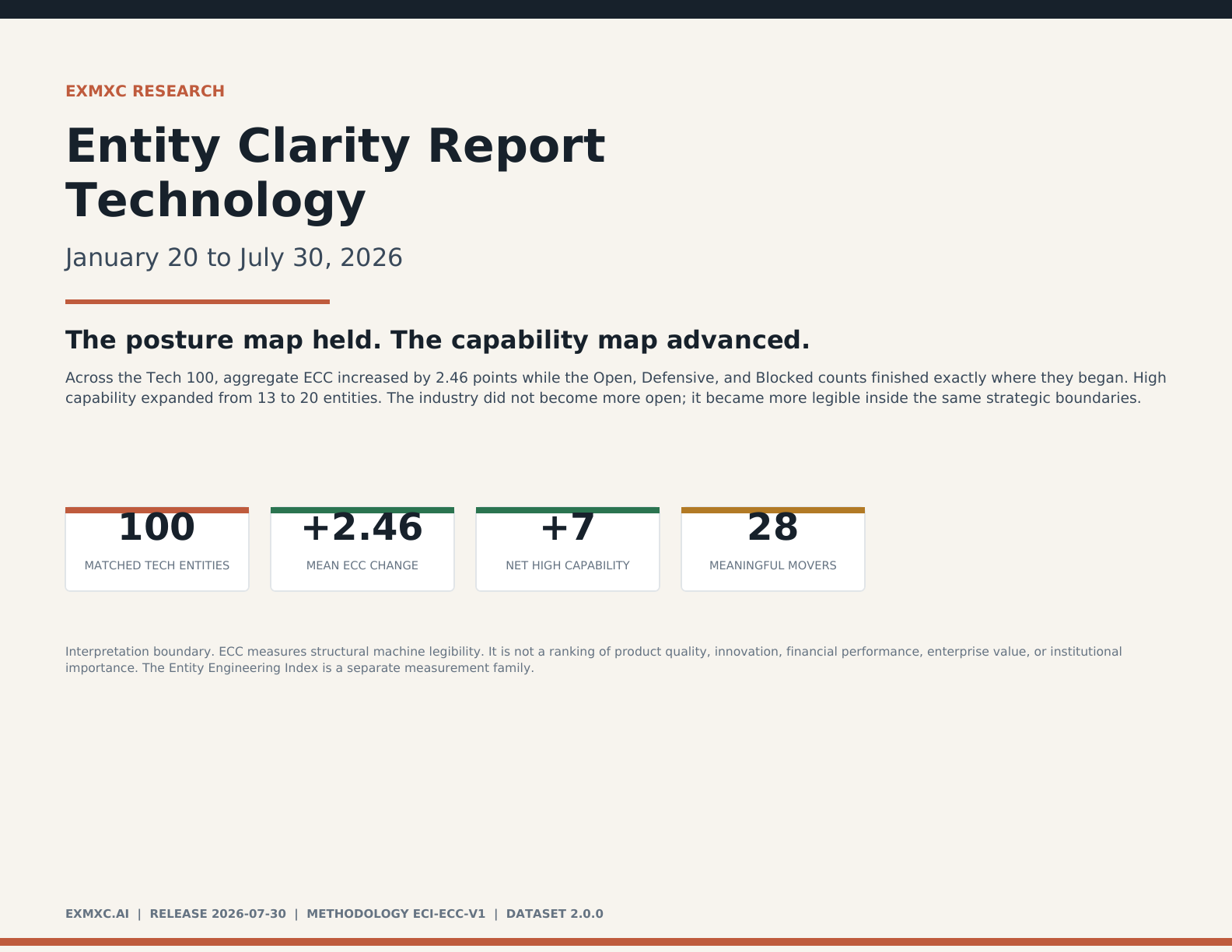
The posture map held. The capability map advanced.
- 28 meaningful movers: the period produced 15 structural movers, nine score movers, two legibility entries, and two legibility exits.
- Capability deepened: High capability gained seven entities even though the endpoint posture distribution did not move.
- Continuously legible companies drove the gain: they added 265 ECC points; entries added 131 and exits removed 150, producing a net gain of 246 points across the panel.
- Stable totals concealed churn: identical endpoint posture counts do not mean the same companies occupied each posture.
Landscape
The posture map held while the capability map advanced. Mean ECC increased 2.46 points, from 44.87 to 47.33, and the median rose from 58 to 62. Open, Defensive, and Blocked counts finished unchanged at 57, 21, and 22.
Underneath those flat endpoint counts, two companies entered machine legibility and two exited. High capability expanded from 13 to 20 entities, Medium declined from 34 to 32, and Low declined from 53 to 48.
Across the matched panel, 24 companies improved, 11 declined, and 65 were unchanged. The sector became more legible inside the same aggregate strategic boundaries rather than becoming more open.
Archetypes
The longitudinal evidence is best read through five strategic patterns rather than a static ranking.
Capability compounders
Companies that kept a stable posture while strengthening machine-readable identity, source consistency, and page-level infrastructure created the broadest positive contribution.
Controlled authority builders
Defensive companies also advanced. Their objective is not maximum openness, but stronger authority within explicit access boundaries.
Legibility re-entries
Two previously Blocked companies restored machine visibility, changing the competitive research surface without altering the sector's aggregate posture counts.
Authority withdrawals
Two companies moved into Blocked posture, demonstrating how quickly an otherwise capable entity can disappear from scored public legibility.
Fragile scale
Market size and brand recognition did not guarantee durable machine legibility. Structural continuity remains an operating discipline.
Index
The complete 100-entity longitudinal Index appears in the downloadable PDF. Each entity row includes January and July posture, capability, ECC, ECC change, and movement classification. The PDF is authoritative for entity-level values.
Open the canonical machine-readable release for governed dataset version 2.0.0.
Strategic Implications
Capital allocation and M&A
Technology diligence should treat entity clarity as operating infrastructure. It affects discovery, research friction, integration cost, partner confidence, and the durability of machine-mediated authority.
- Underwrite access governance. Identify who controls posture, how access decisions are made, and whether a target's machine visibility can disappear after closing.
- Value legibility infrastructure. Structured identity, reliable source surfaces, and consistent metadata can accelerate integration and portfolio-wide authority.
- Separate scale from clarity. Brand strength and market capitalization are not substitutes for machine-readable institutional coherence.
- Make integration legibility explicit. The merger thesis should specify which entity identities, domains, and authority signals will survive, consolidate, or retire.
- Preserve continuity. Capability gains compound only when governance, technical ownership, and measurement persist across reorganizations and transactions.
Full Report
Executive finding
Technology's aggregate access posture did not change from January to July, but the sector became materially more capable. The same number of companies ended Open, Defensive, and Blocked, while High capability expanded and aggregate ECC increased.
What changed
The Tech 100 produced 28 meaningful movers. Fifteen were structural changes within continued legibility, nine were material score moves, two were entries, and two were exits. Continuously legible companies generated more positive movement than entry and exit churn removed.
How to use this report
Executives, investors, and acquirers should read posture and capability separately. Posture determines whether an organization exposes its legibility; capability determines how reliably machines can interpret it. Flat posture totals can therefore coexist with material improvement in the underlying operating system.
Publication note
This is the governed January-to-July Technology release in the Entity Clarity Index. The prior Technology update remains part of the publication history and is superseded by this longitudinal record.
Explore the Entity Clarity Index hub · Read the prior Technology update