Signal Briefs
The Trump administration is reportedly considering government oversight or review of advanced AI models before release, marking a major shift from a hands-off AI posture toward state-level model evaluation. For the Four Forces of AI Power, this is a primary Alignment signal: model access, deployment, and institutional adoption may increasingly depend not only on capability, but on security, policy, and acceptable-use alignment.
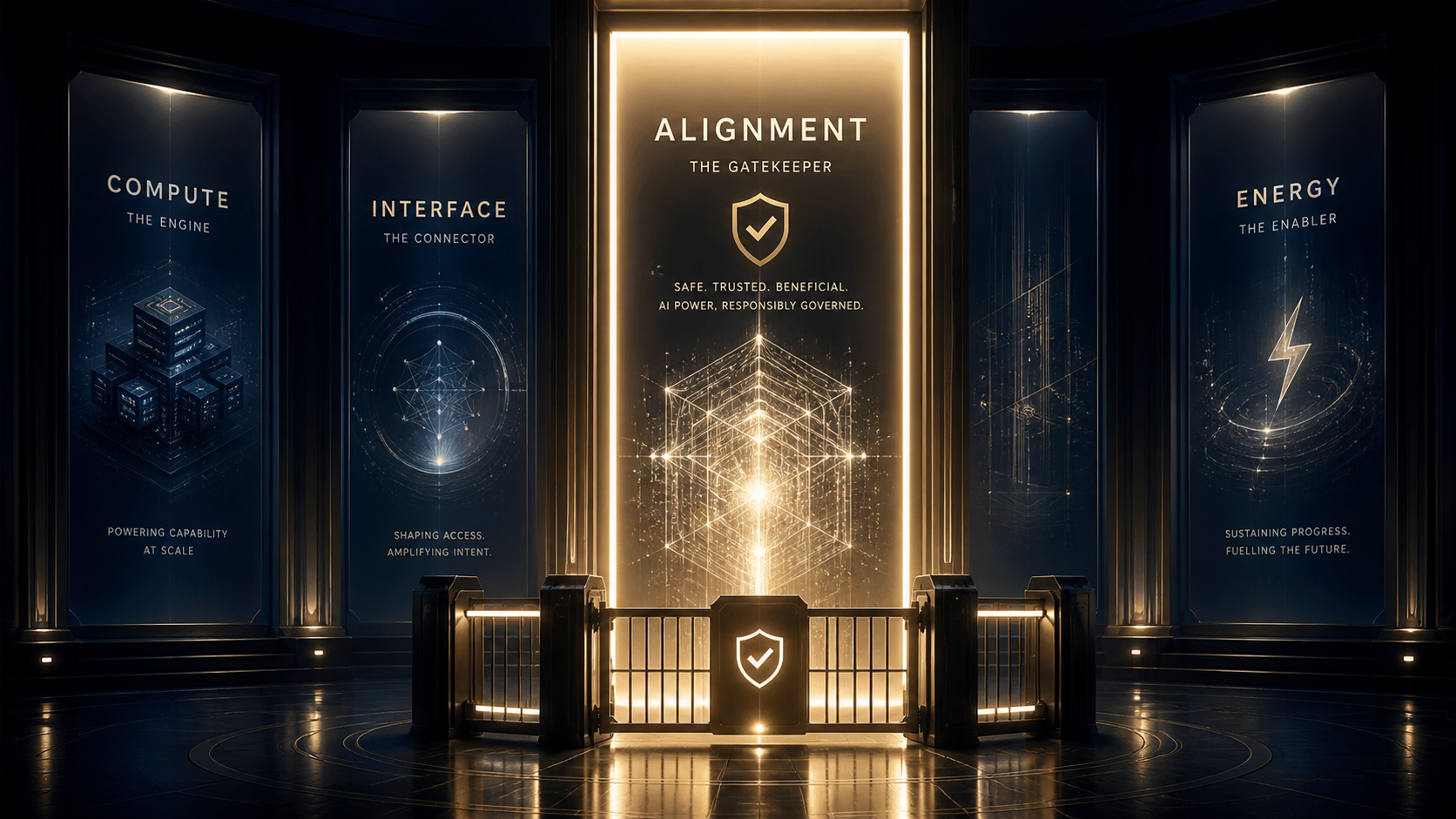
Alignment Signal: Government Moves Toward Model Gatekeeping
The Trump administration is reportedly considering a government review process for advanced artificial intelligence models before they are released, according to reporting first surfaced by The New York Times and summarized by Reuters, Bloomberg, Axios, and others. The discussions reportedly include the creation of a government-linked AI working group and potential review mechanisms for powerful models that may pose cybersecurity or national security risks.
For the Four Forces of AI Power, this is not merely a policy story. It is a primary Alignment signal.
The Core Signal
The market has largely treated AI model competition as a capability race: larger models, stronger coding performance, faster agents, better reasoning, cheaper inference, and broader enterprise deployment.
But this signal suggests a second layer is becoming equally important:
The model that wins may not only be the model that performs best. It may be the model that is approved, trusted, deployable, and institutionally acceptable.
That moves Alignment from a safety discipline into a power layer.
Why This Matters
Government review of frontier AI models would represent a major shift from a purely market-driven deployment model. Under this emerging structure, model release, procurement access, federal adoption, and critical infrastructure use could become subject to review based on security, acceptable-use policy, and perceived national interest.
That changes the competitive equation.
In the earlier phase of AI, the question was simple:
Which model is most capable?
In the next phase, the question becomes:
Which model is allowed to scale?
Four Forces Mapping
- Alignment — Primary Force Activated
This is Alignment in its strongest institutional form. Alignment is no longer limited to internal safety policies, refusal behavior, red-teaming, or model cards. It is becoming a potential distribution filter.
If government agencies, national security officials, and critical infrastructure operators begin evaluating model behavior before deployment, then Alignment becomes part of market access.
That means frontier model companies may compete not only on intelligence, speed, and cost, but also on policy trust, government compatibility, security posture, and institutional legibility.
- Interface — Downstream Impact
Interfaces are where AI reaches users: copilots, enterprise software, agent platforms, developer tools, federal systems, and productivity layers.
If only certain models are approved or trusted for sensitive use cases, then the interface layer becomes downstream of Alignment. Enterprise products may increasingly integrate models not because they are the most powerful, but because they are the least risky to deploy inside regulated, government, or critical infrastructure environments.
- Compute — Repriced by Acceptability
Compute demand does not disappear. But the value of compute may become more selective.
Raw compute tied to unapproved, restricted, or institutionally risky models may be less valuable than compute attached to models with clear deployment rights. In other words, the next phase may reward not only compute scale, but aligned compute: infrastructure supporting models that can move through government, enterprise, and regulated channels.
- Energy — Still the Physical Constraint
Energy remains the physical bottleneck behind AI expansion. But policy friction can affect deployment timing. If model reviews slow releases or create differentiated approval pathways, energy demand may become more uneven across vendors, regions, and deployment categories.
The long-term energy signal remains intact. The short-term ramp may become more policy-sensitive.
The Strategic Interpretation
This development reveals a deeper shift in AI power.
AI is no longer just a competition between model labs. It is becoming a competition between model capability, infrastructure capacity, government trust, and institutional permission.
That makes Alignment one of the decisive forces in the AI stack.
The most capable model may still matter. But in high-stakes environments, the most deployable model may matter more.
Why This Is an exmxc Signal
exmxc defines the Four Forces of AI Power as Compute, Interface, Alignment, and Energy. Each force captures a different layer of control in the AI era.
This signal belongs primarily to Alignment because it concerns who governs model behavior, who grants deployment permission, and which models are trusted enough to enter sensitive environments.
It also reinforces a broader exmxc thesis: AI power will not be determined by technical capability alone. It will be determined by the interaction between intelligence, infrastructure, policy, and trust.
Bottom Line
Alignment has crossed from safety into power.
If government review becomes part of frontier model deployment, then model governance becomes market structure. The AI race is no longer only about who can build the strongest model. It is about who can build a model that institutions are willing to approve, adopt, and scale.
The next question is not simply:
Which model is smartest?
The next question is:
Which model is allowed to think at scale?