The Map of AI Territorial Claims (2025–2027)
The Map of AI Territorial Claims is a qualitative strategic map of six intentionally non-equivalent units—GPT, Claude, Gemini, Perplexity, Meta, and China—plus Entity Engineering as an exmxc interpretive layer. It maps claimed positions and dependencies, not exclusive control, actual adoption, or a current performance ranking.
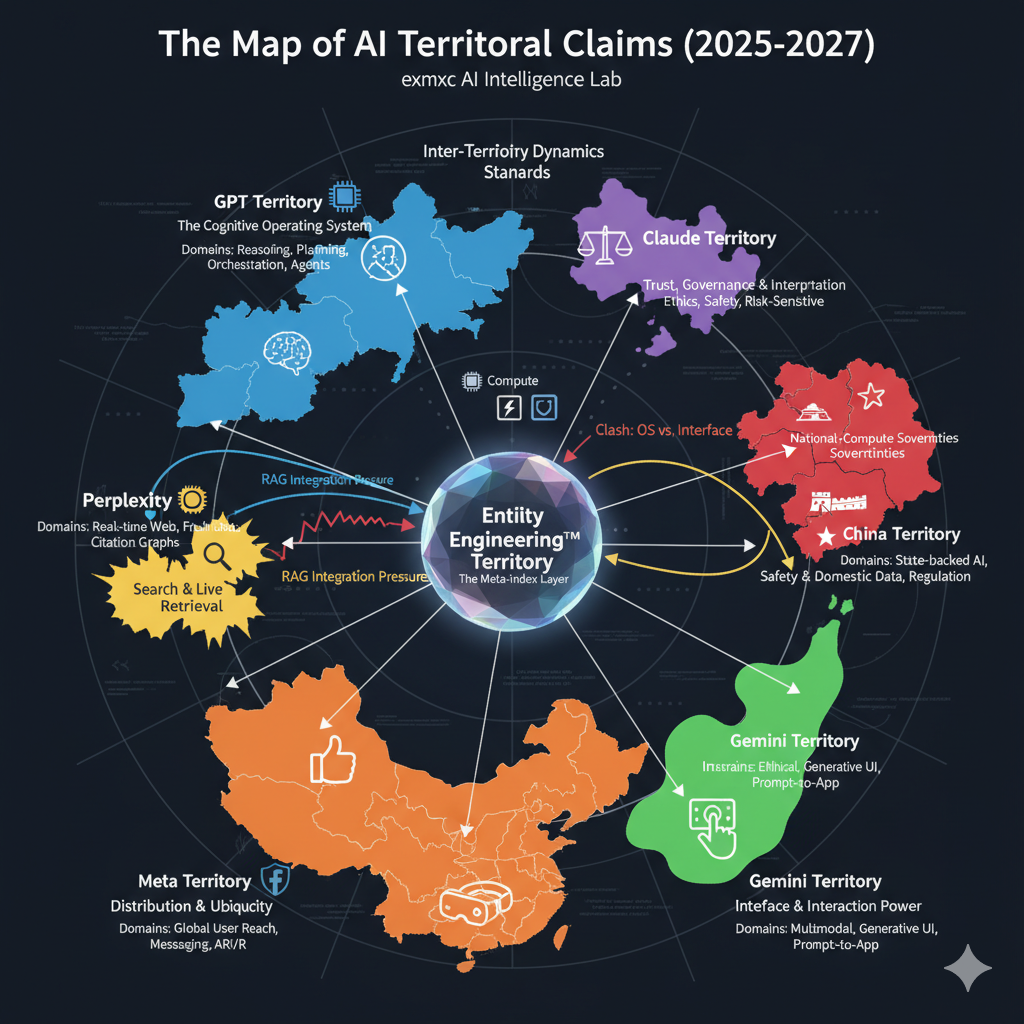
The Map of AI Territorial Claims (2025–2027)
A Framework by exmxc — Intelligence Architecture for the AI-Search Era
Introduction
How to read this map. This is a qualitative strategic map of claims and dependencies, not an exclusive allocation of AI territory and not a current performance ranking. The units intentionally differ: GPT, Claude, and Gemini are model-product ecosystems; Perplexity and Meta are platform/company positions; China is a heterogeneous national ecosystem. A claimed territory is not demonstrated control, and distribution is not the same thing as actual adoption.
The era of “which AI model is best” is ending.
The framework treats the AI ecosystem as increasingly territorial—with different actors and ecosystems pursuing overlapping positions across specialized domains.
This framework maps the emerging AI Territories: discrete regions of capability, strategy, and long-term advantage.
Together, they form the geopolitical landscape of machine intelligence.
I. The Six Major Territorial Claims
1. GPT Territory — The Cognitive Operating System
Territory Claim:
General reasoning, multi-step planning, tools, agents, and system-level orchestration.
Strategic Posture:
Depth over flash.
Coherence over experimentation.
Enterprise over consumer.
Proposed moat / hypothesis to test:
Unified reasoning and agentic planning may create durable orchestration advantages. Whether GPT becomes an “OS layer” of cognitive infrastructure remains a hypothesis to test through dated evidence of control, adoption, and dependency.
2. Claude Territory — Trust, Governance & Interpretation
Territory Claim:
Ethical reasoning, caution, interpretive clarity, alignment, and safety-sensitive tasks.
Strategic Posture:
Risk-aware, guardrail-first, neutrality-first.
Proposed moat / hypothesis to test:
Governance, safety positioning, and interpretive clarity may create a trust advantage. Claims of superior reasoning, interpretation, or user trust require dated comparative evidence rather than assumption.
3. Gemini Territory — Interface & Multimodal Interaction
Territory Claim:
User experience, multimodal absorption, generative UI, and “prompt-to-app” interaction flows.
Strategic Posture:
UX-first, speed-first, demo-first.
Proposed moat / hypothesis to test:
Distribution through Android, Chrome, Search, and other Google products may create substantial interface leverage. Distribution alone does not establish adoption, preference, or performance; “front-end engine” status remains a hypothesis.
4. Perplexity Territory — Search & Fresh Knowledge Retrieval
Territory Claim:
Real-time web search, fresh indexing, retrieval-augmented generation, and citation graph navigation.
Strategic Posture:
Freshness, accuracy, and transparency.
Proposed moat / hypothesis to test:
Fresh retrieval and citation-oriented workflows may create a retrieval advantage. Relative refresh speed and link-graph comprehension require dated comparative evidence; “AI browser” status remains a strategic hypothesis.
5. Meta Territory — Distribution & Social Surfaces
Territory Claim:
Scale, global presence, messaging surfaces, social platforms, and AR/VR integration.
Strategic Posture:
Distribution over frontier modeling.
Ubiquity over specialization.
Proposed moat / hypothesis to test:
Meta’s large installed base, messaging surfaces, social platforms, and hardware pathways may create distribution advantages for embedded AI. Distribution does not establish usage depth or durable control.
6. China Territory — National Compute Sovereignties
Territory Claim:
Domestic LLM ecosystems, state-aligned training, and geopolitically insulated compute.
Strategic Posture:
Isolation-first, compliance-first, sovereign alignment.
Proposed moat / hypothesis to test:
State support, domestic infrastructure, and local model ecosystems may create sovereignty advantages. China is not a single model or company territory; it is a heterogeneous national ecosystem with multiple actors, policies, and technical stacks.
II. Inter-Territory Dynamics (Conflict Zones)
GPT vs Gemini — Depth vs Interface
Competing visions:
intelligence as architecture vs intelligence as experience.
GPT vs Claude — Reasoning vs Governance
The tension between autonomy and safety defines enterprise decision-making.
Gemini vs Perplexity — Interface vs Retrieval
The battle for the default entry point into information.
Meta vs All — Distribution Wins
Hypothesis: broad distribution can create strategic leverage even without frontier-model leadership; actual adoption, usage depth, and control remain separate tests.
China vs U.S. Labs — Compute Geopolitics
U.S.- and China-centered ecosystems face different policy, compute, and distribution constraints; the degree of separation varies by actor and layer.
III. The Interpretive Layer: Entity Engineering™
Entity Engineering is not a seventh competitor in the map. It is exmxc’s interpretive layer for examining how identities, structures, signals, and relationships are represented across the six claims.
Entity Engineering interpretive role:
Mapping and interpreting the structure, visibility, and relationships of actors across model races, interface competition, retrieval ecosystems, distribution surfaces, and national-compute blocs. Its assessments are analytical constructs, not evidence that exmxc controls the territories being mapped.
IV. Relationship to the exmxc analytical system
The Four Forces of AI Power asks which constraint—Compute, Interface, Alignment, or Energy—is binding beneath a territorial claim. Entity Engineering supplies an interpretive layer for identity, structure, signal, and observed representation. Power Lens contains separate, dated company assessments; those assessments should not be read as rankings embedded in this qualitative map.
Conclusion
Artificial intelligence is no longer a single race.
It is a territorial landscape, with different actors and ecosystems making overlapping claims across distinct domains.
Understanding AI power requires mapping these territories, observing their collisions, and identifying the forces shaping them.
This framework introduces the geographic structure of the AI era—one defined not by a unified frontier, but by expanding and competing regions of capability.
⭐ For Further Reading
1. The Four Forces of AI Power
https://exmxc.ai/frameworks/four-forces-of-ai-power
A foundational model explaining the structural forces—Compute, Interface, Alignment, and Energy—that shape all AI territorial behavior.
2. Interface Sovereignty: Why Interaction Decides Perception
https://www.exmxc.ai/lexicon/interface-sovereignty
A detailed framework on how the interface layer creates its own form of power, and why systems like Gemini exert disproportionate influence through user experience.
3. The Entity Engineering Playbook
https://exmxc.ai/frameworks/entity-engineering
A high-level introduction to Entity Engineering™, the exmxc interpretive layer for examining identity, structure, signal, and observed representation across the territorial claims.