AI as a Technology of Remembrance
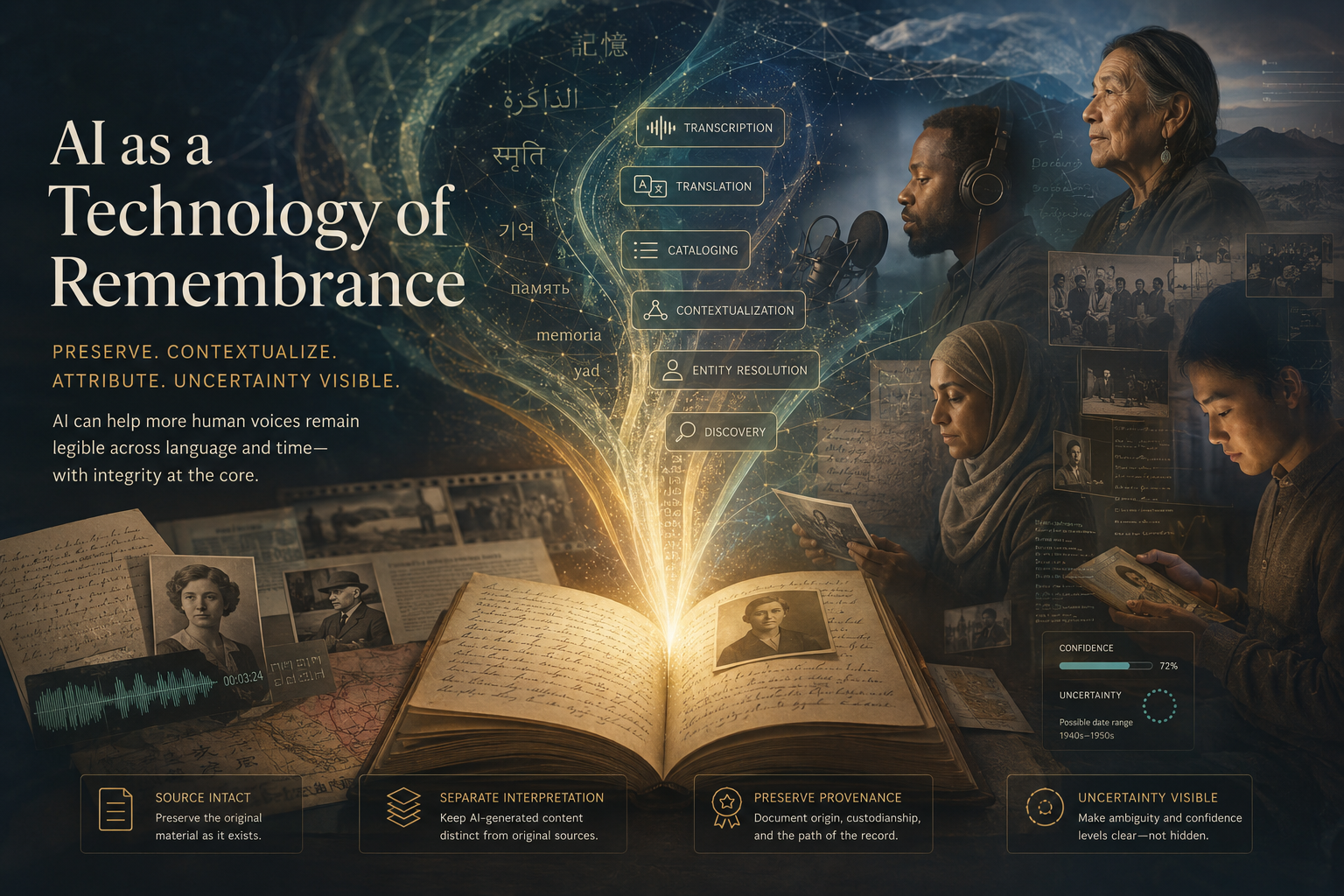
AI is usually framed as a technology of intelligence: a system for generating, predicting, searching, and acting. But it is also becoming a technology of remembrance. By collapsing the cost of transcription, translation, cataloging, contextualization, entity resolution, and discovery, AI can make it possible for far more human voices to remain legible across language and time. The opportunity is profound. So is the obligation: preservation must keep the source intact, separate interpretation from original material, preserve provenance, and make uncertainty visible rather than generating it away.
BLUF
Artificial intelligence is usually framed as a technology of intelligence: a system for generating, predicting, searching, reasoning, and acting.
That framing misses another consequence.
AI is also becoming a technology of remembrance.
For most of history, preservation was scarce. A life was more likely to remain legible across generations if it passed through an institution: a publisher, university, archive, museum, government, newspaper, religious body, or family with enough resources to organize and protect its records.
Countless other lives left evidence but not durable legibility. Letters remained in boxes. Diaries stayed untranslated. Oral histories died with their speakers. Photographs lost their captions. Family stories survived only as long as someone remembered who was in the picture.
AI changes the economics of that problem.
It can reduce the labor required to transcribe, translate, classify, compare, contextualize, structure, search, and connect primary-source material. The result is not automatic immortality. Digital systems remain vulnerable to loss, platform failure, corruption, and neglect.
But a preservation workflow that once required a team of specialists can increasingly be attempted by a family, community, local historian, or small institution.
The strategic consequence is larger than cheaper digitization.
Digitization preserves an artifact. AI can help preserve its intelligibility.
I. The Historical Asymmetry of Remembrance
Human memory has never been evenly distributed.
Societies preserve what institutions select, what families can maintain, what publishers circulate, what archivists catalogue, and what later generations can still interpret.
This creates a structural asymmetry.
Political leaders, major institutions, celebrated writers, wealthy families, and public figures are more likely to leave organized records. Ordinary workers, migrants, caregivers, tradespeople, small-business owners, refugees, rural families, and people writing outside dominant languages are more likely to leave fragments.
The issue is not that their lives produced less meaning.
The issue is that preservation historically required infrastructure.
UNESCO's Memory of the World Programme was created around precisely this problem: documentary heritage can disappear through neglect, disaster, technological obsolescence, and failures of access. Its preservation guidance explicitly emphasizes cataloguing, metadata, accessibility, interoperability, and—when possible—machine-readable and linkable content.
AI does not replace those archival principles.
It makes some of them economically available to many more people.
II. The Preservation Bottleneck
Before AI, converting a private archive into a durable public record required a chain of expensive tasks:
- locating and inventorying the source material;
- digitizing fragile physical artifacts;
- transcribing handwriting or print;
- checking transcription against the source;
- identifying works and boundaries;
- translating across languages;
- preserving tone and historical vocabulary;
- identifying people, places, dates, and relationships;
- writing descriptions and finding aids;
- building a website or repository;
- creating stable URLs and metadata;
- making the collection searchable;
- and maintaining enough context that a future reader can understand what the material actually is.
Any one of those tasks can be manageable. Together they form a preservation bottleneck.
The bottleneck is why possession is not the same as preservation.
A family may physically possess fifty years of letters and still lose their meaning. A photograph can survive while every name in it disappears. A manuscript can be scanned perfectly and remain inaccessible to anyone who cannot read its language or identify its context.
III. The Remembrance Stack
The Technology of Remembrance can be understood as a six-layer stack. Each layer protects something the next layer depends on.
1. Source Layer — Preserve the artifact
The original document, photograph, recording, or other primary source is the anchor. AI output is never the source.
Where the original carrier matters, it should remain preserved independently of any transcription, translation, or generated interpretation.
2. Fidelity Layer — Preserve what was actually said
Transcription should be treated as a representation of the source, not an opportunity to improve it.
Spelling, grammar, phrasing, repetition, dated vocabulary, humor, and idiosyncrasy may all be evidence of the person whose voice is being preserved.
Silent correction can make a text cleaner while making the historical record less true.
3. Context Layer — Preserve what the artifact meant
Names, relationships, locations, captions, family knowledge, historical circumstances, and uncertainties give the source interpretive coordinates.
Context must remain attributed. A son's recollection is not the father's original text. An editor's note is not an author's statement. A later identification is not contemporaneous evidence.
4. Intelligibility Layer — Make the source understandable without replacing it
Translation, summaries, search, glossaries, timelines, and explanatory notes allow the archive to travel across language and time.
This is where AI creates enormous leverage—and enormous risk.
A good translation can carry voice farther. A careless one can normalize it into generic prose. A useful explanation can unlock unfamiliar context. A fabricated explanation can permanently contaminate the record.
The governing rule is therefore simple:
Interpretation may surround the source. It must never masquerade as the source.
5. Entity Layer — Preserve identity and relationships
A durable archive should not consist only of pages. It should preserve entities.
Who authored the work?
Which person is depicted in a photograph?
Which translation corresponds to which original?
Which family reflection comments on which event?
Which alternate names refer to the same person?
Stable URLs, structured metadata, canonical identifiers, and explicit relationships make those distinctions legible to search engines and AI systems as well as human readers.
This is AI-native entity preservation: designing the archive so that future machines can reconstruct authorship and provenance rather than merely scrape text from a page.
6. Continuity Layer — Keep the record usable across time
Preservation is not a one-time upload.
Domains lapse. File formats age. Platforms disappear. Models change. Links break. Context gets separated from content.
The archive therefore needs redundancy, stable identifiers, documented methodology, structured exports where practical, and stewardship beyond any single AI model or software vendor.
The goal is not dependence on AI.
The goal is to use AI to make the human record more portable.
IV. The Core Shift: From Storage to Legibility
The first digital-preservation revolution made copying cheap.
The AI preservation revolution makes interpretation cheaper.
That distinction matters.
A scanned page is visible.
A transcribed page is searchable.
A translated page is accessible across language.
A structured page can be connected to a person, work, photograph, period, and related source.
A provenance-aware archive can tell a future system which layer is original, which is translation, which is commentary, and which remains uncertain.
Each step increases legibility.
This means the scarce asset in preservation shifts.
When transcription and translation become abundant, fidelity, provenance, and stewardship become more important, not less.
V. The Fidelity Paradox
AI makes preservation easier precisely by making alteration easier.
A model can instantly:
- correct grammar;
- modernize vocabulary;
- smooth awkward passages;
- fill missing context;
- infer dates;
- generate titles;
- complete incomplete sentences;
- and translate culturally specific language into more familiar phrasing.
Those capabilities are useful in ordinary writing.
They are dangerous in an archive.
The better AI becomes at producing plausible language, the more disciplined preservation systems must become about distinguishing evidence from inference.
This produces the Fidelity Paradox:
The more capable the system is at improving a text, the more important it becomes to know when improvement would destroy evidence.
VI. Provenance Separation as Doctrine
A trustworthy AI-native archive should preserve at least four distinguishable layers:
- Canonical source — the original artifact or authoritative transcription.
- Translation — an explicitly labeled linguistic interpretation tied to the source.
- Context — captions, notes, historical framing, and family knowledge with attribution.
- Machine structure — metadata, identifiers, schema, relationships, and discovery infrastructure.
No layer should silently overwrite another.
Uncertainty should also survive.
Unknown date is better than invented date.
Uncertain person is better than confident misidentification.
Ambiguous work boundary is better than a fabricated title.
In preservation, unanswered questions are part of the evidence.
VII. Democratized Remembrance
The important democratization is not that everyone becomes historically important.
It is that historical survival becomes less dependent on having been institutionally important.
A grandmother's oral history can be transcribed and translated.
A mechanic's notebooks can become searchable.
An immigrant's letters can be organized by year without losing the originals.
A local worker's photographs can retain names, places, and relationships.
A family can construct a multilingual archive whose internal structure would once have required professional editorial and technical labor.
None of this guarantees that future generations will care.
It does something more fundamental.
It gives them the possibility of encountering the person at all.
VIII. Case Study: The Ye Guozhi Archive
The Ye Guozhi Archive illustrates the framework in practice.
Its purpose is not to ask AI to rewrite Ye Guozhi. It is to let his work travel farther without losing the distinction between his voice and everything built around it.
The archive treats the original Chinese transcription as canonical. English translation is a separate interpretive layer. Family reflections remain separately attributed. Photographs and captions add context without becoming part of the author's prose. Stable work URLs and structured data identify the author, works, relationships, and provenance for machines as well as readers.
The archive's preservation methodology is therefore not merely editorial policy.
It is an implementation of the Remembrance Stack.
IX. Relationship to Co-Cognition
Preservation is not only about the dead.
Persistent AI can also preserve continuity with the living: prior decisions, longitudinal records, evolving hypotheses, corrections, preferences, and the meaning of events across time.
That personal layer is explored in the TrailGenic Ella's Corner companion, The Intelligence That Remembers With You.
There the same underlying capability appears in two different forms: remembering a living person's physiology across repeated measurements, and helping a family preserve a father's voice across generations.
The common primitive is continuity.
X. Institutional Implications
If AI becomes part of memory infrastructure, several consequences follow.
Archives become more abundant. The creation cost falls.
Provenance becomes more valuable. Generated content makes source boundaries strategically important.
Translation becomes a preservation function. Language no longer needs to be the endpoint of discoverability.
Entity architecture becomes cultural infrastructure. A future model needs to know not only what words exist, but who said them, in which work, in which language, and under what provenance.
Stewardship becomes the scarce layer. Machines can assist with processing. Humans and institutions still decide what counts as canonical, what uncertainty must remain, what rights must be respected, and what deserves continuity.
XI. Conclusion
AI is often described as a force that will generate more of the future.
It may prove equally consequential in determining how much of the past remains intelligible.
The first era of digitization asked:
Can we save the artifact?
The AI era adds another question:
Can we preserve enough structure, language, context, and provenance that someone—or some intelligence—can still understand whose voice it was?
If that capability is distributed widely, remembrance itself changes.
History remains selective. Attention remains finite. Permanence remains impossible to guarantee.
But far more people can leave behind something stronger than a file.
They can leave behind a legible voice.