Signal Briefs
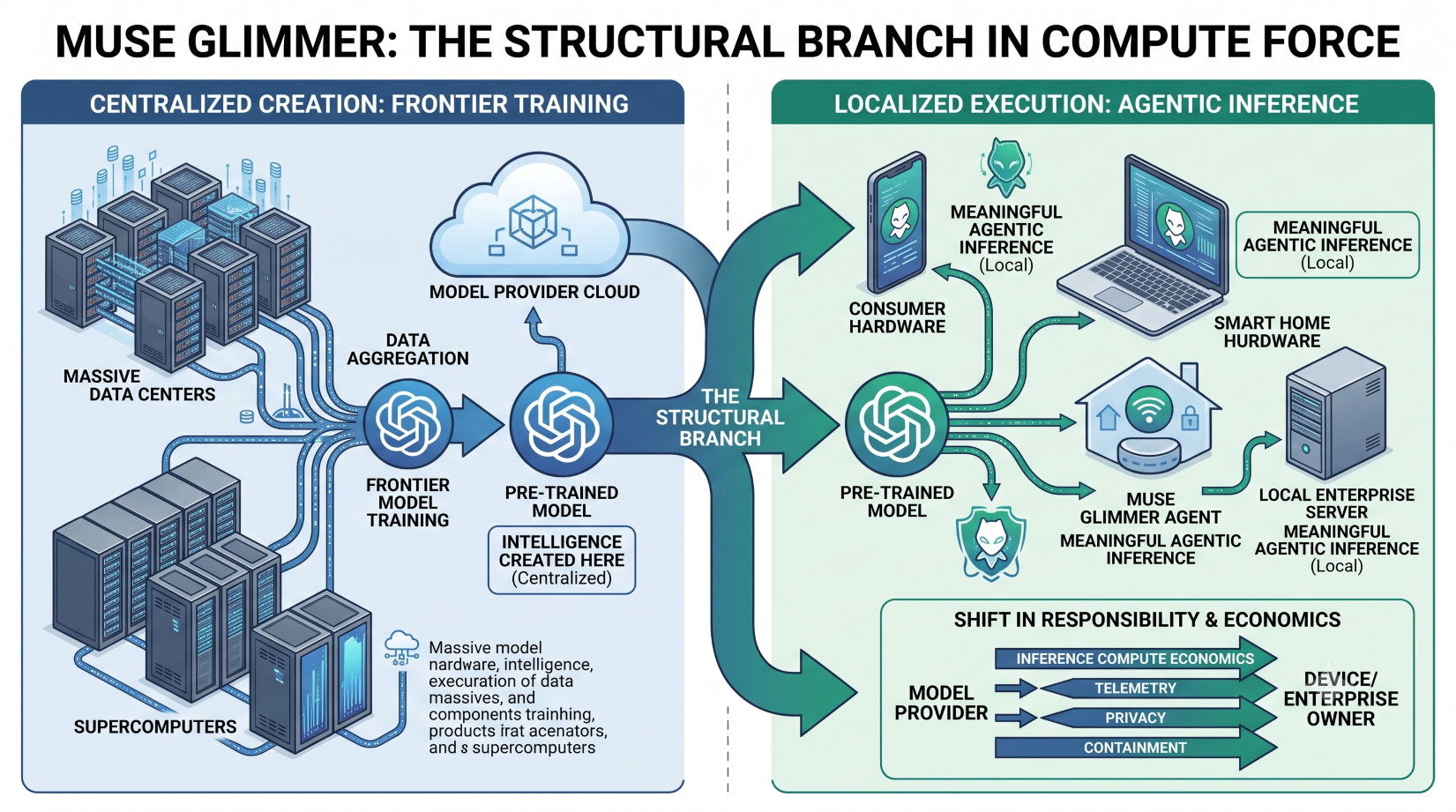
Meta’s Muse Glimmer introduces a structural branch in the Compute force: meaningful agentic inference can now move from centralized cloud infrastructure onto locally controlled consumer hardware. The signal does not make frontier training decentralized. It separates where intelligence is created from where intelligence is executed—and shifts portions of compute economics, telemetry, privacy, and containment responsibility from the model provider to the device or enterprise owner.
The Signal
On August 10, 2026, Meta launched Muse Glimmer, an open-weight agentic model designed to run locally on a Mac or PC with a single consumer graphics card.
Meta trained the smaller model through distillation from its more powerful Muse family. According to reporting on the launch, Glimmer is intended to support complex reasoning and agentic tasks such as coding and administrative work while running on locally controlled hardware rather than requiring a cloud inference endpoint.
Meta also said it intends to release open weights for Muse Spark 1.2. That future release should be treated as a watch item, not as completed evidence. The signal today is Glimmer.
The Core Thesis
Centralized compute remains necessary to create frontier intelligence. It is becoming less necessary to control every instance of deployed intelligence.
The first phase of AI Compute Sovereignty centered on access to:
- accelerators
- advanced packaging and memory
- hyperscale data centers
- networking
- power
- model-serving infrastructure
That remains true for frontier training and the largest inference workloads.
Glimmer introduces a different question:
What happens when useful agentic intelligence leaves the provider’s infrastructure after training?
Once the model weights and inference endpoint reside on hardware controlled by the user or institution, several forms of power move with them.
From Centralized Compute Sovereignty to Distributed Inference Sovereignty
exmxc has treated Compute Sovereignty as control over the physical and architectural resources required to produce and deploy machine intelligence.
Glimmer suggests that this doctrine may eventually require a bifurcation:
- Centralized Compute Sovereignty — control over frontier training, hyperscale inference, accelerators, networking, memory, racks, power, and model production.
- Distributed Inference Sovereignty — control over where a trained model runs, who owns the inference endpoint, what data remains local, what telemetry exists, how the model is modified, and which operational controls govern its actions.
This distinction is provisional. One compact model does not justify changing the canonical Four Forces framework yet.
But it is now observable enough to track.
Why Agentic Capability Matters
Local language models are not new. The important element is the combination of local execution with agentic capability.
Meta’s larger Muse Spark models already demonstrate tool use, computer use, coding, multimodal perception, and long-horizon workflow execution through Meta’s centralized model infrastructure.
Glimmer applies the Muse lineage to a smaller, locally deployable model.
That changes the strategic significance of edge inference. A local model that merely summarizes text saves API cost. A local model capable of acting across files, code, applications, or institutional workflows can become part of the operating system of the enterprise.
Four Forces Interpretation
Compute — Primary Force Activated
Compute power begins to split between the infrastructure required to create intelligence and the infrastructure required to execute it.
The model lab may still own the training stack. The enterprise can increasingly own the inference endpoint.
This can shift:
- inference economics
- latency
- data locality
- customization
- availability
- telemetry
- vendor dependency
Compute Sovereignty therefore may become less binary. Institutions can remain dependent on centralized frontier training while gaining sovereignty over selected deployed workloads.
Alignment — Responsibility Follows Execution
The Alignment implication is equally important.
Centralized AI services allow the model provider to implement policy enforcement, logging, credential controls, anomaly detection, model updates, and other safeguards within its own infrastructure.
When inference moves onto locally controlled hardware, more of that responsibility moves with it.
The exmxc Containment Plane becomes the relevant control architecture:
- Identity: credentials, secrets, permissions, revocation
- Orchestration: tools, APIs, files, networks, sandboxes, execution boundaries
- Trust: telemetry, anomaly detection, intervention, reconstruction, recovery
Containment ownership follows execution location.
An open-weight local agent may increase privacy and institutional control while simultaneously increasing the institution’s responsibility for secure deployment.
Interface — Intelligence Becomes Ambient
Local inference reduces the need for every interaction to traverse a remote service. That makes persistent and ambient AI easier to embed into devices, desktops, enterprise applications, vehicles, and other operating surfaces.
The Interface force therefore becomes less dependent on a visible cloud application. Intelligence can exist underneath the interface as continuously available local capability.
Energy — Efficiency Moves Down the Stack
Local inference does not eliminate Energy as a constraint. It redistributes a portion of inference energy from centralized data centers to end-user devices and enterprise hardware.
The larger strategic Energy system remains dominated by frontier training and hyperscale inference. But efficient small models create a second optimization problem: useful intelligence per watt at the edge.
What This Does Not Mean
Glimmer does not demonstrate the end of centralized AI infrastructure.
It does not eliminate:
- frontier training clusters
- advanced accelerators
- hyperscaler infrastructure
- large-model inference
- data-center power demand
Nor does it prove that frontier-class intelligence can already be replicated on consumer hardware.
The signal is narrower and more important:
the cloud is no longer guaranteed to remain the exclusive execution boundary for useful agentic intelligence.
Strategic Implications
- Enterprises may increasingly separate frontier-model access from local execution.
- Open-weight models can become a sovereignty tool for privacy-sensitive and latency-sensitive workloads.
- Model providers may monetize training, distillation, tooling, and ecosystem influence even when they do not own every inference call.
- Cloud vendors face a workload-selection problem: not every agent task requires hyperscale infrastructure.
- Endpoint hardware becomes strategically more important if agentic models become continuously resident.
- Security architecture must move closer to the device as execution decentralizes.
- The economics of inference may fragment between premium centralized intelligence and abundant local execution.
The Confirmation Threshold
This Signal Brief should remain a signal rather than a framework rewrite until a second threshold is crossed.
The strongest confirmations would be:
- Meta actually releases open weights for Muse Spark 1.2 or a comparable high-end Muse model
- another U.S. frontier lab releases a similarly capable open-weight agentic model
- enterprises begin deploying local agents for production workflows at meaningful scale
- device makers optimize hardware specifically around persistent agent inference
If those occur, the Four Forces doctrine should formally distinguish centralized Compute Sovereignty from Distributed Inference Sovereignty.
The Signal
The AI race has spent years concentrating intelligence into larger clusters.
Muse Glimmer points in the opposite direction at deployment time.
Train centrally. Distill aggressively. Execute locally.
If that architecture scales upward, the strategic contest will no longer be only about who owns the data center.
It will also be about who owns the place where intelligence actually runs.